AI Observability vs MLOps: Where Each Discipline Starts and Stops
What MLOps covers, what AI observability adds once a model or agent is live, where the two disciplines genuinely overlap, and how a team running LLM-based systems should split ownership between them.
In this guide13 sections
At a glance
MLOps and AI observability are often talked about as if they were competing categories, or worse, as if one had simply been renamed. They aren't, and treating them as interchangeable is exactly how a team ends up with a fraud model that sails through every pre-deploy gate and still quietly degrades three weeks into production. MLOps is the discipline of getting a model from data to a reliably deployed artifact: versioned data, reproducible training, a model registry, automated deployment, and rollback. AI observability is the discipline of understanding what a deployed model or agent actually does once real traffic hits it: traces of individual decisions, evaluation scores on live outputs, drift detection against the training distribution, and the evidence a team needs to say whether the system is still behaving the way it did when it was approved. One discipline ships the model. The other tells you what shipping it actually caused. This article works through where each one's responsibility starts and stops, where they share real ground, and how to assign ownership so neither gap goes unowned.
This is a category-level comparison — what AI observability is covers the definition in depth and is not repeated here, and AI agent observability vs APM covers a related but different boundary, between infrastructure monitoring and AI-specific observability, that this article assumes as background rather than re-deriving.
The operating model: the Lifecycle Ownership Model
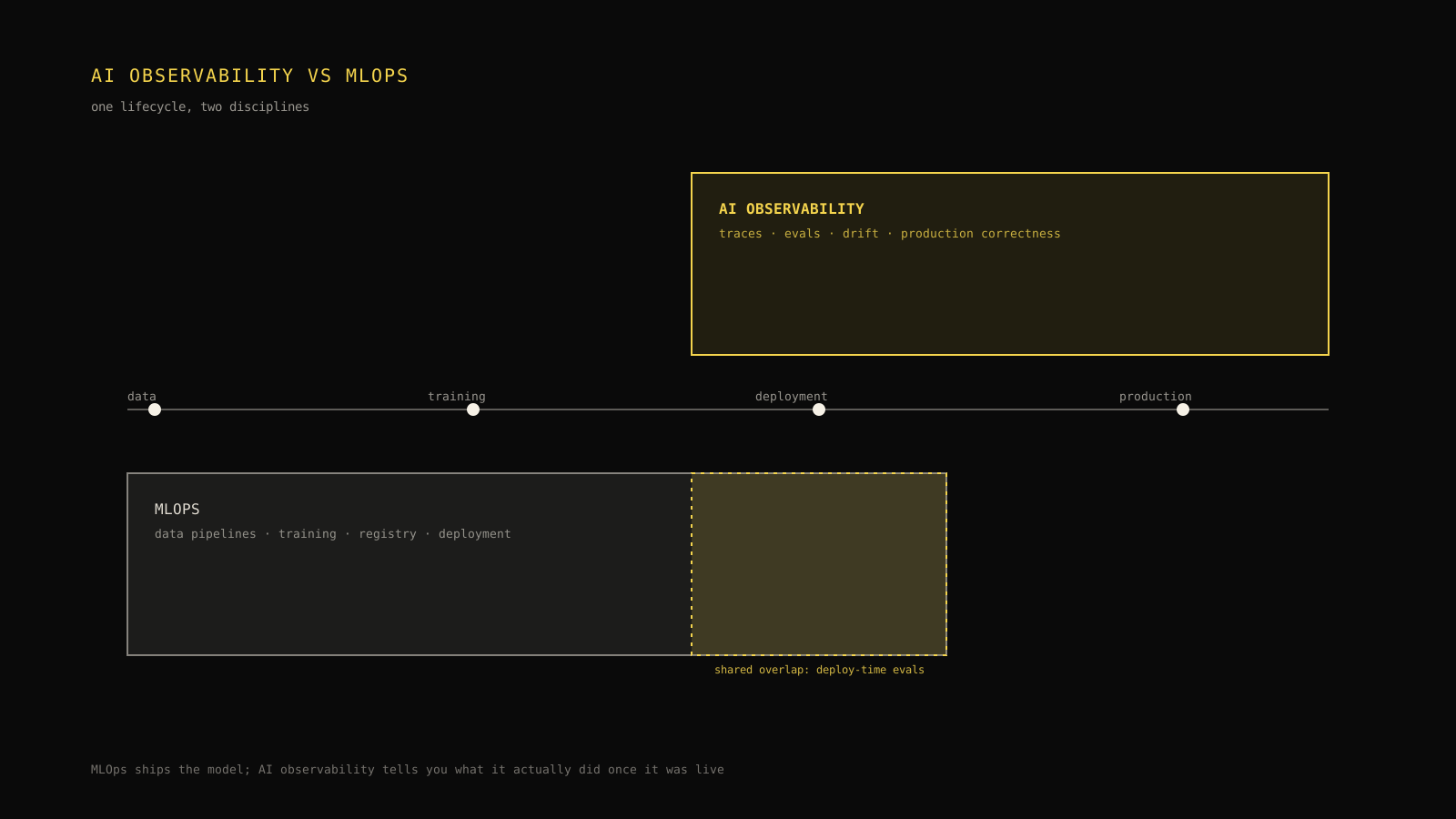
The framework this article uses is the Lifecycle Ownership Model: every artifact a model-based system produces — a dataset version, a trained checkpoint, a registry entry, a deployed endpoint, a single production decision — belongs to exactly one stage of the lifecycle, and each stage has a primary owning discipline. MLOps owns the stages from data through deployment. AI observability owns the stage after deployment, where a live system meets real inputs it wasn't fully tested against. The model's use is mechanical: for a given artifact or question, ask which stage produced it, and read off who owns keeping it correct. Most artifacts map cleanly to one stage. A small set — chiefly promotion decisions and rollback triggers — depend on evidence from both stages at once, and that overlap is where teams most often leave a gap unowned.
| Lifecycle stage | Primary artifact | Owning discipline |
|---|---|---|
| Data and training | Versioned datasets, reproducible training runs, checkpoints | MLOps |
| Registry and deployment | Approved model versions, rollout configuration, rollback plans | MLOps |
| Production | Live traces, per-decision evaluations, drift signals, incidents | AI observability |
| Promotion and rollback decisions | Evidence combining pre-deploy checks and live production signal | Shared |
MLOps answers "did we build and ship this correctly?" AI observability answers "is it still behaving correctly now that it's live?" Those are different questions, and a system can answer the first one perfectly while failing the second one for weeks before anyone notices — which is exactly what happened in the opening scenario.

That map is the fast version of the table above: read down the two columns and the pattern holds — deployment-mechanics questions sit under MLOps, live-behavior questions sit under AI observability, and only the promotion question is genuinely shared.
What MLOps was built to do
The problem MLOps solves
MLOps grew out of a genuinely hard, genuinely solved-well problem: turning machine learning from a research notebook exercise into a repeatable, auditable production practice. Before MLOps tooling matured, teams routinely lost track of which dataset version produced which model, couldn't reproduce a training run from six months earlier, and deployed models through manual, undocumented processes that made rollback a genuine crisis rather than a button press. MLOps solved that by borrowing DevOps discipline — version control, automated pipelines, staged environments, and repeatable deployment — and applying it to the specific artifacts machine learning produces.
Concretely, MLOps practice covers:
- Data versioning and lineage. Tracking exactly which dataset, at which version, with which preprocessing, produced a given training run, so a result can be reproduced or audited later.
- Reproducible training pipelines. Automating the training job itself — hyperparameters, compute environment, random seeds where feasible — so a training run isn't a one-off script run on someone's laptop.
- Offline evaluation and promotion gates. Running the trained candidate against held-out test sets and comparing it to the current production model on accuracy, F1, calibration, or whatever the relevant offline metrics are, then gating promotion on a threshold.
- Model registry. A system of record for which model versions exist, which one is currently serving traffic, their lineage back to training runs, and who approved each promotion.
- Deployment automation. Packaging a model into a servable artifact, rolling it out (often via canary or blue-green deployment), and having an automated, tested path back to the previous version if the rollout goes wrong.
- Infrastructure and resource management. Provisioning the compute a training job or serving endpoint needs, autoscaling under load, and keeping serving infrastructure within its resource and cost budget.
This is substantial, well-understood engineering, and a serious MLOps practice turns rollback from a crisis meeting into a button press: a team with good data versioning can answer "what exactly did we train on" months later; a team with a real registry and rollback plan can respond to a bad deployment in minutes. None of what follows is an argument that this coverage is unnecessary or that AI observability should replace it. A production model still needs to be reproducibly built and reliably deployed, and MLOps is the discipline that does that job well.
Where the boundary actually sits
MLOps's tooling and metrics are built around the question of whether the model was built and shipped correctly, evaluated against data and checks available at or before deploy time. It says very little, by design, about how that same model behaves against inputs it meets only after deployment — inputs the offline evaluation set, by definition, could not have contained.
What changes once a system is live
A model that passes every offline check can still fail in production, and it fails in ways that have no equivalent at the training or deployment stage, because the failure mode is specifically about the mismatch between what the model was evaluated on and what it now sees.
- A deployment failure surfaces as a failed health check or an automated rollback trigger. A drift failure — the live input distribution moving away from what the model was trained on — surfaces as nothing at deployment time. The endpoint is healthy, serving traffic, returning responses in budget; the model is just increasingly wrong about a population it was never evaluated against.
- A registry mismatch surfaces as an alert when the wrong version is live. A silent degradation — the correct, approved version producing steadily worse decisions on a specific slice of traffic — surfaces as nothing in the registry, because the registry only tracks which version is deployed, not whether that version is still performing the way its offline evaluation predicted.
- A resource exhaustion surfaces as an autoscaling event or an outage. A reasoning failure in an LLM-based agent — following an instruction embedded in retrieved content, choosing the wrong tool, or hallucinating a fact in a fluent, confident paragraph — surfaces as nothing in deployment metrics. The request completed, the tokens were within budget, the response was well-formed.
- A failed canary rollout is caught automatically before full promotion. A model that passes canary cleanly but degrades three weeks later against a traffic pattern the canary window never saw — a seasonal shift, a new product line, an adversarial input pattern — has no deployment-stage signal at all, because the canary window has already closed by the time the pattern appears.
The common thread: each of these is a production-stage failure that offline evaluation and deployment automation were never instrumented to see, because the data that reveals the failure didn't exist until the model was already live. That's precisely the gap AI observability closes — by instrumenting the traces, evaluations, and drift signals that only exist once a system is processing real traffic.
Side by side: the Lifecycle Ownership Model
This table is the article's core argument. Each row is a category of signal or concern a model-based production system produces. The two right-hand columns mark whether each discipline actually instruments and owns that signal in a typical production deployment.
| Signal or concern | MLOps | AI observability |
|---|---|---|
| Data and feature versioning | Covered | Not its focus |
| Training reproducibility | Covered | Not covered |
| Offline evaluation (held-out test sets) | Covered | Not its focus, though shared evaluation infrastructure sometimes spans both |
| Model registry and approval history | Covered | Not covered |
| Deployment automation, canary, rollback mechanics | Covered | Not covered |
| Live per-request traces (prompts, tool calls, retrieval, output) | Not covered | Covered |
| Production correctness evaluation on live traffic | Not covered | Covered |
| Input and prediction drift after deployment | Partial, when monitoring is wired into the pipeline | Covered |
| Root-cause investigation of a specific bad production decision | Not covered | Covered |
| Promotion decision for a new version replacing production | Covered | Partial, when live shadow or canary evaluation feeds the decision |
Read down the two right columns and the split is close to clean: the top five rows belong to MLOps, the middle four belong to AI observability, and the last two rows — drift monitoring and promotion decisions — are where real shared ground exists. A team with a mature MLOps practice and no AI observability layer is not running a slightly incomplete version of full coverage; it is running exactly the build-and-ship half, with the entire "is it still right, right now" half unowned.
A worked example: the fraud model that passed every gate
Return to the opening scenario and work it end to end, the way an on-call engineer would actually have to reconstruct it.
Week 0. A fraud-scoring model finishes training on the current versioned dataset. The offline evaluation suite reports precision and recall both above the promotion threshold, comparing favorably to the currently deployed version. The registry approves the new version, tagging it with its training run lineage. Canary deployment routes 5% of traffic to the new version for 48 hours; latency and error rate stay within budget, and the canary's aggregate fraud-catch rate matches the offline evaluation closely enough to clear the gate. The new version is promoted to 100% of traffic. Every MLOps checkpoint did exactly what it was designed to do, correctly, on the evidence available.
Week 1. A merchant category that represents a small fraction of total transaction volume — call it a newly onboarded vertical — starts seeing a transaction pattern the training data barely represented, because that vertical was added to the platform after the training dataset was frozen. The model, evaluated in aggregate, still looks fine: this pattern is a small enough slice of total traffic that it doesn't move the aggregate fraud-catch rate the canary was watching. No deployment alert fires, because nothing about the deployment itself changed.
Week 1–3. Within that specific vertical, the model is systematically under-scoring a fraud pattern it never learned to recognize, and confirmed fraud losses in that vertical begin climbing. Because the signal is a slice, not an aggregate shift, it stays invisible to any monitoring that only watches overall model health.
Week 3. A risk analyst reviewing loss reports by vertical notices the pattern and escalates. An engineer starts with the registry and deployment history, because that's the natural first stop for "did something change with the model" — and finds nothing: the correct, approved version has been serving traffic the whole time, with no unplanned redeploys. The engineer has to go a level deeper: pull the model's actual production predictions for that vertical, segment them against the training distribution, and only then see that this transaction pattern was underrepresented at training time and the live input distribution for that vertical has drifted meaningfully away from it.
Root cause and fix. The training dataset is augmented with transactions from the new vertical, a drift-monitoring check is added that segments input distribution by merchant category rather than only in aggregate, and a production-evaluation sample specific to newly onboarded verticals is added so a future onboarding event triggers a targeted correctness check before losses accumulate for three weeks.
Nothing in that incident was an MLOps failure — the training run, evaluation, registry approval, and canary rollout all behaved exactly as designed against the evidence they had. No amount of additional MLOps rigor — a stricter promotion threshold, a longer canary window at the same aggregate granularity, more frequent retraining on the same aggregate cadence — would have caught a slice-level drift that the aggregate metrics never surfaced. It required a layer that segments live production behavior by slice and compares it against the training distribution on an ongoing basis: exactly what AI observability's drift and correctness monitoring is built to do.
Field note: The fastest way to reproduce a version of this incident in your own stack is not a longer canary — it's any new traffic segment (a new customer vertical, a new product surface, a new locale) reaching a model whose promotion gate only evaluates aggregate metrics. If your promotion process can't segment by the dimensions that matter to your business, you have this exposure today, independent of how disciplined your MLOps pipeline is.
How the two disciplines attach to one lifecycle
The two disciplines aren't separate systems that happen to sit near each other — they're sequential stages of the same lifecycle, and a well-run team carries identifiers and evidence forward from one stage to the next so a production finding can be traced back to the training run and dataset version that produced it.
Concretely, for one model version moving through its lifecycle:
- Data and training. MLOps tooling versions the dataset and records the training run's configuration, producing a checkpoint tagged with a reproducible lineage back to that exact data and configuration.
- Offline evaluation and registry. MLOps runs the candidate against held-out test sets, compares it to the current production version, and — if it clears the threshold — registers it with an approval record and lineage pointer back to the training run.
- Deployment. MLOps automation rolls the approved version out, typically via canary, watching deployment-stage signals (latency, error rate, aggregate accuracy on canary traffic) and holding a tested rollback path.
- Production. AI observability instrumentation, attached to the same model-version identifier the registry assigned, starts recording live traces — individual predictions or decisions, their inputs, and (via sampling, automated judges, or downstream outcomes) an evaluation of whether each was correct.
- Drift and promotion feedback. AI observability's drift monitoring compares the live input distribution, segmented meaningfully rather than only in aggregate, against the training distribution MLOps versioned in step 1 — closing the loop back to the discipline that will need to act on a drift finding, whether that's retraining, a targeted data addition, or a rollback.
The illustrative shape below isn't a specific product's schema — it shows, in miniature, how MLOps-stage fields and production-stage fields attach to the same model-version identifier rather than living in two disconnected systems.
// Illustrative: fields present in MLOps-stage records vs. AI-observability-stage records for the same model version.
type ModelVersionRecord = {
  modelVersionId: string;
  datasetVersionId: string;
  trainingRunId: string;
  offlineMetrics: { precision: number; recall: number };
  approvedBy: string;
  deployedAt: string;
};

type ProductionSignal = {
  modelVersionId: string; // same identifier as the ModelVersionRecord it corresponds to
  requestId: string;
  input: Record<string, unknown>;
  prediction: unknown;
  evaluation?: { correct: boolean; judge: "human" | "automated"; note?: string };
  driftScore?: number;
  segment?: string; // e.g. a merchant vertical, locale, or customer tier
};
The point of sharing modelVersionId across both record types is that a drift or correctness finding in production should never require guessing which training run or dataset version is implicated. A slice-level drift and a training-data gap can share a root cause — an underrepresented segment at training time that later grows in production — and you only see that connection if both stages' records point back to the same identifier.
Do you need both, or can one substitute for the other?
Neither discipline substitutes for the other, but the honest answer to "do we need both" depends on what the model or agent does and what's at stake when it drifts or reasons badly.
MLOps alone is not enough for any system whose behavior can meaningfully change after deployment without anyone redeploying it — which, for a model consuming live, non-stationary data, is nearly every production system. A fraud model, a recommendation engine, an LLM-based agent reasoning over live retrieved content, or anything scoring or ranking real-world inputs all fall into this category. If the world the model sees can shift without a code change, you need visibility into whether the model's behavior shifted with it.
AI observability alone is not enough either, and for a structural reason: a system with excellent live monitoring but no reproducible training pipeline, no registry, and no tested rollback plan still fails in ordinary ways — an untracked model, a deployment nobody can safely undo, a retraining effort that can't reproduce last quarter's dataset. Observability tells you something is wrong; it doesn't give you a disciplined, auditable way to fix it and ship the fix. Treating AI-specific monitoring as a full replacement for MLOps discipline just relocates the blind spot to "we saw the problem but can't safely act on it."
Where a smaller team can reasonably start lighter: an internal tool with a small, stable user base and low-stakes outputs can reasonably run a simpler MLOps setup — less automation, more manual promotion review — while still keeping baseline production monitoring in place, since drift and reasoning failures don't become less likely just because the deployment process around them is lighter weight.
Where both disciplines earn their cost immediately: any model or agent in a regulated, financially consequential, or safety-relevant path, and any system where the input distribution is genuinely non-stationary — fraud, personalization, anything reasoning over live retrieved or user-generated content. The cost asymmetry matters here too: MLOps infrastructure is frequently already funded as part of shipping the model at all; the marginal cost of adding production-stage observability on top is the real decision, not observability's cost against MLOps's already-sunk cost.
Decision rule: If the inputs your model or agent sees in production can shift without anyone deploying new code — a new customer segment, a seasonal pattern, adversarial content, a retrieved-document update — add AI observability regardless of how disciplined your MLOps pipeline looks. A clean deployment history is not evidence the model is still behaving correctly today, only evidence it was built and shipped correctly at the time.
A team evaluation checklist
If you're assessing whether your current lifecycle coverage is sufficient, work through these questions in order. Each maps to a specific gap this article has covered.
| Question | What a "no" tells you |
|---|---|
| Can you reproduce the exact dataset and training configuration that produced any currently deployed model? | If no, you have a baseline MLOps gap in data versioning or reproducibility. |
| Does your registry record lineage and an approval trail for every promoted version? | If no, you have no auditable record of what shipped, when, and why it was approved. |
| Can you roll back to the previous model version automatically, without a manual, error-prone process? | If no, a bad deployment becomes a crisis instead of a button press. |
| Can you inspect an individual production decision — the input, the prediction, and whether it was correct — for a specific past request? | If no, you have no visibility into live behavior beyond aggregate metrics. |
| Can you detect drift segmented by a meaningful dimension (customer tier, vertical, locale), not only in aggregate? | If no, a slice-level failure like the worked fraud incident above is invisible to you until losses accumulate. |
| Do your production records and your training/deployment records share a common model-version identifier? | If no, tracing a production finding back to its training root cause will be slow or impossible after the fact. |
| Is there a production-stage evaluation step that runs continuously, not only at the canary window right after deployment? | If no, you're relying on the canary window to represent all future traffic, which the worked example shows is a real gap. |
A team that answers "yes" to the first three questions but "no" to the middle three has solid MLOps coverage and a real AI-observability gap — the most common pattern for teams that built disciplined deployment pipelines before the production-monitoring layer existed as a separate practice to adopt.
Protect the boundary: what neither discipline does for you
Neither discipline, alone or together, replaces a human decision about acceptable risk. Production-stage correctness evaluation — automated or human-reviewed — is a sampling and scoring mechanism, not a guarantee that every single live decision was checked; most deployments evaluate a sample or use an automated judge with its own error rate, not a perfect oracle. MLOps's offline evaluation gates are estimates based on the held-out data available at training time, not a guarantee that the same performance holds against every future input distribution. Both disciplines reduce blind spots; neither eliminates the need for an owner who reviews drift trends, sets promotion and retraining thresholds deliberately, and decides what response a given signal warrants — a hold, a targeted data fix, a rollback, or a full retrain. Treat both as evidence sources that support a decision a person still has to make, not as an automated substitute for that decision.

That's the ownership handoff from the lifecycle described above, drawn as four stacked rows connected by the artifact each stage hands to the next. Notice that the retraining loop is the only path that runs backward, from a production finding all the way to the experiment-tracking stage — every other handoff moves forward, which is exactly why a drift finding that never makes it back to the training stage tends to recur.
What changes the recommendation
The guidance above shifts under a few conditions worth naming explicitly. If your model's input distribution is genuinely stationary — a well-understood, slowly changing domain with infrequent real-world shifts — the priority of continuous drift monitoring drops relative to a solid retraining cadence, because there's less to detect between retrains. If your system is an LLM-based agent reasoning over live retrieved content, user-generated input, or tool results, the priority of production observability rises sharply, because the "training distribution" concept from classical MLOps applies only loosely to a model that's mostly reasoning over context it receives at inference time rather than patterns it learned from a fixed dataset — which is why drift detection for AI agents treats behavioral and prompt drift as first-class signals alongside classical input drift. And if your promotion process currently relies on aggregate metrics only, segmented evaluation matters more than a longer canary window, since the worked fraud incident above shows how much can go wrong in a slice too small to move an aggregate number.
Where the two disciplines genuinely share ground
Two places deserve explicit ownership rather than being left to whichever team happens to notice first.
Promotion decisions. Deciding whether a new model version should replace the one currently serving production traffic is, in a mature setup, informed by both disciplines: MLOps supplies the offline evaluation and canary deployment mechanics, and AI observability supplies live shadow evaluation or extended canary monitoring segmented by the dimensions that matter, not just aggregate accuracy. Treating promotion as a pure MLOps gate — pass the offline threshold, clear a short canary window, ship — is exactly the gap the worked fraud example exploited.
Rollback triggers. A rollback can be triggered by either discipline's signal — a classic MLOps-stage signal (a failed health check, a resource spike) or an AI-observability-stage signal (a correctness score dropping on live traffic, a drift alert on a specific segment). A rollback process that only listens to deployment-stage health checks will miss a rollback-worthy production regression that never touches latency or error rate — the same category of failure the AI agent observability vs APM comparison covers from the infrastructure-monitoring side of a closely related boundary.
Assign a clear owner for both of these shared decisions rather than assuming either discipline's tooling will surface the other's evidence automatically.
Make the operating decision
If you're building the case for adding production-stage observability without discarding your existing MLOps investment, what AI observability is lays the definitional groundwork this article intentionally didn't repeat, and AI agent drift detection goes deeper on the specific mechanics of detecting the kind of slice-level and behavioral drift the fraud example above illustrates. If you're evaluating platforms to close this gap, AI observability platform covers the build-versus-buy decision for the production-monitoring layer directly.
Leave the reader with the next move
- [ ] Confirm MLOps already covers data versioning, training reproducibility, registry approval, and tested rollback for every production model.
- [ ] Confirm there is a separate, working way to inspect individual production decisions and their correctness for a given past request.
- [ ] Confirm drift monitoring segments by the dimensions that matter to your business, not only in aggregate.
- [ ] Confirm production and training/deployment records share a common model-version identifier.
- [ ] Assign an explicit owner for promotion decisions and rollback triggers that draw on evidence from both disciplines.
Run through the checklist above against your own lifecycle this week — segment your drift monitoring by at least one business-meaningful dimension you aren't currently checking, and you'll likely surface the kind of slice-level gap the worked fraud example describes before it costs three weeks of unnoticed losses.
Frequently asked questions
Is AI observability just a new name for MLOps monitoring?
No. MLOps monitoring typically covers deployment-stage health — latency, resource usage, whether the approved version is live. AI observability adds visibility into individual production decisions, their correctness, and drift against the training distribution, which is a different and largely non-overlapping set of signals.
Does a team need both MLOps and AI observability?
Almost always, for any model or agent whose inputs can shift after deployment without a code change. MLOps handles building and shipping the model reliably; AI observability handles knowing whether it's still behaving correctly once real, possibly shifting traffic reaches it.
Can a model pass every MLOps gate and still fail in production?
Yes, and this is the central case this article works through: offline evaluation, registry approval, and a clean canary rollout are all evidence about the model at deploy time. They don't detect a slice-level drift or reasoning failure that only appears once real, evolving traffic hits the model.
Where do MLOps and AI observability actually overlap?
Mainly in promotion decisions and rollback triggers, where evidence from both offline evaluation and live production monitoring should inform the call. Outside those two decisions, the two disciplines cover largely separate stages of the lifecycle.
Does this distinction apply to LLM-based agents, or only classical ML models?
It applies to both, though the drift concept looks different for an agent reasoning over live retrieved or user-generated content rather than a fixed training distribution — which is why production observability, not just a training-time distribution comparison, matters even more for agents.
Practical field notes from the team building Tracify and operating AI agents in production.
Related posts
Next in the loop
Cloud-Native AI Tools: Choosing What to Manage and What to Own
Keep reading →