Cloud-Native AI Tools: Choosing What to Manage and What to Own
A working definition of cloud-native AI infrastructure, the tool categories that make it up, and a framework for choosing managed versus self-hosted per workload.
In this guide12 sections
A team building an agent product eventually hits the same question from a different angle every quarter: does this piece of infrastructure get a managed service, or does it get a Terraform module and an on-call rotation? Cloud-native AI tooling exists to make that question answerable instead of political.
At a glance
This guide is for engineers and platform leads deciding how to run AI infrastructure in production — not just which model to call, but which layer of the stack should live behind someone else's API and which should live in your own cluster. It helps you classify a workload and match it to a cloud-native tool category so the decision is reproducible the next time a new service needs a home.
| Before you start | What to inspect | What good looks like |
|---|---|---|
| A specific workload: its load shape, data sensitivity, and team capacity | Traffic pattern, latency budget, compliance constraints, and who owns operations | A documented managed-vs-self-hosted decision with a stated review trigger |
The cloud-native fit framework
Use Shape → Sensitivity → Staffing → Spend as the decision path for any AI infrastructure component:
- Shape: how does load actually arrive — steady, bursty, seasonal, or unpredictable?
- Sensitivity: what data crosses this layer, and what regulatory or contractual constraint applies to it?
- Staffing: who will operate this in an incident at 2 a.m., and do they exist today?
- Spend: at the traffic level you actually expect in twelve months, which option is cheaper — not at today's volume, and not at a hypothetical scale you have not reached?
Decision rule: Run Shape → Sensitivity → Staffing → Spend for each layer independently. A single "we're cloud-native" or "we self-host everything" policy is usually wrong for at least one layer of a real AI stack.
The framework is deliberately narrower than the full subject of cloud architecture. It does not resolve networking topology, disaster recovery design, or contract negotiation — it gives you a repeatable way to decide who runs what, one component at a time.
What "cloud-native" actually means for AI infrastructure
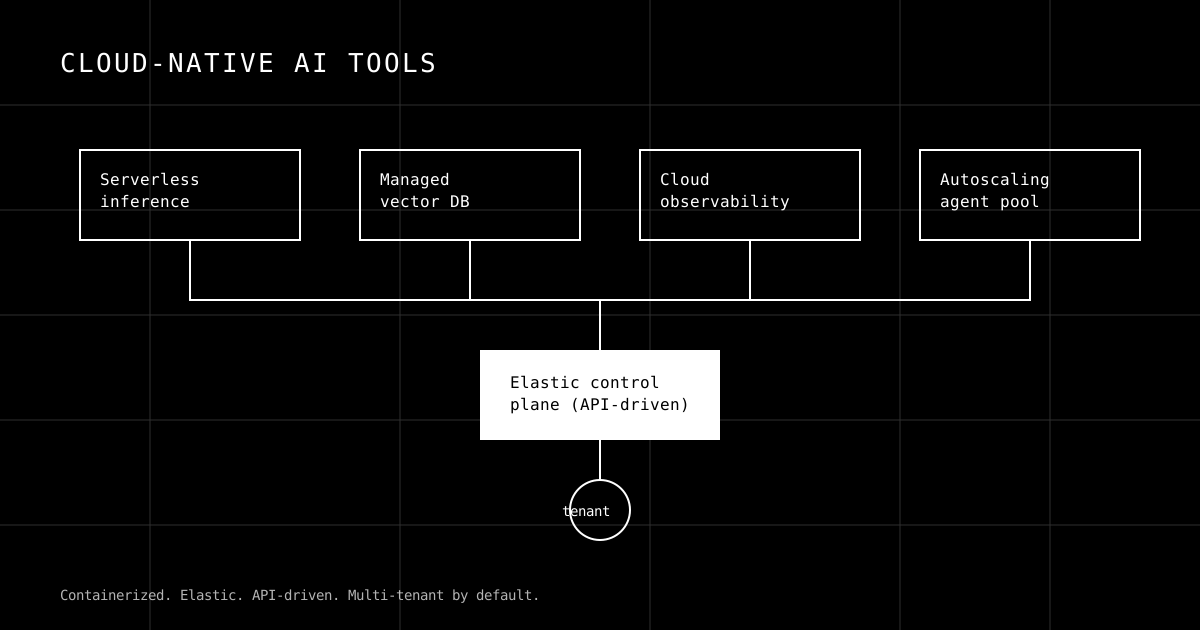
The phrase gets used loosely enough that it is worth pinning down before choosing tools. For AI workloads specifically, cloud-native describes four properties working together, not any single one of them in isolation.
Containerized
The inference server, the retrieval service, the agent orchestrator, and the evaluation worker each ship as a container image with a declared resource footprint. This matters more for AI workloads than typical web services because GPU and memory requirements vary wildly between a small classifier and a 70B-parameter model server — a container boundary lets the scheduler make placement decisions per component instead of per monolith.
Elastic
Capacity expands and contracts based on measured demand, not a provisioned peak. Elasticity is the property that makes spiky AI workloads affordable — a support-triage agent that runs constantly at low volume but bursts 20x during an incident should not require year-round GPU reservations sized for the burst.
API-driven
Every layer — model access, vector search, trace ingestion, autoscaling policy — is controlled through a versioned API rather than a console click or a manually edited config file on a box. This is what makes infrastructure changes reviewable, testable, and revertible the same way application code is.
Multi-tenant by default
Managed cloud-native services are built to isolate many customers on shared infrastructure through logical boundaries — namespaces, API keys, row-level policies — rather than physical separation per customer. This is the property most responsible for cost efficiency, and also the property that deserves the most scrutiny before you route regulated data through it.
None of these four properties is optional if you want the label to mean something. A "cloud-native" vector database that cannot scale down or that requires SSH access to tune is really just a managed VM with a fashionable name.
The four tool categories that make up a cloud-native AI stack
Most production AI systems assemble from the same four categories, whether the team realizes it or not. Naming them precisely makes the managed-vs-self-hosted conversation concrete instead of abstract.
Serverless inference
Serverless inference platforms accept a request, route it to a model — hosted, fine-tuned, or third-party — and bill per token or per invocation rather than per reserved instance-hour. The defining trait is that idle capacity costs nothing, or close to it, because the provider is pooling load across many tenants.
The trade-off is cold-start latency and, for self-fine-tuned or unusual model weights, longer warm-up windows the first time a rarely used model is invoked after scale-to-zero. Teams running latency-sensitive synchronous agent steps often keep a small warm pool for their primary model and let long-tail or batch workloads scale fully to zero.
Managed vector and retrieval stores
Retrieval-augmented workflows need a store that can hold embeddings, run approximate nearest-neighbor search at low latency, and update incrementally as source documents change. Managed vector databases handle index building, sharding, and replica placement as a service; the operator interacts through an API for upsert, query, and namespace management.
The category also includes hybrid search services that combine vector similarity with keyword or metadata filters, which matters more in practice than raw vector search alone — most production retrieval queries need a filter (tenant ID, document type, date range) alongside the similarity score, and that filter has to be enforced by the store, not bolted on in application code after the fact.
Cloud observability for AI workloads
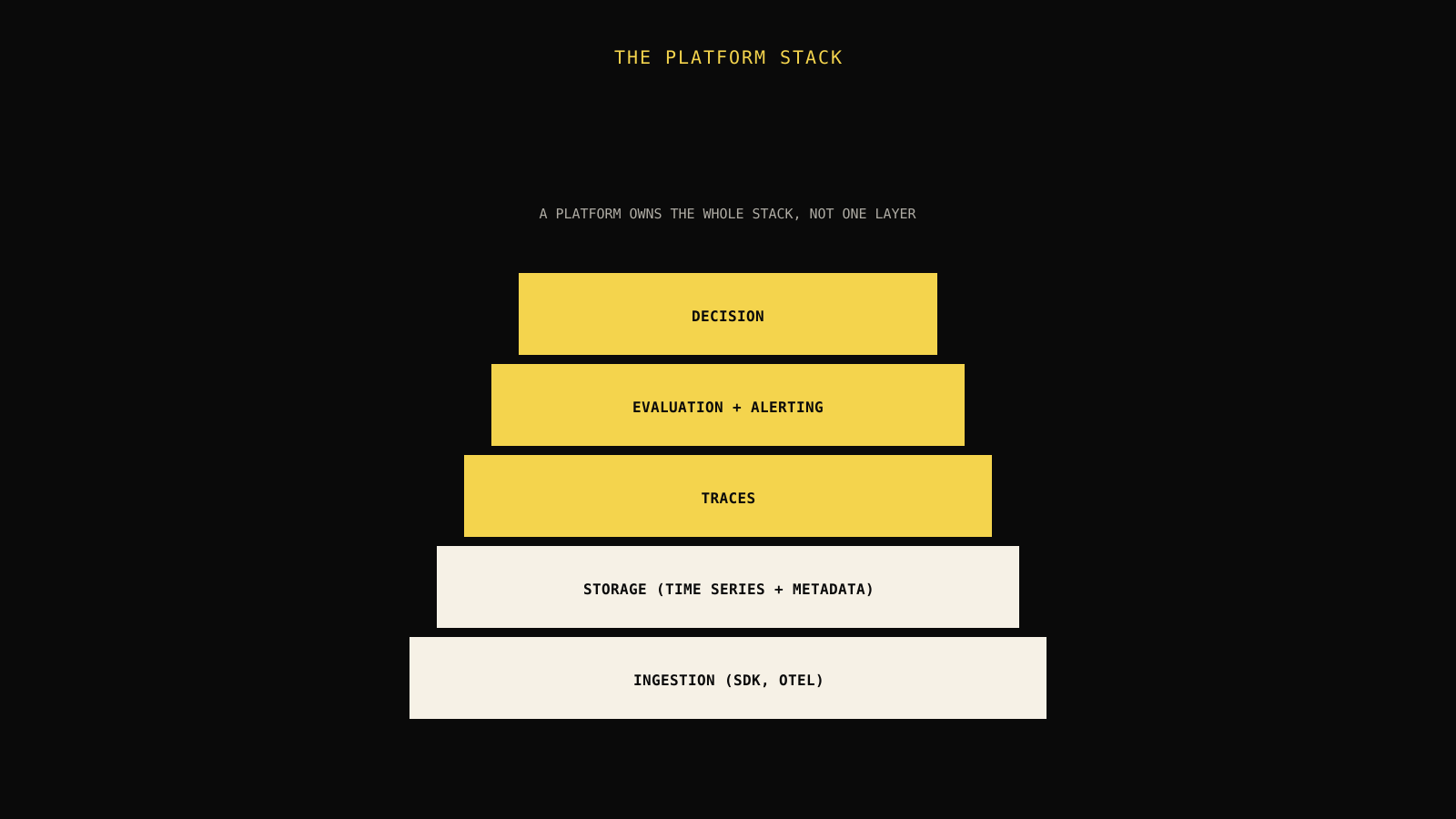
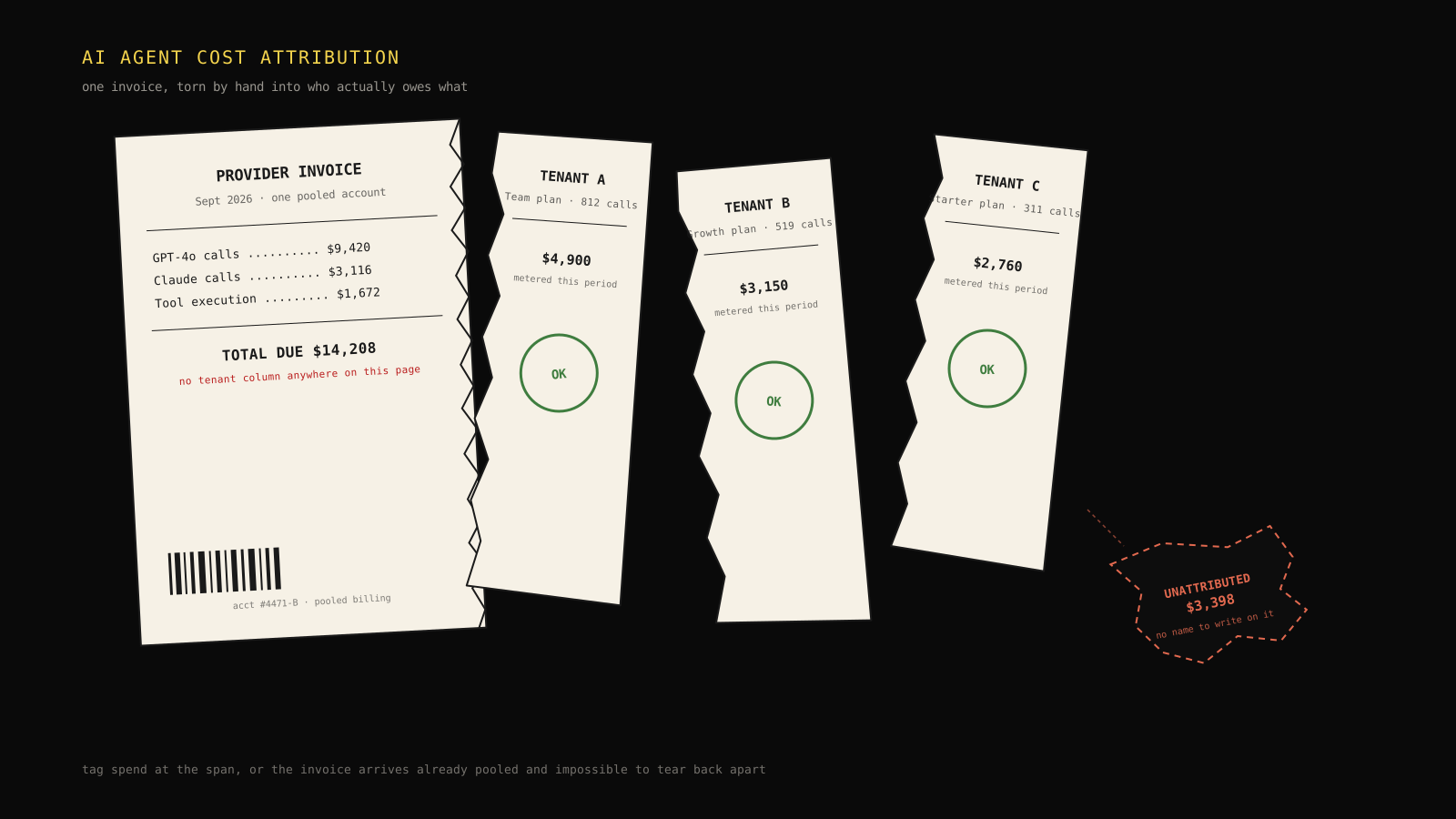
General-purpose APM tools were not built around the unit of work an AI system actually produces: a run composed of nested spans — a model call, a tool call, a retrieval step, a sub-agent handoff — often with retries, parallel branches, and a final evaluated outcome. Cloud-native AI observability platforms ingest that structure directly, correlate cost and latency to the same run, and let an operator open a trace instead of grepping logs across services. AI observability platforms covers what a platform in this category needs to get right, and cost attribution for AI agents covers the specific discipline of tying spend back to the run that generated it.
Autoscaling agent workloads
Agent execution — as opposed to a single inference call — often runs longer, holds more state, and may fan out into parallel tool calls or sub-agents. Autoscaling this layer means the scheduler has to reason about in-flight work, not just request-per-second throughput: a running agent task should not be killed mid-execution because the scheduler decided to scale down, and a burst of new agent runs should not queue indefinitely behind a fixed worker pool sized for yesterday's traffic.
| Category | What it manages | Primary signal it scales on |
|---|---|---|
| Serverless inference | Model hosting, routing, token billing | Request volume and token throughput |
| Managed vector store | Embedding storage, ANN search, hybrid filters | Index size and query QPS |
| Cloud observability | Trace ingestion, correlation, alerting | Span volume and retention window |
| Autoscaling agent workload | Long-running task execution, tool fan-out | In-flight task count and queue depth |
Work through a realistic example
Consider a customer-support agent product: it receives a ticket, retrieves relevant help-center content, calls a model to draft a response, may call a refund-processing tool, and logs the full run for review. Trace the four categories through one incident.
The first divergence
Traffic is steady during business hours and near zero overnight, except during a product outage, when ticket volume spikes 15x for two to six hours. The team has three backend engineers who also own two other services — no dedicated infrastructure headcount.
Applying the framework: Shape is spiky with an unpredictable trigger (an outage they cannot schedule around); Sensitivity is moderate — ticket content may include account details but not payment card data, since that is handled by a separate PCI-scoped service; Staffing is thin; Spend at current volume (roughly 40,000 runs/month) is small relative to what a dedicated GPU reservation would cost sitting mostly idle.
Field note: The spike trigger being unpredictable — not merely large — is what pushes this toward managed serverless inference. A predictable daily peak can often be handled with a smaller reserved baseline plus scheduled scale-up; an outage-triggered spike cannot be scheduled at all.
What the evidence supports
Serverless inference and a managed vector store are strong fits here: idle-cost-near-zero handles the overnight trough, and elastic scaling handles the unscheduled spike without the team provisioning for a worst case that happens a few hours a month. Observability, similarly, benefits from a managed ingestion pipeline the small team does not have to operate — three engineers running two other services cannot also run a self-hosted tracing backend's on-call rotation.
Choosing managed versus self-hosted
The instinct to treat this as a single binary company-wide policy is the most common mistake. The right unit of decision is the workload, not the company.

Most production teams land on a mixed stack: the layer with the strictest constraint gets self-hosted, and the rest stays managed.
When managed wins
Managed cloud-native tools win when the team is small relative to the number of services it runs, when load is spiky or hard to forecast, and when the workload does not carry a data-residency or audit requirement that the managed provider cannot satisfy. They also win during early-stage iteration, when the model, prompt, and retrieval strategy are all still changing weekly — self-hosting adds operational surface area to a system whose shape has not stabilized yet.
When self-hosted wins
Self-hosted infrastructure wins when a regulatory boundary requires data to stay within a specific region, cloud, or network the managed provider cannot guarantee; when sustained volume is high and steady enough that reserved capacity is cheaper than pay-per-use pricing over a realistic time horizon; or when the workload needs a scheduling behavior, hardware configuration, or model-serving optimization the managed API does not expose. Self-hosting also wins when a dedicated platform team already exists and operating this layer is a marginal addition to work they are already doing, rather than a new discipline the company has to build.
Decision rule: If you cannot name who gets paged for this layer at 2 a.m. today, that is evidence for managed, regardless of projected cost savings from self-hosting.
A worked cost comparison
| Scenario | Managed serverless (pay-per-token) | Self-hosted reserved GPU |
|---|---|---|
| 40K runs/month, spiky, 3 engineers | Lower total cost; near-zero idle spend | Idle capacity most of the month; hard to staff |
| 4M runs/month, steady, dedicated platform team | Per-token cost compounds significantly at this volume | Reserved capacity amortizes; team already operates infra |
| Regulated data, strict residency clause | May not satisfy the clause depending on provider region guarantees | Required regardless of cost, if the clause is non-negotiable |
The crossover point between managed and reserved self-hosted inference typically depends on sustained utilization, not peak volume — a workload that is busy 4 hours a day and idle the rest rarely crosses over, no matter how large the daily total looks.
Build the evidence chain: what to instrument before you decide
A managed-vs-self-hosted decision made without traffic data is a guess dressed up as an architecture review. Before choosing, instrument the workload enough to answer three questions with real numbers rather than intuition.
// Illustrative: a minimal workload profile to gather before a managed-vs-self-hosted decision.
type WorkloadProfile = {
  runsPerMonth: number;
  peakToTroughRatio: number; // busiest hour / typical off-peak hour
  p95LatencyBudgetMs: number;
  dataResidencyConstraint: "none" | "region-locked" | "no-egress";
  platformTeamHeadcount: number;
};

function recommendPosture(profile: WorkloadProfile): "managed" | "self-hosted" | "mixed" {
  if (profile.dataResidencyConstraint === "no-egress") return "self-hosted";
  if (profile.platformTeamHeadcount === 0) return "managed";
  if (profile.peakToTroughRatio > 8 && profile.platformTeamHeadcount < 2) return "managed";
  if (profile.runsPerMonth > 1_000_000 && profile.platformTeamHeadcount >= 2) return "mixed";
  return "managed";
}
This function is deliberately simple — it exists to show the shape of the decision, not to replace it. Treat it as a starting checklist: gather the five fields honestly, and if the answer it produces feels wrong for a reason the fields don't capture, that reason belongs in the written decision record, not silently overridden.
Protect the security boundary
Cloud-native's multi-tenant-by-default property is efficient, but it moves the trust boundary somewhere the team has to actively verify rather than assume. Three boundaries matter most for AI infrastructure specifically.
Data in transit to inference providers. Confirm whether prompt and completion content is retained by the provider beyond the request, whether it is used for model training by default, and whether that default can be disabled contractually — not just through a settings toggle a future engineer might miss.
Vector store tenant isolation. A shared vector index with a tenant_id metadata filter is only as safe as the guarantee that every query path enforces that filter. Verify the store enforces isolation at the query layer, not only in application code — a missed filter in one internal tool is enough to leak cross-tenant retrieval results.
Credential scope for autoscaled agent workers. Autoscaling means worker identity is ephemeral — a new container gets a new credential lease each time it starts. Confirm those credentials are scoped to the minimum the agent step needs and expire with the container, so a compromised worker cannot use a long-lived key after it should have been torn down.
Read the lower half visually

The container is temporary; the trace has to outlive it. Correlate by run ID, not by hostname or process ID, or scaled-down instances take their evidence with them.
This is the detail teams miss most often when they move an agent workload onto an autoscaling cloud-native platform for the first time: a debugging workflow built around "which server handled this request" breaks the moment that server can disappear thirty seconds after the request completes. The AI agent architecture guide covers how to draw the model, orchestration, memory, and tool boundaries this observability needs to attach to; metrics that matter for LLM observability covers which signals are worth correlating once the run ID is stable.
What changes the recommendation
A few conditions should make a team revisit a managed-vs-self-hosted decision rather than treat it as permanent:
- Sustained volume crosses the point where reserved capacity is materially cheaper than pay-per-use, verified with real invoices over at least a full billing cycle — not a projection.
- A new regulatory requirement adds a residency or audit constraint the current provider cannot satisfy.
- The platform team grows enough that operating a self-hosted layer becomes a marginal addition instead of a new discipline.
- A managed provider's pricing model changes in a way that breaks the original cost assumption — this happens more often than teams plan for, and the workload profile above should be re-run when it does.
Make the operating decision
Carry the support-agent example to a close: managed serverless inference for the spiky, unscheduled load; a managed vector store for retrieval, since the ticket content does not carry the strictest residency constraint; managed cloud observability, since a three-person team cannot also operate a tracing backend; and an autoscaling agent pool with strict credential scoping and run-ID-based correlation so traces survive scale-down. If a future product line adds payment-card data to the same agent, that layer's decision — not the whole stack's — gets revisited.
Teams comparing platforms in this category often also weigh vendor lock-in and switching cost; a practical guide to AI observability tools is a useful next read for evaluating that trade-off specifically for the observability layer.
Leave the reader with the next move
- [ ] Each of the four categories — inference, vector store, observability, agent execution — has an explicit managed-or-self-hosted decision recorded, not an implicit default.
- [ ] The decision cites real traffic shape and data-sensitivity evidence, not a projection or a competitor's stack.
- [ ] Someone is named as the operator for every self-hosted layer, and that person exists today.
- [ ] Trace correlation survives container teardown — verified by killing a worker mid-run in staging and confirming the trace is still complete.
- [ ] A review trigger is written down for each layer, so the decision gets revisited on evidence, not forgotten by default.
Start with the layer under the most pressure right now — usually inference cost or observability gaps — and run the framework on it before touching the rest of the stack. Expanding a mixed managed/self-hosted architecture one deliberate layer at a time is far more reviewable than migrating everything under one company-wide mandate.
Frequently asked questions
Is 'cloud-native' the same as 'serverless'?
No. Serverless is one implementation of cloud-native's elasticity property, typically for stateless request/response workloads. A self-hosted Kubernetes cluster with autoscaling, an API-driven control plane, and multi-tenant isolation is also cloud-native, even though nothing about it is serverless.
Can a team run a fully managed stack and still call it production-grade?
Yes, as long as the managed choice was made deliberately against the Shape, Sensitivity, Staffing, and Spend evidence for each layer, and the team has verified the provider's tenant isolation, retention, and credential-scoping guarantees rather than assuming them.
How do I estimate the managed-vs-self-hosted cost crossover without committing to either first?
Instrument the actual workload — runs per month, peak-to-trough ratio, and p95 latency — for at least one full traffic cycle including any known spike events, then price both options against that real profile rather than an assumed steady-state average.
Does multi-tenant isolation in a managed vector store need to be re-verified over time?
Yes. Re-verify after any provider architecture change, after adding a new internal tool that queries the store directly, and on a fixed cadence — treat it the same as a security control that can silently regress, not a one-time setup check.
What is the biggest operational mistake teams make when adopting autoscaling agent workloads?
Correlating traces by hostname or process ID instead of a stable run ID. When the container scales down, that correlation key disappears with it, and the trace for a completed run becomes unreconstructable exactly when an operator needs to investigate it.
Build the record, not just the stack
The tools in a cloud-native AI stack change faster than the decision framework that should govern them. A team that can explain, layer by layer, why inference is managed and vector search is self-hosted — with the traffic and sensitivity evidence behind each choice — will adapt faster to a pricing change or a new compliance requirement than a team that only knows "we're on the cloud-native stack" without remembering why any single piece was chosen. Write the decision down next to the infrastructure it governs, and revisit it on evidence rather than on schedule alone.
Practical field notes from the team building Tracify and operating AI agents in production.
Related posts

Next in the loop
Instrumenting AI agents for observability
Keep reading →