AI Observability Platform: What to Require Before You Buy
A decision framework for choosing an AI observability platform: what separates a platform from a point tool, the requirements that predict long-term fit, and how to run a scorecard-based evaluation instead of a feature checklist.
In this guide10 sections
At a glance
An AI observability platform is a single system that owns the full evidence chain for an AI application — ingestion, storage, tracing, evaluation, alerting, and cost tracking — under one schema and one identity model, instead of requiring a team to stitch those layers together from separate tools. This article is a decision framework, not a vendor comparison: it defines what a platform must actually own to earn the name, gives a weighted evaluation scorecard, and states the conditions under which a platform is the wrong call.
| Reader | Job | Boundary |
|---|---|---|
| Engineering leader or platform owner choosing infrastructure | Decide platform versus assembled toolchain, and evaluate specific candidates with real criteria | Does not name or rank specific vendors; see AI observability tools for the category-by-category breakdown |
If you have not yet defined AI observability for your own team, start with what AI observability is; this article assumes that definition and moves straight to the buying decision.
What separates a platform from a point tool
The word "platform" gets applied loosely. A useful test: does the product own the identity and schema that connects a trace to its evaluation, its cost, and its alert — or does it require you to maintain that connection yourself across separate tools?
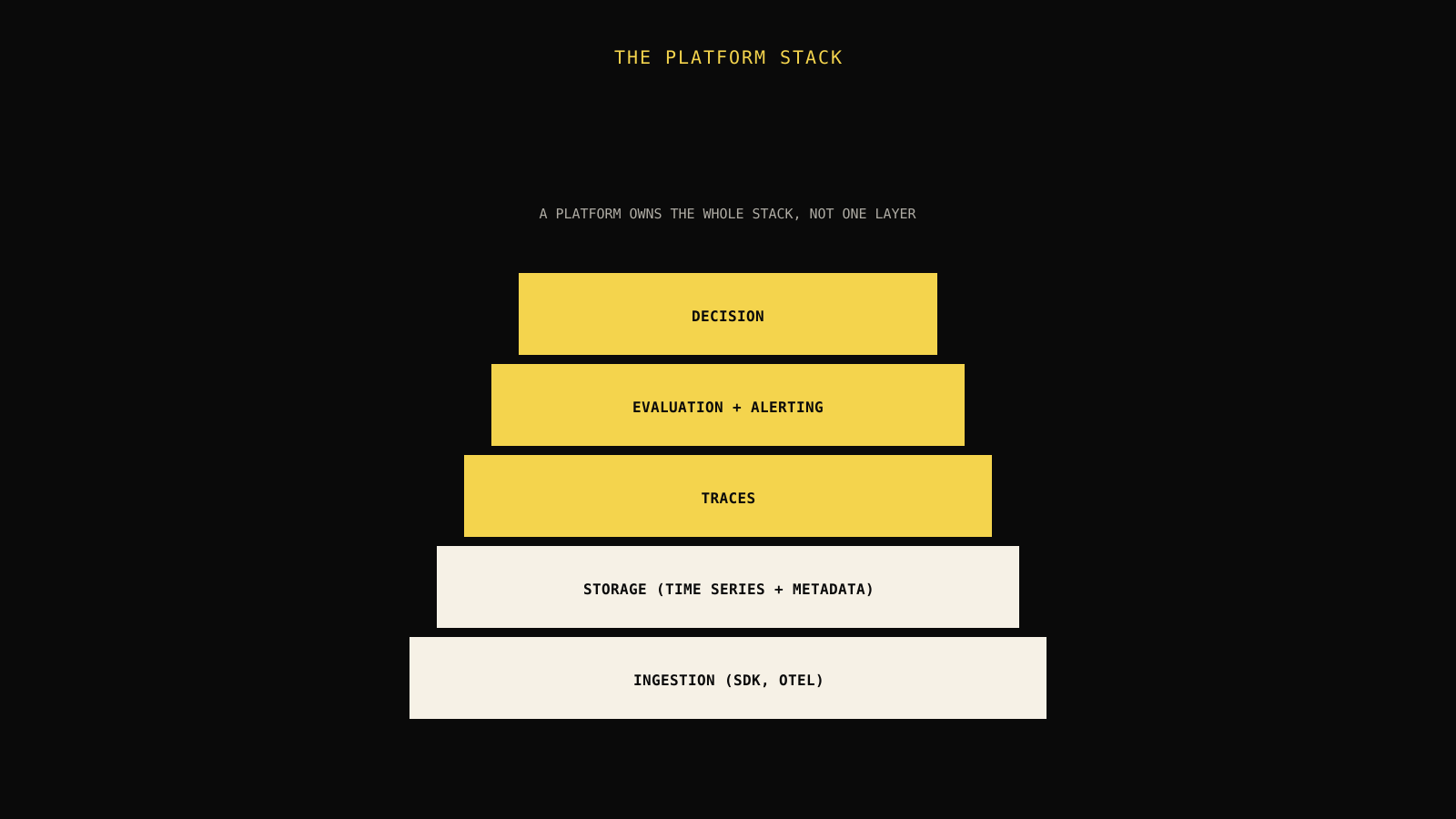
The operating model: five owned layers
| Layer | What it does | Platform requirement |
|---|---|---|
| Ingestion | Receives telemetry from your application (SDK or OpenTelemetry) | Accepts standard instrumentation without a proprietary lock-in format |
| Storage | Retains traces and metadata queryable over time | Supports the retention and query patterns your compliance and debugging needs require |
| Traces | Reconstructs the causal path of a run | Captures model calls, tool calls, retrieval, and retries under one run identity |
| Evaluation and alerting | Judges output quality and routes regressions | Runs evaluation against the same run identity as the trace, and routes alerts with evidence attached |
| Decision | Surfaces the information a human needs to act | Presents cost, quality, and reliability together for a workflow, not as separate disconnected views |
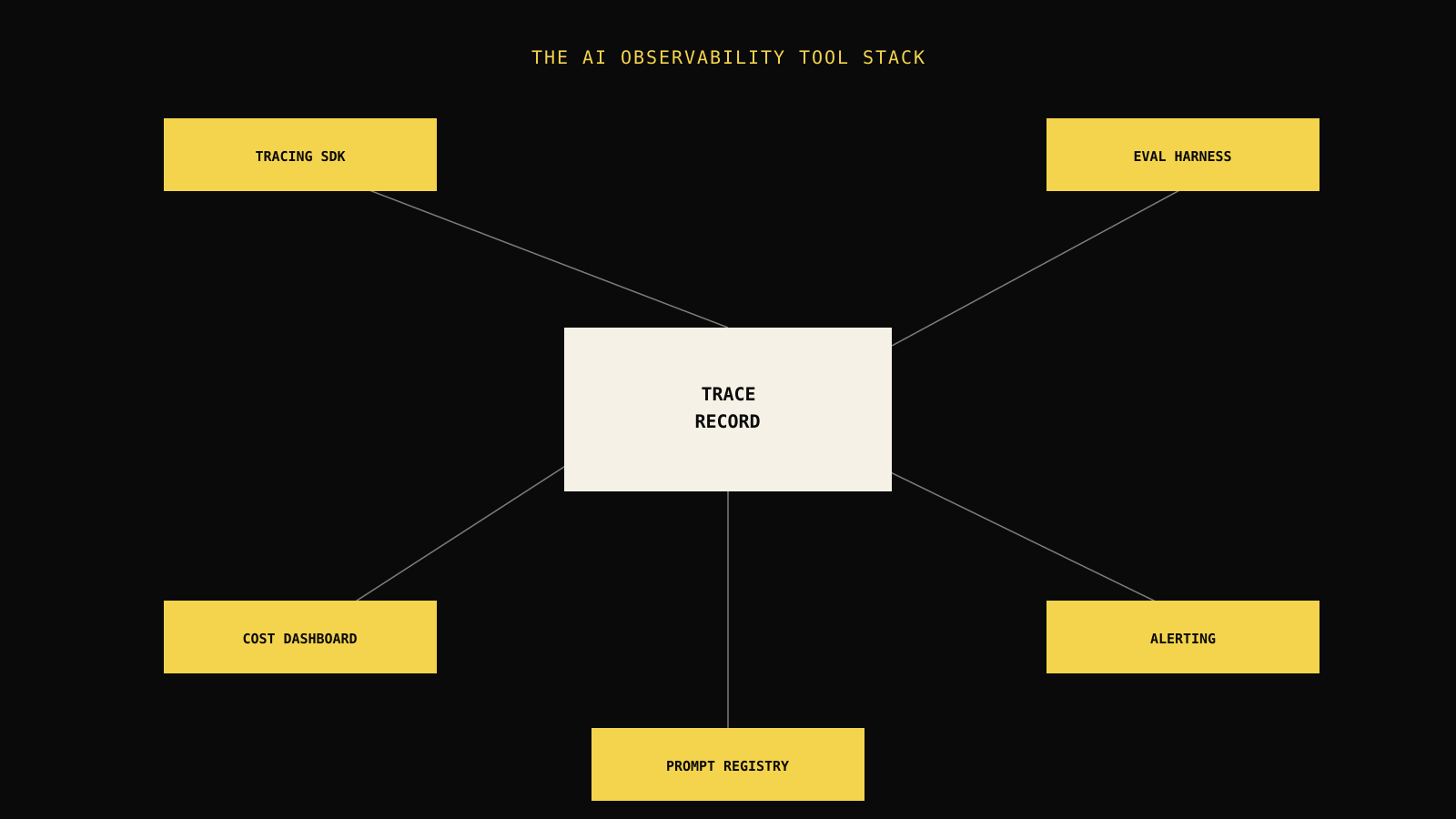
A tool that only owns ingestion and storage is a telemetry pipeline. A tool that only owns evaluation is a grading service. A platform owns enough of the stack that a single run identifier connects a customer complaint to its trace, its evaluation score, its cost, and the release most likely responsible — without an engineer manually joining data from three systems during an incident.
The identifier is the mechanism that makes this possible, and it is worth being concrete about what it looks like in practice. A single run_id generated at the start of a workflow should propagate through every layer: the trace that captures what happened, the evaluation record that scores it, the cost entry attributing spend to it, and any alert that fires because of it.
{
  "run_id": "run_9f21c",
  "workflow": "refund-approval",
  "release": "2026-08-30.2",
  "trace_ref": "traces/run_9f21c",
  "evaluation": { "groundedness": 0.94, "policy_match": false },
  "cost_usd": 0.014,
  "alert": { "fired": true, "reason": "policy_match_failed", "owner": "risk-ops" }
}
A platform's job is to guarantee this record exists and stays connected without an engineer writing the join logic by hand. A point tool can capture any one field in isolation; only a platform (or a carefully maintained assembled stack) guarantees the whole record stays coherent as the workflow evolves across releases.
Decision rule: If reconstructing "what happened, was it good, and what did it cost" for one production run requires querying more than one system and manually matching identifiers, you have an assembled toolchain, not a platform, regardless of what any single tool calls itself.
The build-versus-buy trade-off
Assembling a stack from OpenTelemetry, an open-source evaluation library, and a self-hosted dashboard is a legitimate choice for a team with the engineering capacity to maintain it. The trade-off is not "platform good, assembly bad" — it is where you want engineering time spent: on gluing observability tools together, or on the product.

When assembly is the right call
- A small team with one or two engineers who fully understand the pipeline and value maximum flexibility over convenience.
- A single, simple workflow where the evidence needs are narrow and unlikely to grow.
- An organization with strict infrastructure requirements (fully self-hosted, no third-party data processor) that a given platform cannot meet.
When a platform is the right call
- More than one production AI workflow needs coverage, and the team does not want to re-solve the identifier-joining problem for each one.
- The team has already lived through an incident where evidence was lost or delayed at the seam between two separately maintained tools.
- Engineering time is better spent on the product than on maintaining observability infrastructure.
Ownership determines which answer is right
The honest way to settle this trade-off is to name who currently owns the glue code between your observability tools, and ask whether that person has capacity to keep owning it as workflows multiply. A single senior engineer maintaining the join logic between a tracing tool and an evaluation library is a reasonable bet while there is one workflow and one engineer with full context. The bet stops paying off the moment that engineer is on vacation during an incident, or the second workflow ships and doubles the surface area of glue code without doubling the team.
This is also where "AI observability platforms" as a plural search shows up in practice: teams comparing several candidate platforms are almost always teams that have already tried the assembled approach and hit this exact ownership wall. If you have not hit it yet, that is useful information too — it may mean you are not ready for a platform decision, and the more urgent task is simply finishing the assembled version of layer one (tracing) before adding anything else.
A weighted evaluation scorecard
Rank candidates against criteria weighted by what actually predicts long-term fit, not by which features are easiest to demo.

| Criterion | What to test | Red flag |
|---|---|---|
| Trace fidelity | Instrument your hardest real workflow — a multi-step agent or tool-calling flow — during the trial | Only demos cleanly on a single-call chatbot example |
| Evaluation depth | Can you define a custom, task-specific grader, or only use fixed built-in metrics? | No support for custom evaluation criteria or baseline comparison |
| Alert routing | Does an alert carry the representative trace and likely cause, or just a threshold breach? | Alerts land in a shared channel with no assigned owner or evidence |
| Data residency and access | Where is data processed and stored? Who can see raw prompts and outputs? | No documented redaction, retention, or access control options |
| Pricing model | Model cost at 10x your current trace volume, not current-month cost | Per-event pricing with no visibility into cost at scale |
| Migration path | Can you export your traces and evaluation history if you leave? | Data locked in a proprietary format with no export path |
Run the scorecard as a real trial, not a sales call
Score each candidate using your team's actual production-adjacent traffic, not the vendor's canned demo data. A platform that handles a clean single-turn chatbot flawlessly can fail silently on a five-step agent with branching tool calls — exactly the workflow most likely to need observability the most.
Field note: The most reliable signal from a trial is whether an engineer, unprompted, opens the platform during a real (or simulated) incident three weeks in. If they reach for raw logs instead, the platform has not earned trust yet regardless of its scorecard total.
Work through a realistic decision
Consider a mid-size team running a customer-facing support agent that calls three internal APIs, retrieves from a knowledge base, and escalates to a human for high-risk requests.
| Observation | Weak interpretation | Better next move |
|---|---|---|
| The platform's dashboard looks polished and complete | "This platform is production-ready for us" | Instrument the actual escalation path during the trial; polish on the happy path says nothing about coverage of the branching logic that matters most |
| Pricing looks competitive at current trace volume | "Cost is settled" | Project cost at 3x and 10x current traffic explicitly; per-event pricing can invert the competitive advantage at scale |
| The platform supports OpenTelemetry ingestion | "Migration risk is low" | Confirm evaluation history and alert configuration also export, not just raw traces — partial export is still lock-in |
Protect the security and governance boundary
A platform that receives your production traces is receiving prompts, retrieved documents, tool arguments, and potentially personal data. Before adopting one, confirm:
- Redaction controls at the field level, so sensitive values (account numbers, personal data, credentials accidentally captured in a tool argument) can be excluded before they leave your infrastructure.
- Retention limits that match your compliance obligations, not an indefinite default.
- Access controls that distinguish who can see raw content versus aggregate metrics — not every engineer needs to see every customer's raw conversation to debug a latency regression.
- A documented data processing agreement if the platform is a third-party processor of regulated data.
These four requirements are not equally urgent for every team. A platform processing internal tooling traffic with no personal data has more room to defer a full data processing agreement than one handling customer support conversations that include account numbers and names. Match the rigor of the governance review to the sensitivity of what actually flows through the workflow being instrumented, rather than applying the same checklist depth to every workflow regardless of risk. A workflow with no personal data and no financial action can reasonably move faster through this review than one that can approve a refund or send a message on a user's behalf.
Ask about the failure mode of redaction itself
Redaction tools can fail in both directions: over-redaction that strips the evidence you need to debug an incident, and under-redaction that leaks a value the policy was supposed to catch. Ask a candidate platform how its redaction rules are tested, whether you can preview redacted output before it is committed to storage, and whether a missed redaction rule is at least logged so you know a gap existed, even if the specific value is already gone. A platform that treats redaction as a one-time configuration step, rather than something to monitor and iterate on, will accumulate silent gaps as new tool integrations and data sources are added to the workflow over time.
Read the lower half visually: the AI observability dashboard question
Teams frequently ask specifically about the "AI observability dashboard" — the surface a platform presents day to day. A good dashboard for this domain differs from a generic APM dashboard in a specific way: it must show quality, cost, and reliability for the same workflow side by side, not as three separately filtered views a person has to mentally merge.

The illustrative record above maps directly onto this view: the evaluation, cost_usd, and alert fields are exactly what the three panels render for a given workflow, all keyed to the same run_id. When a dashboard cannot answer "did the cost-saving change also hurt quality for this workflow" in one view, it is showing you data, not a decision, and the underlying platform question is whether that gap is a UI limitation or evidence that the data was never actually connected underneath.
| Dashboard pattern | What it reveals | What it hides |
|---|---|---|
| Separate tabs for traces, evaluation, and cost | Each dimension in detail | Whether a cost-saving change also degraded quality for the same workflow |
| A single workflow view combining all three | Trade-offs at a glance for one release decision | Deep per-trace detail, which should still be one click away |
| A composite "health score" | A simple number for a status update | Which specific dimension moved and why — avoid this as the primary view |
What changes the recommendation
A platform-first approach is the wrong call for a team validating an early prototype with uncertain product-market fit — the integration and contract overhead is not worth it before the workflow itself is proven. It becomes the right call once a workflow is customer-facing, changes weekly, and the cost of a silent regression (a wrong refund amount, an unsafe tool call, an unnoticed cost spike) exceeds the cost of the platform itself.
Make the operating decision
Carry the scorecard to a concrete pilot: instrument one real workflow, run it against your hardest test cases, project cost at scale, and confirm the data governance boundary before signing. AI observability tools breaks the five underlying categories down further if you decide assembly is still the right path for your team.
Write the decision down once it is made, even informally: which workflow drove the evaluation, which criteria mattered most, what the trial actually tested, and what would need to change to revisit the decision. Six months later, when someone asks why the team chose its current setup, that short record is worth more than anyone's memory of a sales call, and it gives the next evaluation — for the next workflow, or the next contract renewal cycle — a documented starting point instead of a blank page and a repeated procurement process from scratch.
Leave the reader with the next move
- [ ] You can state, in one sentence, whether your current setup requires manually joining identifiers across tools during an incident.
- [ ] A weighted scorecard has been run against your hardest real workflow, not a vendor demo.
- [ ] Cost has been projected at 3x and 10x current trace volume, not just current-month spend.
- [ ] Data residency, redaction, and retention have been confirmed before the technical decision is finalized.
- [ ] Migration and export options have been tested, not just claimed in a sales deck.
Run one real workflow through the scorecard this week. If two or more of the six criteria come back weak, treat that as a disqualifying signal rather than a feature gap to work around after signing. A weak score on trace fidelity or evaluation depth in particular rarely improves after the contract is signed, because those gaps are usually architectural rather than configuration issues a support ticket can resolve later.
A closing note on scope creep
Platform evaluations tend to expand mid-process: a stakeholder asks whether the platform can also cover a second workflow, or whether it integrates with an unrelated internal tool, and the scorecard quietly grows past its original six criteria. Resist adding criteria mid-evaluation that were not part of the original workflow's requirements — a platform selected for its fit to one well-understood workflow, then expanded deliberately, tends to outperform one selected against a sprawling wishlist assembled under time pressure. If a genuinely new requirement surfaces, note it, finish the current evaluation against the original scope, and treat the new requirement as input to the next workflow's evaluation rather than retrofitting it into this one.
Frequently asked questions
What is the difference between an AI observability platform and AI observability tools?
Tools are individual products covering one function — tracing, evaluation, cost tracking, or alerting. A platform owns multiple of those functions under one schema and identity model, so a single run can be traced, evaluated, and cost-tracked without manually joining data across separate systems.
How many AI observability platforms should we evaluate before deciding?
Three to five candidates scored against a consistent weighted scorecard is usually enough to surface a clear leader for your specific workflow. Evaluating more than that tends to add noise rather than confidence, since the scorecard criteria matter more than the raw number of options considered.
Is a self-hosted, open-source AI observability platform a realistic alternative to a commercial one?
Yes, if your team has the engineering capacity to maintain schema consistency, upgrades, and identifier-joining logic across components. The trade-off is engineering time spent on infrastructure versus a subscription cost; there is no universally correct answer, only a fit for your team's constraints.
What is the biggest red flag when evaluating an AI observability platform?
A platform that only demos cleanly on a single-call chatbot workflow and struggles to capture multi-step, tool-calling, or branching agent traces during a trial. That gap tends to surface exactly when observability matters most: during a real production incident.
Should pricing or capability drive the platform decision?
Capability should narrow the shortlist first; pricing should then be modeled at future scale, not current volume, before making the final call. A platform that is cheap today but scales unpredictably with trace volume can become the more expensive option within a year of real production traffic.
Practical field notes from the team building Tracify and operating AI agents in production.
Related posts
Next in the loop
AI Observability Tools: How to Evaluate and Choose
Keep reading →