Enterprise AI adoption trends: A governance framework that actually ships
A decision framework for the real enterprise AI trends of 2026 — governance gates, cost control, build-vs-buy, and the evidence that lets an agent rollout survive its first audit.
In this guide10 sections
At a glance
If you run platform, security, or product for a large organization, you are not short on AI pilots. You are short on a repeatable way to decide which pilots get a production budget, which get paused, and which get killed before they create a liability nobody owns. This article is not a hype roundup. It is a decision framework — built from patterns that show up consistently once an organization has more than a handful of agents running against real data — for the four questions every enterprise AI program eventually has to answer: how do we govern this, how do we control the cost, when do we build versus buy, and what does "ready for production" actually mean.
The boundary is deliberate. This piece does not predict model capability, does not cite vendor-reported benchmarks, and does not claim to know next year's regulatory text. It describes the operating patterns that recur when agentic systems move from a demo to something with a budget line, a support queue, and a name on an incident report — patterns that are visible in how mature engineering and platform organizations structure their rollouts, independent of which model or vendor sits underneath.
The failure mode is rarely the model. It is the absence of an inventory, an owner, and a rollback path.
The operating model: four gates, one ladder
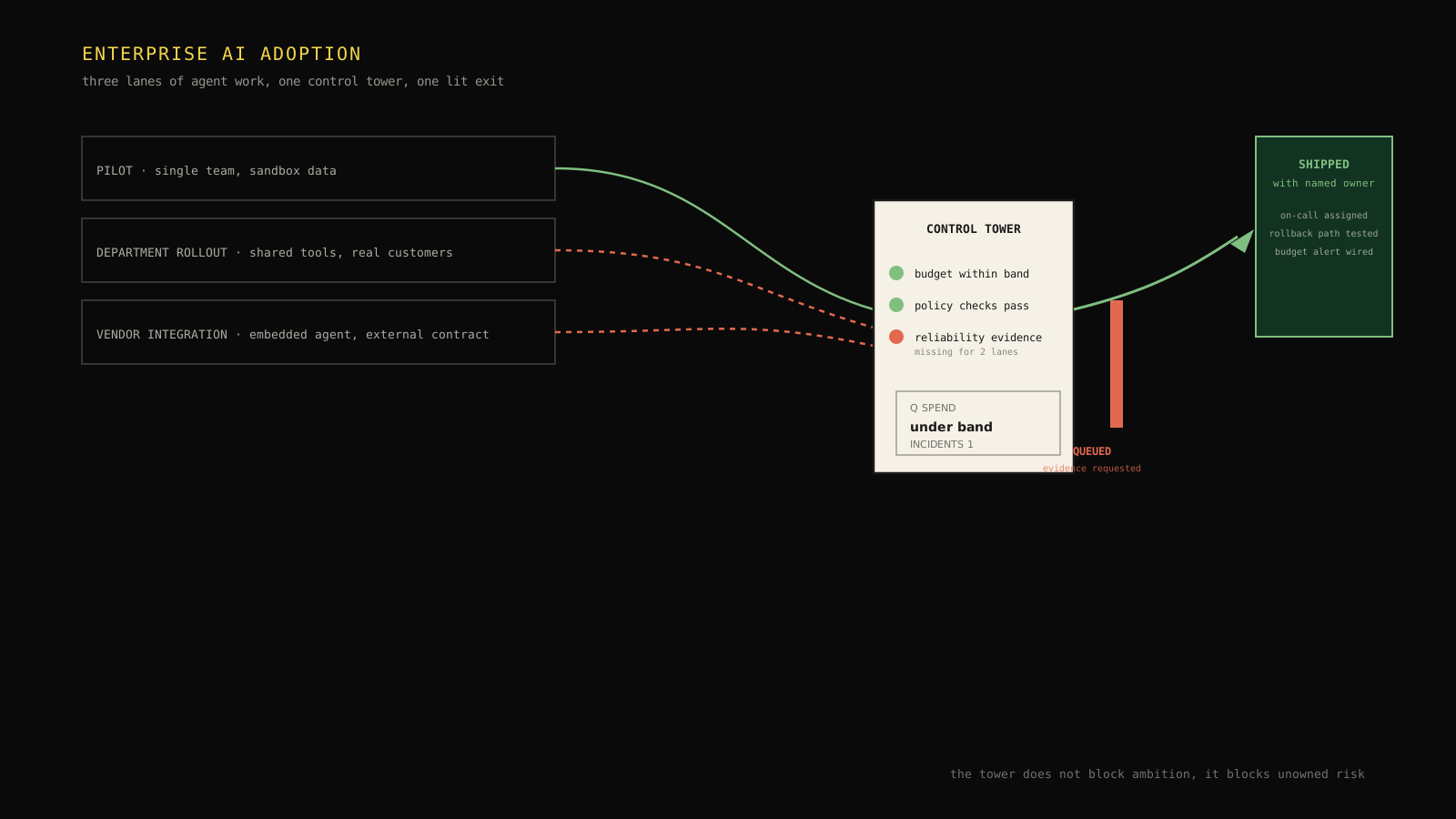
Large organizations that get agent adoption right are not the ones moving fastest. They are the ones that make a small number of gating decisions explicit and repeatable, then let teams move quickly inside those gates. This article organizes around four such gates, matched to a maturity ladder that explains why most organizations are stuck between the second and third step.
| Gate | Question it answers | Who owns the answer |
|---|---|---|
| Governance | Is this agent inventoried, scoped, and reviewable? | Platform or AI governance lead |
| Cost | Does spend stay inside a defined band as usage grows? | Finance + engineering owner, jointly |
| Build vs. buy | Should this workload be built, bought, or wrapped? | Product + engineering lead |
| Reliability | What evidence proves this is safe to run unattended? | On-call owner for the workload |
Governance: the gate that gets skipped first
Most organizations that end up with an ungoverned sprawl of agents did not decide to skip governance. They simply never wrote down what "governed" meant, so pilots quietly graduated into production because nobody's job was to stop them. The pattern is consistent: a team ships a working prototype, it gets useful fast, a few more teams copy the pattern, and eighteen months later nobody can produce a full list of what agents are touching customer data, what they're allowed to do, or who gets paged when one misbehaves.
What an inventory actually needs to contain
A governance inventory that survives an audit is not a spreadsheet of project names. It needs, at minimum, five fields per agent: the system it acts on behalf of, the tools or actions it is authorized to invoke, the data classes it can read or write, the human who owns its incident response, and the review date for its last permission audit. If any of those five fields is blank, the agent is not governed — it is merely deployed.
Field note: The organizations that recover from sprawl fastest are the ones that build the inventory retroactively before building any new policy. You cannot govern what you cannot list, and listing is a bounded, unglamorous task that a policy committee tends to skip in favor of writing rules for agents it hasn't found yet.
The three checkpoints that hold up in practice
Once an inventory exists, three checkpoints tend to recur across organizations that have stabilized their agent governance, independent of industry:
- Scope review. Before an agent gets write access to a new system or data class, someone outside the building team confirms the access matches the stated job. This is the single highest-leverage check, because most agent incidents trace back to an agent having more access than its task required, not to a subtle reasoning failure.
- Data boundary review. Confirm what the agent can see (prompts, tool outputs, retrieved documents) against what it is allowed to retain, log, or pass to a third-party model provider. This is the review that regulated industries cannot skip, and the one most pilots quietly bypass because "it's just a demo."
- Owner assignment. No agent moves past pilot without a named human who is paged when it fails. "The team" is not an owner. A person, with a defined escalation path, is an owner.
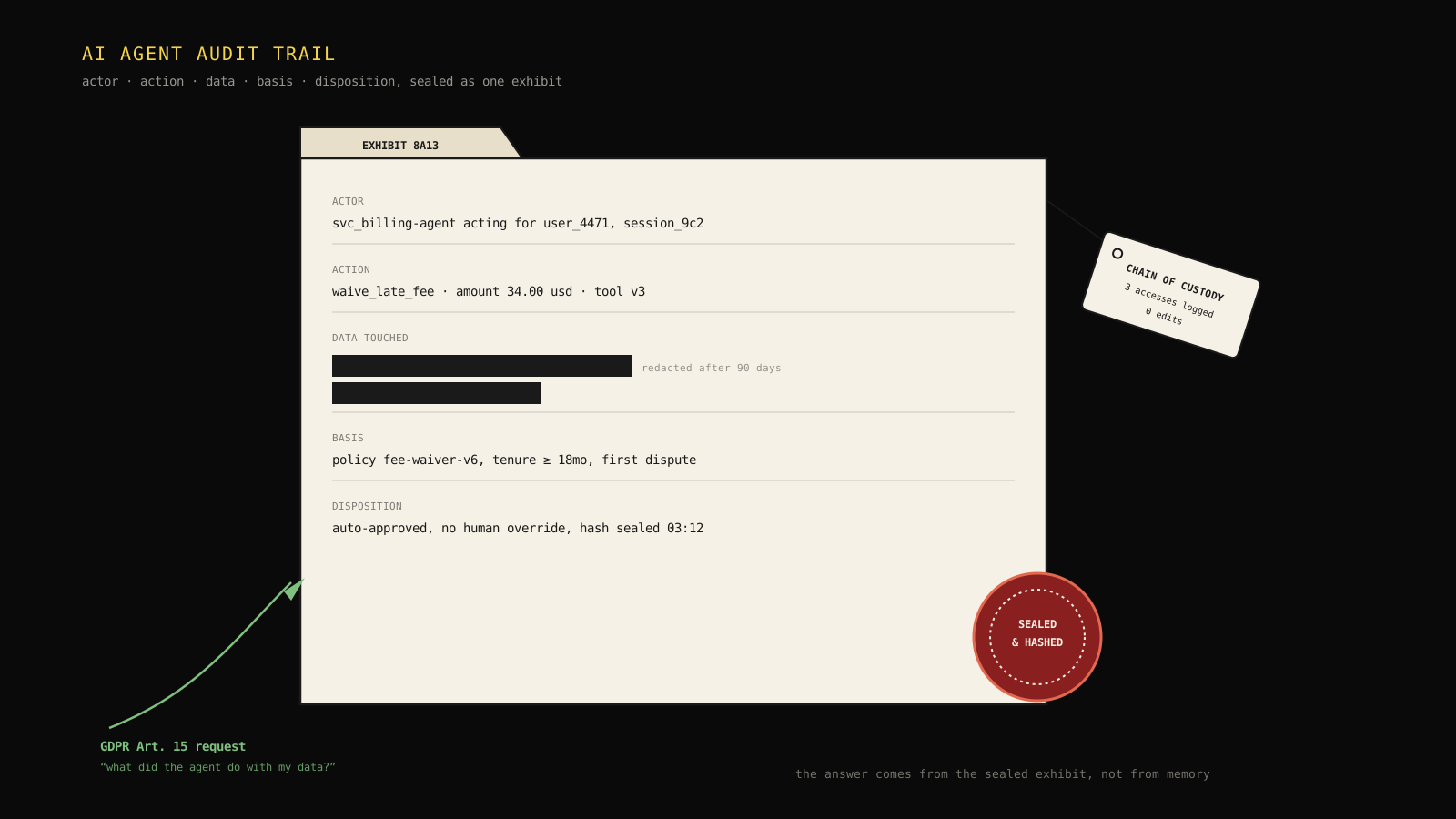
A useful reference for building the underlying record that makes these checkpoints auditable — rather than a verbal promise — is this guide to building an audit trail that survives a compliance review, covering what to capture, what to redact, and how long to retain it.
Where governance goes wrong
The most common governance failure is process that exists on paper but has no enforcement mechanism — it becomes a formality teams route around. The second most common failure is process that blocks everything equally, regardless of risk, which trains teams to under-report what they're building rather than submit it for a review that will take three months for a low-risk internal tool. Calibrate gate strictness to blast radius: a pilot with no write access and no customer-facing surface needs a lighter gate than an agent that can issue refunds or edit records.
Cost control: the second-quarter problem
Almost every organization's first AI pilot looks cheap. A single team, a narrow use case, a manageable token bill. The cost conversation gets serious in the second or third quarter, when the same pattern that worked for one team gets replicated across five teams, usage compounds with each new integration, and retries and multi-step agent loops turn what looked like a linear cost model into something closer to exponential, because nobody budgeted for the tax that failures and retries add on top of the "happy path" cost per task.
Why the naive model underestimates spend
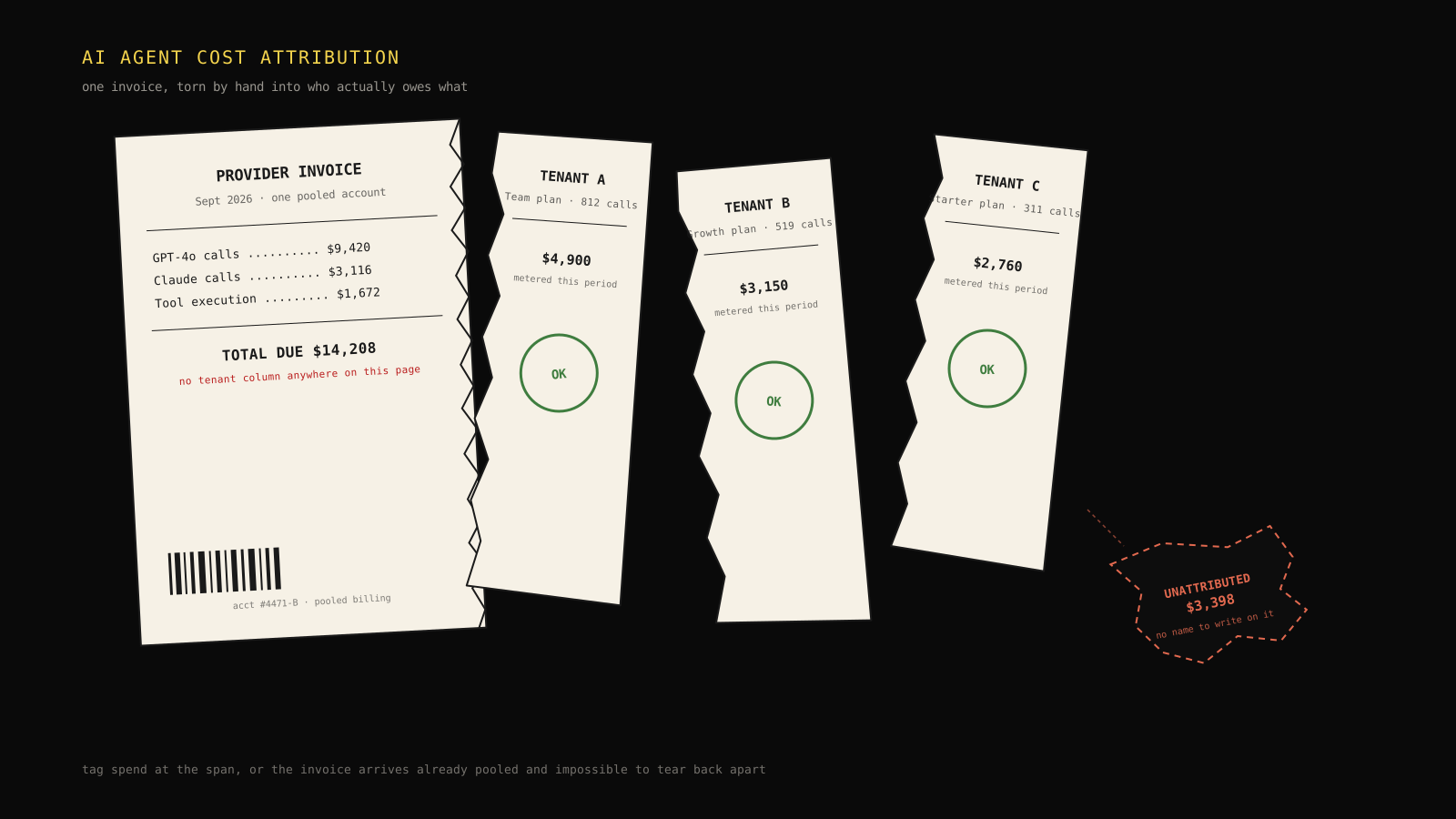
A simple mental model — cost per successful task times expected volume — misses three multipliers that show up once an agent runs against real, messy input: retries on transient tool failures, redundant context re-sent on every turn of a multi-turn conversation, and the fan-out effect of multi-agent patterns where a single user request triggers several sub-agent calls that aren't visible in a naive per-request estimate. Understanding the true cost of a task, not just the cost of one model call, is worth treating as a first-class metric before it becomes a budget-line surprise. A structured approach to attributing agent spend to a specific task, team, or customer — rather than reading a single undifferentiated model bill — is the practical starting point for closing that gap.
A cost governance table that scales
| Control | What it catches | Typical trigger |
|---|---|---|
| Per-workload budget band | Runaway usage from a single team or feature | Spend exceeds 120% of forecast for two consecutive weeks |
| Retry ceiling | Silent cost inflation from unbounded retry loops | More than 3 retries per task, or retry rate above 15% |
| Model tiering policy | Overpaying for tasks that a smaller model handles adequately | New workload launch, or a cost review flags a mismatch |
| Cross-team dedupe review | Multiple teams solving the same problem with separate agents | Quarterly platform review |
Decision rule: If a workload's cost per successful task has grown for two consecutive review cycles without a corresponding increase in successful outcomes, freeze new feature work on that agent until the cost driver is identified. Growth in spend without growth in value is the signal that should stop a rollout, not a fixed dollar ceiling that ignores what the spend is buying.
The build-vs-buy cost dimension
Cost control and build-vs-buy are not separate conversations — a "buy" decision moves marginal cost to a vendor's pricing model, while a "build" decision moves it to engineering time and infrastructure spend that is easy to underestimate early and expensive to unwind later. This is the natural bridge into the next gate.
Build, buy, or wrap: a decision that should not be made by enthusiasm
Every organization running more than a few agent workloads eventually faces the same question for each one: build it in-house, buy a vendor product, or wrap an existing tool with a thinner integration layer. The honest answer is that the workload's position on two axes — how differentiated it is to your business, and how sensitive the data it touches is — should decide the column, not which option the loudest engineer on the team prefers.

The two-axis test
- Differentiation. Is this capability something a competitor could buy off the shelf without losing anything meaningful, or is it built on proprietary data, workflows, or pricing logic that only your organization has? Low differentiation, high sensitivity workloads (an internal support triage bot on public documentation) are strong buy candidates. High differentiation workloads (a pricing agent tuned on your proprietary transaction history) usually justify the build cost.
- Data sensitivity. Not all data sensitivity blocks a buy decision — it changes which buy decision is safe. A vendor that cannot demonstrate tenant isolation and a clear data-processing agreement is a governance risk regardless of how good its agent is. This is where the governance gate and the build-vs-buy gate share the same evidence requirement: prove the data path, not just the feature list.
A worked example
A mid-size financial services team evaluated three workloads in the same quarter: a support-ticket triage agent, a claims document reviewer, and an internal pricing assistant. The triage agent scored low on both axes — commodity task, low-sensitivity ticket metadata — and the team correctly bought a vendor product rather than building. The claims reviewer touched regulated PII and fed decisions that required an audit trail, so despite being a build-friendly team, they built it in-house with strict logging and human review on every high-value determination, because no vendor at the time could satisfy the retention and explainability requirements their compliance team needed to sign off. The pricing assistant, tuned on internal transaction history that no vendor could replicate, was an unambiguous build.
Where wrapping fits
Wrapping is the underused middle option — building a thin, owned integration layer around a third-party model or tool rather than a full custom agent. It preserves the ability to swap the underlying provider, keeps the data path and logging under your control even when the reasoning engine is external, and avoids the multi-quarter build timeline of a fully custom system. Most low-differentiation, moderate-sensitivity workloads belong here rather than in a pure build or pure buy bucket.
Reliability: the evidence that lets an agent run unattended
Governance answers whether an agent is allowed to exist. Cost control answers whether it's affordable at scale. Reliability answers the question that actually determines whether a rollout survives contact with real users: what evidence proves this agent can run without a human catching every mistake in real time?
The maturity ladder
Reliability maturity tracks closely with the broader adoption ladder, and skipping steps on it is the single most common cause of a rollback that damages trust in the whole AI program, not just one workload.

- Scattered pilots. No shared trace format, no inventory, success measured by demo reactions.
- Tracked pilots. A shared logging or tracing standard exists; most organizations sit here today, with visibility but not yet enforcement.
- Governed rollout. A policy gate with named owners, an incident runbook, and a tested rollback path exists before an agent gets production traffic.
- Platform with reuse. A shared evaluation and guardrail library lets new workloads inherit reliability controls instead of rebuilding them, with a chargeback model that makes the platform's cost visible and fundable.
Most reliability incidents are not model failures — they are the absence of a tested rollback path.
What "tested" rollback actually means
A rollback plan that has never been executed is a hypothesis, not a control. The minimum bar: the team has actually disabled the agent (not just planned to) in a staging or limited-blast-radius production environment, confirmed the fallback path — human handling, a simpler rule-based system, or a previous agent version — takes over cleanly, and measured how long the disable takes to propagate. If that number is unknown, the team does not yet have a rollback path; it has a rollback intention.
A rollback control is easiest to keep honest when it is a single, testable switch rather than a scattered set of feature flags. A minimal shape that most teams can adapt:
// Illustrative: replace with your platform's actual feature-flag or routing client.
type AgentRolloutState = "active" | "disabled" | "shadow";

interface RolloutRecord {
  workloadId: string;
  state: AgentRolloutState;
  disabledAt?: string;
  disabledBy?: string;
  fallback: "human-queue" | "rule-based" | "previous-version";
}

// Disabling should be a single call that a named on-call owner can make
// without a deploy, and it should be timed on every drill.
export function disableAgent(record: RolloutRecord, actor: string): RolloutRecord {
  return {
    ...record,
    state: "disabled",
    disabledAt: new Date().toISOString(),
    disabledBy: actor,
  };
}
The value of this pattern is not the code itself — it is that "disable" is a single, timed, ownable action rather than a paragraph in a runbook nobody has rehearsed.
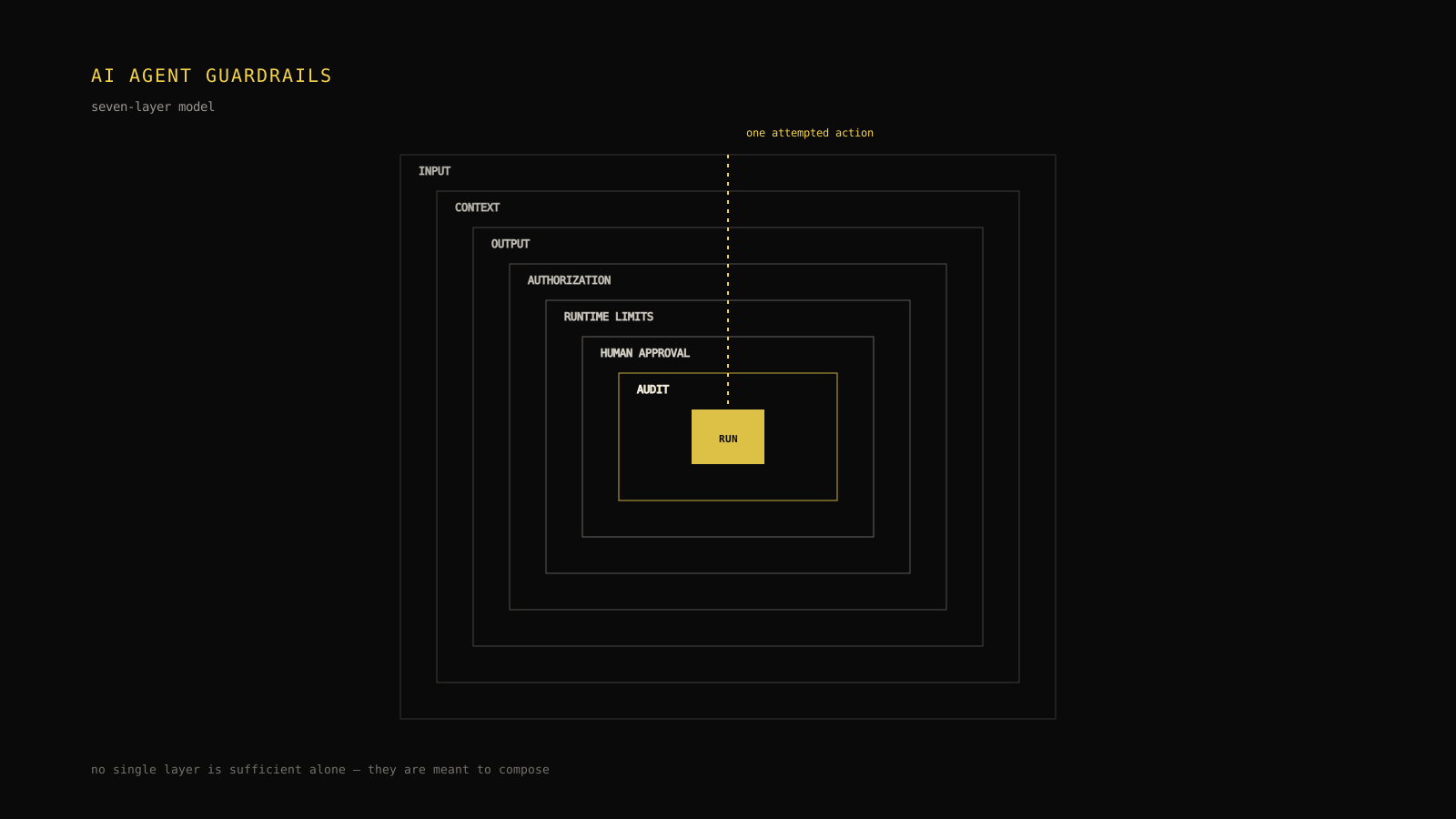
Guardrails — the explicit constraints that stop an agent from taking an action outside its authorized scope even when its reasoning would otherwise allow it — are the reliability control that most directly prevents an incident from becoming a governance failure. A practical breakdown of guardrail patterns that hold up under real production load is useful reading before writing your own policy layer from scratch, rather than reinventing constraints that are already well understood.
A pre-production evidence checklist
| Evidence | Why it matters | Owner |
|---|---|---|
| Named on-call owner with escalation path | Removes "the team" as a non-answer during an incident | Engineering lead |
| Rollback tested end to end, with timing recorded | Converts a plan into a control | On-call owner |
| Guardrails enforced outside the model's own reasoning | Prevents a scope violation even under a reasoning failure | Platform/security |
| Budget band with an alert, not just a dashboard | Catches runaway cost before the invoice does | Finance + engineering |
| Audit-ready action log for every high-impact decision | Answers "what did the agent do and why" without reconstruction | Compliance/platform |
Compliance considerations that cut across all four gates
Compliance is not a fifth, separate gate — it's the requirement that the other four gates produce evidence in a form a regulator, auditor, or internal risk committee can actually inspect. An organization can have excellent governance, cost control, a sound build-vs-buy decision, and a tested rollback, and still fail a compliance review if none of that evidence is retrievable on demand.
The practical requirement is a per-action record, not a per-conversation summary — one that captures who or what acted, what action was taken, what data was touched, the policy basis for the action, and the disposition. That record needs to survive the retention period your regulatory context requires, with sensitive fields redacted rather than deleted, so the answer to "what did this agent do with this customer's data six months ago" comes from a sealed record instead of a best-effort reconstruction from logs that were never designed for the question. Building that record correctly from the start is considerably cheaper than retrofitting one under audit pressure.
What this framework does not solve
This framework will not tell you which model to use, will not predict a specific regulation's final text, and will not substitute for legal review in a regulated industry. It also assumes an organization that already has more than one agent in flight — a single-team pilot with no plan to scale doesn't need the full weight of a governance inventory or a chargeback model yet, though it should still name an owner and test a rollback before it touches real customer data. Apply the gates in proportion to blast radius, not uniformly to every prototype in the building.
Make the adoption decision
Carry these four questions into the next rollout review instead of a generic "is this ready" discussion. Teams that adopt AI agents well are not the ones with the most sophisticated models — they're the ones that made inventory, cost bands, the build-vs-buy test, and tested rollbacks a routine part of shipping, the same way code review and on-call rotations became routine a decade earlier.
Leave the reader with the next move
- [ ] Every live agent is listed in an inventory with an owner, scope, and last review date.
- [ ] Cost per successful task — not per call — is tracked and reviewed against a defined band.
- [ ] Every workload has an explicit build, buy, or wrap decision tied to its differentiation and data-sensitivity position.
- [ ] The rollback path has been executed at least once, with the disable-to-fallback time recorded.
- [ ] A per-action audit record exists for every agent that touches regulated or customer data.
Finish this review in your next platform or risk meeting, not as a standalone project. The four gates are cheap to check and expensive to skip.
Frequently asked questions
What is the single most common reason enterprise AI pilots fail to reach production?
Not model quality — the absence of a named owner and a tested rollback path. Teams can usually get an agent working; they less often prove it can be safely turned off and handed back to a human process when it fails.
How should a team decide between building an agent and buying a vendor product?
Plot the workload on two axes: how differentiated it is to the business and how sensitive the data it touches is. Low differentiation and manageable sensitivity favor buying or wrapping an existing tool; high differentiation or data that no vendor can adequately protect favors building in-house.
How often should an organization review its AI governance inventory?
At minimum quarterly, and immediately after any incident or before any agent gains new write access or a new data class. An inventory that is reviewed annually is effectively unmaintained by the time of the next audit.
Does cost control mean using the cheapest available model for every task?
No. It means tracking cost per successful task against a defined budget band and using model tiering deliberately — routing tasks that don't need a frontier model to a smaller one — rather than defaulting to the most capable and most expensive model for every step of every workflow.
What evidence should a compliance or risk team ask for before approving an agent rollout?
A per-action audit record showing actor, action, data touched, policy basis, and disposition; a named on-call owner; a rollback that has actually been executed and timed, not just planned; and confirmation that guardrails are enforced outside the model's own reasoning rather than relying on the model to police itself.
Practical field notes from the team building Tracify and operating AI agents in production.
Related posts
Next in the loop
The AI Monitoring Toolchain: Wiring Tools Into One System
Keep reading →