AI Agent Guardrails: A Layered Safety Model for Tool-Using Systems
A seven-layer guardrail model for tool-using AI agents, showing what each layer catches, what it doesn't, and how the layers compose into one safety posture.
In this guide11 sections
At a glance
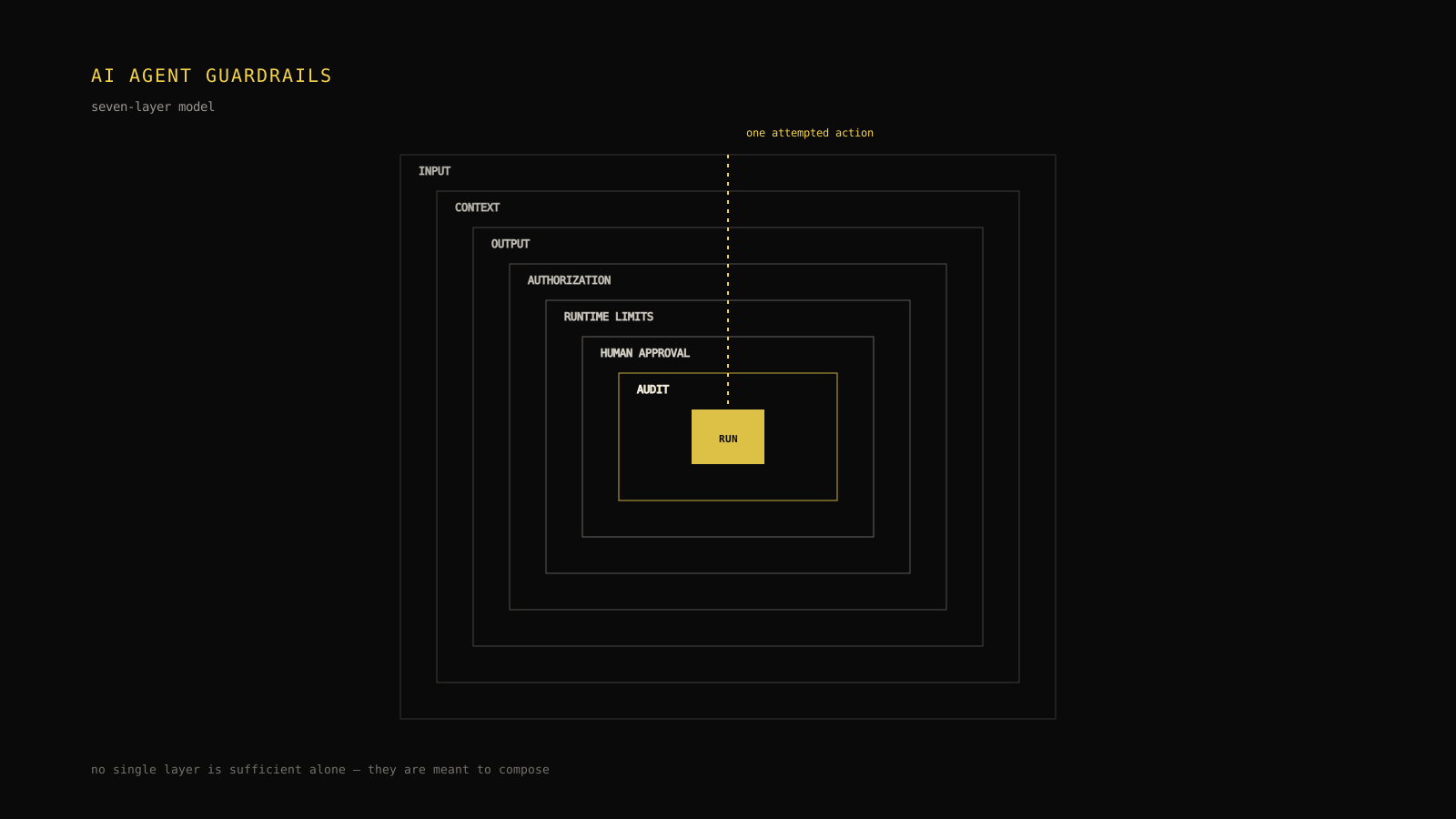
Guardrails for a tool-using AI agent are layered controls — input validation, context restriction, output validation, tool authorization, runtime limits, human approval, and audit logging — that together reduce the chance the agent takes an unsafe or unintended action. No single layer is sufficient by itself: input validation cannot substitute for authorization, and a spend limit cannot substitute for an audit trail. They exist to compose, catching what the layer before them missed, and every one of them has an honest limit on what it does not catch.
This article names each of the seven layers, works through a refund-tool example end to end, and gives you a tool-permission matrix you can adapt. It stays at the architecture level — it does not repeat the prompt-injection-specific defenses covered in prompt injection defense or the platform-hardening controls covered in AI agent security. Those two are layers inside this model; this is the model itself.
The operating model
The refund example above is not a business-logic bug. The amount check worked exactly as designed — it just answered a different question than the one that mattered. That confusion is common enough to be worth naming precisely before going further.
| Concept | Question it answers | Failure mode if missing |
|---|---|---|
| Business logic | Is this specific action valid under policy — is the amount, date, or quantity within range? | The agent approves actions that violate stated rules, even from authorized callers |
| Authorization | Is this actor allowed to take this action at all? | Any caller who can reach the tool can trigger it, valid parameters or not |
| Guardrail | A general term for any control — including the two above plus runtime limits, review, and logging — that constrains what an agent-driven action can do | Depends on which specific layer is missing; there's no single "guardrail" to add |
The refund tool had business logic and no authorization layer. It's a common pairing, because business logic is usually written first — someone has to define what a valid refund looks like before anyone worries about who gets to request one — and authorization gets added later, if at all, often after an incident makes the gap visible.
The layered guardrail model, layer by layer
No single control in an agent pipeline can carry the full weight of "safe." Each layer below addresses a specific point where an agent's behavior can diverge from what was intended, and each one has a boundary — a category of failure it structurally cannot catch, because that's not what it was built to check. The table names all seven, with the "does not catch" column filled in honestly rather than left implicit.
| Layer | What it catches | What it does NOT catch | Example control |
|---|---|---|---|
| Input validation | Malformed, oversized, or structurally suspicious input before it reaches the model or a tool | An input that is well-formed but semantically manipulative (a persuasive prompt injection payload written in valid prose) | Schema validation on tool-call arguments; length and encoding limits on user-supplied text |
| Context restriction | Untrusted content (tool output, retrieved documents, user messages) being treated with more authority than it should have | An agent correctly ignoring untrusted instructions but still executing a legitimate-looking action that happens to be unauthorized | Marking retrieved and tool-returned content as data, not instructions, in the prompt structure |
| Output validation | Malformed, out-of-schema, or policy-violating model output before it's acted on | An output that is well-formed and policy-compliant but initiated by a caller who shouldn't be allowed to trigger it | JSON schema validation on structured tool-call output; a content filter on generated text |
| Tool authorization | An actor invoking a tool or tool parameters they aren't permitted to use | A permitted actor using a permitted tool in a way that violates business rules (the amount is fine, the caller isn't) or a permitted actor with too broad a grant | Role-based permission checks per tool, evaluated separately from business-logic validation |
| Runtime limits | Cumulative harm from repeated or runaway actions — spend, call volume, loop iterations | A single high-harm action that fits comfortably inside the limit (one $4,000 refund under a $10,000 daily cap) | Per-session spend caps, max tool-call counts, max loop iterations |
| Human approval | High-risk or irreversible actions that shouldn't execute without a person confirming them | Approval fatigue — a reviewer who rubber-stamps requests because the volume is too high to evaluate each one meaningfully | A queued approval step before an irreversible or above-threshold tool call executes |
| Audit logging | The ability to reconstruct what happened after the fact, across every layer above | Anything in real time — logging does not prevent an action, it only makes it reviewable afterward | Structured, immutable logs of every tool call, its authorizing actor, and its outcome |
Two things to take from this table before moving on. First, the layers are ordered roughly by where they sit in an action's lifecycle — input, then context, then output, then authorization, then runtime, then approval, then logging — but they don't have to run in strict sequence in every implementation; authorization and runtime limits are often checked together, for instance. Second, every layer's gap is filled by a different layer, not by making that layer stricter. Tightening output validation will never catch an authorization gap, because it isn't built to ask who's calling.
Input validation
Input validation is the earliest checkpoint: rejecting malformed, oversized, or structurally anomalous input before it reaches the model or influences a downstream tool call. This includes schema checks on structured input, length and encoding limits on free text, and rejecting input that doesn't match an expected shape.
Context restriction
Context restriction governs how untrusted content is represented to the model — separating instructions the system trusts (the system prompt, the developer's tool definitions) from content the system does not fully trust (retrieved documents, tool output, user-supplied text). The goal is to prevent untrusted content from being treated as if it carries the same authority as a direct instruction.
This layer catches a wide category of injection-style attacks where the danger is retrieved or returned content trying to redirect the agent's behavior. It does not catch a case where the agent correctly treats all content as data, behaves exactly as instructed, and still takes an action nobody should have been allowed to authorize — that's not a context problem, it's an authorization problem.
Output validation
Output validation checks the model's output — both natural-language responses and structured tool-call arguments — against a schema or policy before anything acts on it. A tool call with a string where a number was expected, an out-of-range enum value, or a response that violates a content policy should be caught here before execution.
Output validation is necessarily downstream of intent: it can confirm the output is well-formed and policy-compliant, but it has no visibility into whether the actor who triggered this particular call chain was allowed to. A perfectly valid, perfectly policy-compliant refund of $4,200 is still perfectly valid and policy-compliant when the wrong person asked for it.
Tool authorization
Tool authorization is the layer the refund-tool incident was missing: a check, independent of business-logic validation, of whether this specific actor is permitted to invoke this specific tool with these specific parameters. It answers "who is this and what are they allowed to do," not "is this request internally consistent."
Authorization needs its own enforcement point, separate from the code path that validates amounts, dates, or quantities, precisely because the two questions have different owners in most organizations — a product or policy team defines valid refund ranges, while a security or platform team defines who can trigger irreversible financial actions. Conflating them into one code path means whichever team wrote it first defines both, often without realizing the second question was never asked.
Runtime limits
Runtime limits bound cumulative harm rather than any single action: a maximum spend per session, a maximum number of tool calls, a cap on loop iterations before the agent must stop and report. These exist because even a well-authorized, well-validated agent can accumulate damage across many small, individually-fine actions — a refund tool issuing twenty $150 refunds in a runaway retry loop is a runtime-limit failure even though every single refund passed both business-logic and authorization checks.
Runtime limits do nothing for a single action that fits inside the limit. A $4,000 refund under a $10,000 daily session cap sails through a runtime-limit check with no signal at all — the limit was never designed to catch a single high-harm event, only accumulation.
Setting the limit itself is a judgment call that deserves more scrutiny than it usually gets. A cap set from a single "worst plausible day" estimate tends to be either too loose to matter — set so high that ordinary runaway behavior never trips it — or too tight to survive a legitimate high-volume period, like a promotional event that genuinely produces a spike in valid refund requests. A more durable approach ties the limit to an observed baseline (the 95th or 99th percentile of a normal session's cumulative spend or call count, drawn from actual production traces) with a defined review cadence, rather than a number picked once during design and never revisited. Runtime limits that don't get revisited as usage patterns shift tend to drift out of calibration in one of two directions — permanently too loose to catch anything, or the more disruptive kind, tripped constantly on legitimate traffic until someone raises the cap without re-examining why.
It's also worth distinguishing session-scoped limits from actor-scoped limits, because they catch different failure shapes. A session cap bounds what a single conversation or task can do, which is the right unit for catching a runaway loop within one interaction. An actor-scoped limit — total refunds a given support-agent identity can trigger across all sessions in a day — catches a different pattern: a compromised or misused credential spread across many short sessions specifically to stay under any single session's cap. A system with only session limits has a gap an attacker who understands the limit can route around simply by starting a new session for every action.
Human approval
Human approval routes specific actions — chosen by risk, value, or reversibility — to a person before execution rather than letting the agent execute autonomously. This is the layer that should hold for the refund-tool scenario: anything above a defined threshold, or anything irreversible regardless of amount, should queue for a human rather than execute on the agent's authorization alone. Human-in-the-loop agent design covers where to place these checkpoints in more depth.
The honest limitation here is human capacity. Approval only works as a guardrail if the person approving has enough context and enough time per request to actually evaluate it — a queue that grows faster than a reviewer can meaningfully assess degrades into the reviewer approving everything, which is authorization theater, not a functioning guardrail.
Audit logging
Audit logging records what happened: which actor triggered which tool, with what arguments, under which authorization decision, and what the outcome was. It is the layer that makes every other layer's failure diagnosable after the fact — without it, "was this refund authorized" is a question you can only answer by asking the person who triggered it and hoping they remember.
Audit logging's limitation is timing. It documents; it does not prevent. A perfectly logged unauthorized refund is still an unauthorized refund — the log tells you it happened and who to talk to, not that it didn't happen.
Designing a tool-permission matrix
Authorization decisions should follow from two independent variables — how risky the tool is, and who's calling it — rather than being uniform across every tool a given role can reach. A support agent role that gets blanket access to "all tools" collapses a read-only lookup and an irreversible refund into the same permission level, which defeats the purpose of having risk-differentiated tools in the first place.
A workable matrix starts by classifying each tool into a small number of risk tiers:
- Read-only — no state change (look up an order, check a refund's eligibility).
- Reversible write — changes state that can be undone (update a ticket's priority, change a shipping address before fulfillment).
- Irreversible write — changes state that cannot be cleanly undone (issue a refund, delete a record, send an external communication).
Then cross that against role. The worked example below is for a refund-issuing tool across three roles typical of a support product: the end user acting through a self-service agent, a support agent supervising a session, and an admin.
| Tool | End user | Support agent | Admin |
|---|---|---|---|
| Check refund eligibility (read-only) | Auto-allow | Auto-allow | Auto-allow |
| Update ticket priority (reversible write) | Require approval | Auto-allow | Auto-allow |
| Issue refund ≤ $200 (irreversible write, low value) | Block | Require approval | Auto-allow |
| Issue refund > $200 (irreversible write, high value) | Block | Require approval | Require approval |
| Delete customer record (irreversible write) | Block | Block | Require approval |
Reading this matrix diagonally is the point: risk goes up, the required control gets stricter, and role only shifts where the line falls, not whether irreversible actions get a check at all. Notice that even the admin role doesn't get unconditional auto-allow on the highest-risk rows — elevated privilege reduces friction, it doesn't remove the guardrail. Try the interaction below with your own agent's tools in mind: for each one, is the recommended control what your system actually enforces today?
Tool-permission matrix builder
Pick a tool's risk level and the role attempting to call it. The result is a fixed decision table, not a live policy engine — use it to check whether your own agent's tool authorization follows risk and role, or whether every tool gets the same treatment regardless of what it can do.
Tool risk level
Changes state that cannot be cleanly undone — e.g. issuing a refund or deleting a record.
Calling role
The customer the agent is acting on behalf of.
Recommended control
Block
Refuse at the authorization layer regardless of what the request contains. This role cannot take this action through the agent, ever.
An illustrative policy snippet
The following is a pseudo-config for illustration only — it isn't tied to a specific policy engine and should be adapted to whatever authorization system your stack already uses, not copied as-is.
# Illustrative — not a runnable configuration for any specific product.
tool: issue_refund
risk_tier: irreversible_write
permissions:
  end_user:
    allowed: false
  support_agent:
    allowed: true
    requires_approval: true
    approval_threshold_usd: 0        # every amount requires approval for this role
  admin:
    allowed: true
    requires_approval: true
    approval_threshold_usd: 200      # only refunds above $200 require approval

runtime_limits:
  max_calls_per_session: 3
  max_total_spend_per_session_usd: 1000
  on_limit_exceeded: "block_and_alert"

audit:
  log_fields: [actor_id, actor_role, tool, arguments, decision, approver_id, timestamp]
  retention_days: 400
Two details worth naming explicitly. The approval_threshold_usd field is a business-logic parameter (what amount is "small enough") living inside an authorization policy (who this rule applies to) — that's intentional and fine, because the two are meant to compose at the point of enforcement, just not to be the same check. And runtime_limits is scoped per session, not per call, because its job is catching accumulation across multiple authorized-and-valid actions, not any single one.
Blocked vs. ambiguous execution paths
Not every guardrail decision is a clean allow or block. A meaningful share of real traffic falls into an ambiguous middle: the tool call is plausible, the actor has some claim to permission, but the specific combination of parameters, timing, or context doesn't cleanly match a rule. Treating "ambiguous" the same as "blocked" produces a system that's technically safe and practically unusable; treating it the same as "allowed" defeats the guardrail.
The workable answer is a third path — route ambiguous cases to human approval rather than forcing a binary decision at the authorization layer. This is exactly what the "require approval" column in the matrix above is for: it's not a weaker version of "allow," it's the deliberate answer to "we can't fully resolve this automatically."
Field note: If your authorization layer only has two outcomes — allow or block — you'll eventually see engineers quietly widen the allow conditions to cover legitimate edge cases, which is how a well-designed guardrail erodes one exception at a time. Adding a genuine third path removes the pressure to do that.
Ambiguity tends to show up in a handful of recurring shapes worth naming explicitly, because each one calls for a slightly different resolution. There's parameter ambiguity — a refund amount that's technically within policy but unusually large relative to that customer's order history, where the tool's own validation has no concept of "unusual for this customer" and can't be expected to. There's identity ambiguity — a session where the calling actor's role is correctly established but their relationship to the specific record they're acting on is unclear, such as a support agent attempting an action on an account outside their assigned queue. And there's temporal ambiguity — a request arriving just after a policy or price change takes effect, where the "correct" answer depends on a timing detail the tool wasn't built to evaluate. None of these are failures of the guardrail model; they're exactly the category of case the model expects to route to human approval rather than resolve automatically, and building a system that can recognize "I can't resolve this cleanly" is itself part of a well-designed authorization layer, not a sign that the layer is incomplete.
False positives and user friction
Every guardrail that can block or delay a legitimate action will, eventually, block or delay one that was actually fine. This is not a sign the guardrail is broken — it's the cost side of the risk-reduction trade, and it should be tracked as a real metric, not treated as an acceptable but invisible tax.
Track false-positive rate per layer, not just in aggregate. A tool-authorization layer with a 2% false-positive rate on a low-volume, high-risk tool is a very different operational problem than the same rate on a high-volume, low-risk tool — the second is probably fine to leave as-is, the first is worth investigating because each false positive there likely means a legitimate high-stakes action stalled.
There's a second, quieter cost worth naming: the friction a guardrail adds is rarely distributed evenly across users. A support agent who handles refunds daily learns quickly which requests will trigger approval and routes around the friction by pre-framing requests to avoid it — sometimes legitimately, sometimes by learning to word things in ways that dodge a check that should have applied. An end user hitting an approval queue for the first time has no such fluency and experiences the same guardrail as a much larger obstacle. Measuring friction only in aggregate hides this gap; a guardrail that "works fine on average" can still be badly miscalibrated for the population that encounters it least often, which is usually the population with the least context for what to do next.
Distinguish, too, between friction that's doing its job and friction that's just cost. A guardrail that delays a genuinely risky action while a human reviews it is friction with a purpose — the delay is the point. A guardrail that delays a routine, low-risk action because its risk tier was set too conservatively, or because the authorization rule wasn't scoped tightly enough, is pure cost with no corresponding risk reduction. The fix for the second case is almost never "add an exception" — exceptions accumulate into exactly the erosion described in the field note above — it's revisiting the risk tier or the rule's scope so the classification itself is more accurate.
Warning: No layer in this model, and no combination of them, guarantees that an agent can never be misused or that every attack is caught. Guardrails reduce the probability and blast radius of an unsafe action; they do not eliminate it. Treat every claim in this article as risk reduction, never as a safety guarantee.
What guardrails cannot guarantee
None of the seven layers, individually or composed, guarantee that an agent will never take an unsafe action. That claim would be false, and it's worth stating plainly rather than letting a layered model imply completeness it doesn't have.
What the layered approach does provide is defense in depth: an attacker or a failure mode that gets past one layer still has to get past the others, and the layers that remain — particularly authorization, runtime limits, and audit logging — don't depend on the specific technique that defeated an earlier layer. A prompt injection that slips past context restriction still has to clear tool authorization before it can trigger a refund; the failure of one layer doesn't cascade into failure of the rest, provided the layers are genuinely independent rather than all keying off the same signal.
The honest limitations, stated directly:
- Novel attack techniques can defeat any single layer. Input validation, context restriction, and output validation are all pattern- and structure-based; a sufficiently novel technique can slip through any of them, which is why authorization and human approval — the two layers least dependent on recognizing a specific attack pattern — carry disproportionate weight for high-risk actions.
- Layered controls add latency and engineering cost. Every layer is a real cost in complexity, review burden, and often user-facing delay. The matrix approach exists precisely so that cost gets applied where the risk justifies it, not uniformly across every tool call.
- A misconfigured layer is worse than no layer, because it creates false confidence. An authorization check that always returns "allowed" due to a bug is more dangerous than an acknowledged gap, because nobody is watching for the gap that appears closed.
- Guardrails reduce risk; they do not eliminate it. Framing any of these controls as making an agent "safe," full stop, overstates what they do. The correct framing is that a specific class of failure becomes less likely, at a specific cost, with specific coverage gaps that remain the responsibility of the layers around it.
- Coverage gaps compound quietly across a growing tool surface. A permission matrix reviewed and correct on the day a tool ships tends to drift as new parameters, new roles, or new integrations get added to that same tool over time — nobody deliberately removes the authorization check, it just doesn't get extended to cover the new surface area, and the gap isn't visible until something exercises it.
- The model can only enforce what the surrounding system gives it authority to enforce. No guardrail layer described here changes what the underlying infrastructure allows. If the database credentials a refund tool uses can, at the infrastructure level, write to any table regardless of what the authorization layer decided, the authorization layer is a courtesy the infrastructure isn't actually enforcing — a determined bypass at the infrastructure layer defeats every guardrail built on top of it.
None of these limitations are arguments against building the layers — they're arguments for treating "we have guardrails" as the start of an ongoing operating practice, not a completed project. A permission matrix needs periodic re-audit as tools change. Runtime limits need recalibration as usage patterns shift. Audit logs need someone actually reviewing them, not just accumulating. A layered model that's designed once and never revisited degrades into the same false confidence a misconfigured layer creates on day one — it just takes longer to get there.
Worked example: guardrails around a refund-issuing tool
Pulling the model together against the opening scenario. The original refund tool had one layer: business-logic validation on the amount, date, and duplicate-request check. Applying the seven-layer model to the same tool:
- Input validation — the refund request arguments (order ID, amount, reason code) are schema-checked before reaching the tool.
- Context restriction — if the refund reason is drawn from a customer's message, that text is treated as data informing the request, not as an instruction the agent executes directly.
- Output validation — the model's structured tool-call output is validated against the refund tool's schema before execution.
- Tool authorization — the calling actor's role is checked against the permission matrix above, independent of the amount check.
- Runtime limits — the session's cumulative refund total and call count are checked against per-session caps.
- Human approval — refunds above the role's threshold are queued for a person rather than executed.
- Audit logging — every field in the illustrative policy's
log_fieldslist is recorded regardless of the outcome.
The original incident happened because layer 4 didn't exist and nothing else in the pipeline was positioned to catch its absence — business-logic validation at layer "0" (folded into the tool's own code, not shown above because it isn't one of the seven) answered a different question than authorization does, and no layer downstream of it was checking who was calling. Adding tool authorization as an explicit, independently-owned layer — not a stricter version of the existing amount check — is what closes that specific gap.

Read the lower half visually
The permission matrix above is the clearest single artifact for auditing an existing agent: for every tool it can call, plot risk tier against every role that can reach it, and check whether the recommended control in each cell matches what's actually enforced. Rows where a high-risk tool shows "auto-allow" for a broad role are the ones worth investigating first.
What changes the recommendation
The matrix values in this article are a reasonable starting point, not a fixed rule. Two conditions should shift a cell toward stricter controls even for a role or risk tier that would otherwise auto-allow: a demonstrated pattern of the agent misusing that specific tool (tracked via audit logs and evaluation traces, not intuition), and a change in the blast radius of the tool itself — a "reversible write" that later gains an irreversible side effect (an update that also triggers an external notification, for instance) needs to be reclassified, not left in its old tier out of inertia.
Make the operating decision
Reviewing an agent's structured tool-call outputs is a natural companion step here: a schema-valid tool call is necessary but not sufficient evidence that the call should have executed — that's the authorization layer's job, and it's worth confirming both are actually wired in, not just the one that's easier to test.
Leave the reader with the next move
- [ ] Every tool your agent can call is classified into a risk tier (read-only, reversible write, irreversible write).
- [ ] Tool authorization is enforced as a check independent from business-logic validation, for every irreversible-write tool at minimum.
- [ ] Runtime limits exist per session, not just per call, to catch accumulation.
- [ ] High-risk or irreversible actions route to human approval rather than auto-executing, and the approval queue is sized to what a reviewer can actually evaluate.
- [ ] Every guardrail decision — allow, require-approval, or block — is captured in an audit log with the actor, tool, arguments, and outcome.
Start with the highest-risk tool your agent can call today and walk it through all seven layers. If tool authorization is missing or folded into business-logic validation, that's the gap most worth closing first — it was the one in this article's opening incident, and it's the one most commonly missing in practice.
Frequently asked questions
What are AI agent guardrails?
Layered controls — input validation, context restriction, output validation, tool authorization, runtime limits, human approval, and audit logging — that together reduce the risk of an unsafe or unintended agent action. No single layer is sufficient alone.
Are guardrails the same as business logic validation?
No. Business logic checks whether an action is valid — a refund amount within policy, for instance. Authorization checks whether this specific actor is allowed to take this action at all. Both matter, and conflating them is a common source of gaps.
Can guardrails fully prevent prompt injection?
No single guardrail layer can guarantee that. Layered input validation and output checks reduce risk but should be paired with the platform-level defenses described in dedicated prompt-injection guidance, not treated as a complete solution on their own.
What should trigger human approval instead of automatic execution?
Actions that are irreversible, high-value, or outside the agent's demonstrated reliability range for that specific tool. The threshold should scale with risk tier and role, not be uniform across every tool.
What happens when a guardrail blocks a legitimate action?
It should fail with a clear, auditable reason and a path to human review, not a silent failure. False positives are a real cost of guardrails and should be tracked per layer, not treated as an invisible tax.
Practical field notes from the team building Tracify and operating AI agents in production.
Related posts


Next in the loop
LLM-as-a-Judge Evaluation: When It Works, When It Fails, and What to Measure
Keep reading →