AI Observability Best Practices: A Practical Rollout Guide
A staged implementation guide for rolling out AI observability across an organization: where to pilot, how to expand without drowning in alert noise, who should own what, and the governance checkpoints that keep the rollout from stalling.
In this guide15 sections
At a glance
AI observability best practices describes not which metrics to track (see AI observability metrics that matter) or how to design the dashboard (see the AI observability dashboard guide), but the organizational sequence that makes either of those pay off: a staged rollout starting from one pilot workflow, deliberate expansion with tuned alerting, a standardized schema across teams, and clear ownership before the whole organization is asked to rely on it.
| Reader | Job | Boundary |
|---|---|---|
| Engineering leader or platform owner rolling out AI observability across a team or organization | Sequence the rollout so it produces trust and adoption instead of alert fatigue and abandoned tooling | Focused on rollout process and organizational practice, not tool selection (see AI observability platform) or metric definitions |
Why rollouts fail even with the right tooling
The most common AI observability rollout failure has nothing to do with tool capability. It is sequencing: instrumenting everything at once, setting generic alert thresholds with no tuning period, and never assigning a clear owner for the alerts that result. The tool works exactly as designed; the organization was never given a chance to build trust in it.
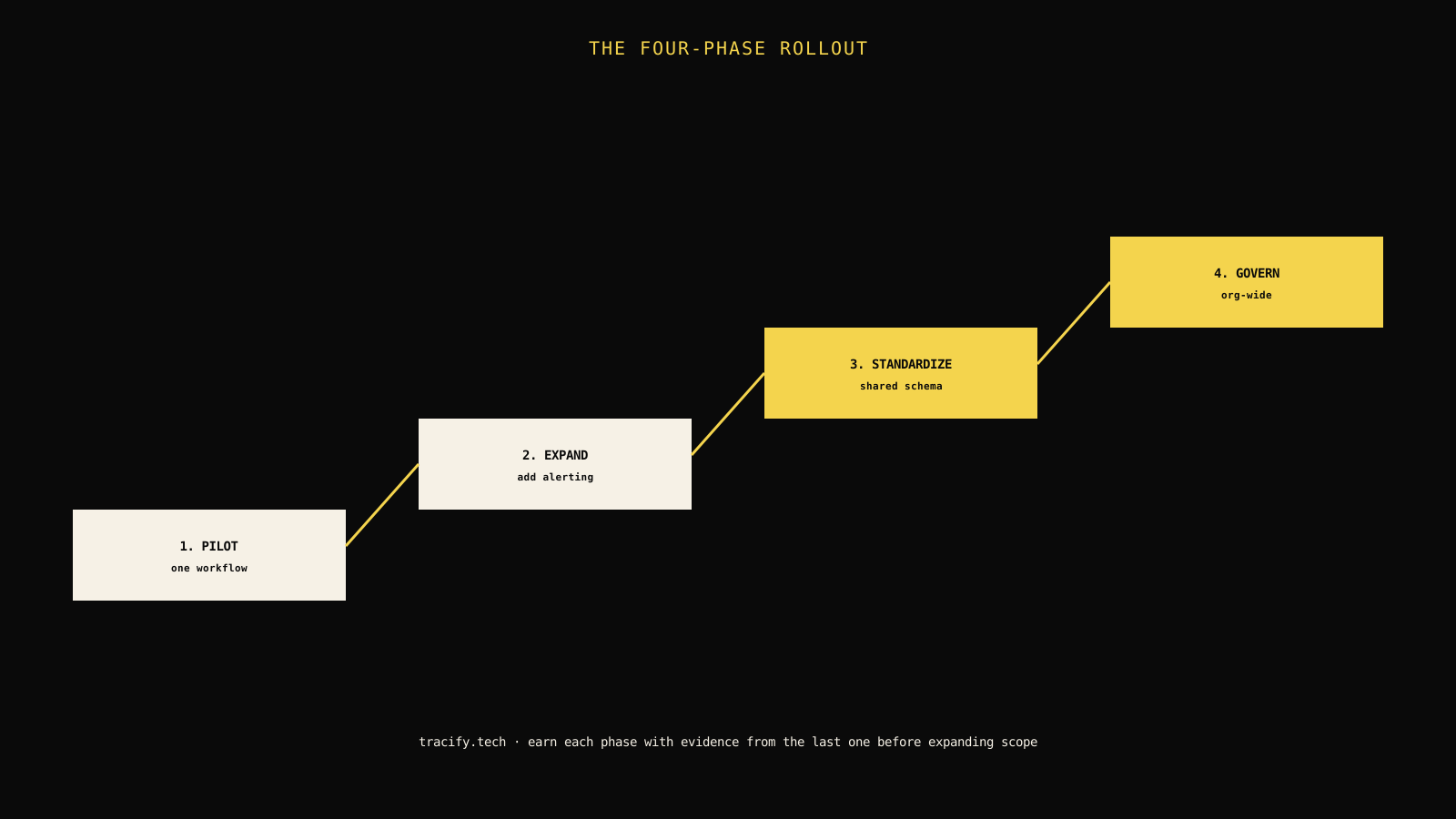
The operating model: four phases, each earning the next
| Phase | Goal | Exit criteria before expanding |
|---|---|---|
| Pilot | Prove the value on one real, moderately important workflow | The team using it can point to a real incident it caught or a real decision it informed |
| Expand | Add alerting and extend to two or three more workflows | Alert precision (share of alerts that led to a real finding) is above an agreed bar, not just alert volume |
| Standardize | Establish a shared trace schema and naming convention across teams | A new workflow can be onboarded using the existing schema without a custom one-off integration |
| Govern | Assign clear ownership, review cadence, and access controls org-wide | Every production workflow has a named observability owner, not just a subscribed channel |

Each phase exists to earn trust for the next one, and skipping straight to organization-wide rollout is the single most common cause of abandoned observability tooling — not because the tooling was wrong, but because nobody had the chance to learn what a real alert versus a noisy one looked like before the whole organization was asked to depend on it.
Choose the pilot workflow deliberately
Not every workflow makes a good pilot. The right pilot is real enough to generate genuine signal but contained enough that a mistake in the rollout itself does not cause a serious incident.
What makes a good pilot workflow
- Real production traffic, not a staging environment — synthetic traffic will not surface the actual failure modes a rollout needs to learn from.
- A team with capacity to iterate on alert thresholds and dashboard layout during the pilot period, since the first configuration will not be right.
- Moderate, not maximal, stakes — a workflow important enough that the team cares about the outcome, but not so critical that early false positives or missed alerts cause a serious incident while the process is still being tuned.
Field note: Avoid piloting on your most complex, highest-stakes workflow and your simplest, lowest-stakes workflow alike. The first makes it hard to distinguish rollout problems from genuinely hard observability problems; the second will not generate enough real signal to teach the team anything transferable to the rest of the organization.
Expand deliberately, and expect a noise spike
The second phase is where most of the real tuning work happens, and it comes with a predictable, temporary cost: alert noise tends to rise before it falls, as generic default thresholds meet real production variance for the first time.

Tune thresholds against real incidents, not intuition
For every alert that fires during the expansion phase, record whether it led to a real, actioned finding or was a false positive, and use that log — not a general sense of "this feels noisy" — to adjust thresholds. A threshold tuned against a dozen real logged outcomes is far more defensible, and far more likely to be correctly calibrated, than one adjusted based on a single loud complaint in a team channel.
// Illustrative: a simple alert-outcome log to drive threshold tuning decisions.
type AlertOutcome = {
  alertId: string;
  metric: string;
  threshold: number;
  ledToRealFinding: boolean;
  notes: string;
};

export function precisionForMetric(outcomes: AlertOutcome[], metric: string): number {
  const relevant = outcomes.filter((o) => o.metric === metric);
  if (relevant.length === 0) return 0;
  return relevant.filter((o) => o.ledToRealFinding).length / relevant.length;
}
Decision rule: Do not expand alerting to a new workflow until the pilot workflow's alert precision has been measured against at least twenty fired alerts and sits above roughly 30-40%. Below that, the team is more likely to be trained to ignore the channel than to act on it, and expanding a bad pattern to more workflows compounds the problem rather than distributing it.
Standardize the schema before it becomes expensive not to
Every workflow instrumented with its own ad hoc field names, identifier formats, and metadata structure works fine in isolation and becomes a serious liability the moment someone needs to compare or aggregate across workflows.
| Standardization choice | Cost of deciding early | Cost of deciding late |
|---|---|---|
| Run identifier format | Small — one convention adopted from the start | Large — retrofitting every existing workflow's logs |
| Cost and latency field naming | Small — a shared schema document | Large — a mapping layer needed to reconcile inconsistent field names before any cross-workflow query |
| Severity and category taxonomy for alerts | Small — agreed once, applied consistently | Large — inconsistent severity meanings across teams undermine any org-wide alert triage process |
The cost of standardizing a schema rises with every workflow instrumented before the standard exists, which is why this phase belongs after the pilot (when you know what fields actually matter) but before the expansion phase reaches more than a handful of workflows.
Work through a realistic example
Consider a mid-size engineering organization with six teams, each running at least one AI-powered workflow, deciding how to roll out observability across all of them simultaneously.
| Observation | Weak interpretation | Better next move |
|---|---|---|
| All six teams are eager to start immediately | "Roll it out everywhere at once to capture the momentum" | Pick one team's real workflow as the pilot; use the enthusiasm to recruit the other five as fast followers once the pilot proves the pattern, not as simultaneous first movers |
| Leadership wants an org-wide dashboard within a month | "Build the dashboard first, backfill the schema later" | Sequence standardization before the org-wide dashboard; a dashboard built on six inconsistent schemas will need to be rebuilt once standardization happens anyway |
| Each team already has its own informal alerting habits | "Let each team keep their own approach to avoid disruption" | Use the standardization phase to reconcile approaches into one shared severity taxonomy; permanently inconsistent alerting undermines any future cross-team incident review |
Assign ownership before the rollout reaches scale
An observability rollout that reaches organization-wide coverage without clear ownership produces exactly the failure mode in this article's opening scenario: alerts fire, nobody is accountable for responding, and the channel gets muted within weeks.

A simple ownership split that scales
A pattern that works across most organizations: the platform team owns instrumentation quality and schema consistency, application teams own alert response and workflow-specific thresholds, and a risk or compliance function (where one exists) owns evaluation criteria for anything with regulatory or safety exposure. Ownership clarity matters more than which specific split you choose — an organization that picks a slightly different but clearly documented split will outperform one with a theoretically better split that nobody has actually written down.
Diagnose the first divergence
When a rollout stalls, the diagnostic path should check phase discipline before assuming a tooling problem.
Compare the meaningful trade-offs
A staged rollout takes longer to reach full coverage than an all-at-once approach, and that slower timeline is a real cost worth naming honestly to stakeholders who want immediate organization-wide visibility.
| Dimension | All-at-once rollout | Staged four-phase rollout |
|---|---|---|
| Time to full coverage | Faster on paper | Slower, but coverage that is actually trusted and used |
| Alert quality at scale | Generic thresholds everywhere, high noise | Tuned thresholds informed by real pilot and expansion data |
| Risk of tool abandonment | High — noise fatigue sets in before trust is built | Lower — trust is established incrementally |
| Stakeholder communication | Simple headline ("everything is covered") | Requires explaining the staged timeline honestly upfront |
Communicate the rollout timeline honestly
A staged rollout only survives contact with leadership pressure if the timeline and the reasoning behind it are communicated clearly and early, rather than discovered midway when a stakeholder asks why the whole organization isn't covered yet.
What to put in the rollout communication
- The phase the organization is currently in, stated plainly, along with what "done" looks like for that phase specifically.
- The exit criteria for the next phase, so a request to accelerate can be evaluated against a concrete bar rather than a vague sense of readiness.
- A rough timeline range, framed as dependent on real signal (alert precision, schema stability) rather than a fixed calendar date that creates pressure to skip steps to hit it.
A rollout communicated as "we are building trust in this system deliberately" survives budget and leadership scrutiny far better than one communicated as "we are almost done everywhere," because the second framing sets an expectation that any delay reads as failure, while the first framing makes the staged approach itself the plan being executed successfully.
Field note: Share the alert-precision number from the pilot phase with leadership directly, even if it looks unimpressive early on (a 25% precision rate sounds low in isolation). Framed as "this is what the pilot found before we tuned it, and here is the plan to raise it before we expand," a modest early number becomes evidence the process is working as intended rather than a red flag.
Revisit the rollout after the first real incident

The first genuine production incident that the observability rollout either catches cleanly or misses entirely is the most valuable piece of evidence the organization will get about whether the rollout is actually working, and it deserves a deliberate review rather than being absorbed into normal incident response and forgotten.
Treat the first real incident after rollout as a structured test of the observability system itself, not just of the AI system it monitors. Ask explicitly: did the alert fire with enough lead time to matter, did it carry evidence sufficient for the responder to act without reconstructing context manually, and did the named owner actually see it. A rollout that passes this first real-incident test earns organizational trust faster than months of quiet, uneventful operation, because it is the first piece of evidence anyone outside the rollout team has seen that the system does what it was built to do.
Protect the security boundary
A rollout that reaches multiple teams and workflows also multiplies the number of people with some form of access to observability data, which often includes prompts, tool arguments, and customer data. Fold access review into the governance phase explicitly: define who can see raw trace content versus aggregate metrics per team, and revisit those permissions as new teams onboard rather than defaulting new teams to the same access level as the original pilot team. A rollout that scales access alongside coverage without a deliberate review is quietly expanding a data exposure surface at the same rate it expands observability coverage.
Make the operating decision
Start by naming your pilot workflow this week, and write down the exit criteria for each of the four phases before starting, so "are we ready to expand" is a pre-agreed question rather than a debate that happens under pressure later. The AI observability dashboard guide and AI observability metrics that matter cover what to build once each phase's foundational sequencing is in place.
Leave the reader with the next move
- [ ] A single pilot workflow is named, with real production traffic and moderate — not maximal — stakes.
- [ ] Alert precision from the pilot has been measured against real fired alerts before any expansion.
- [ ] A shared schema for run identifiers, cost, latency, and alert severity exists before the third or fourth workflow is instrumented.
- [ ] Every alert-generating metric has exactly one named accountable owner.
- [ ] Access to raw trace content has been reviewed as part of the governance phase, not left at pilot-team defaults.
Write down which of the four phases your current rollout is actually in, honestly, even if the organization has been describing it as "done." That honest placement is the single most useful diagnostic for deciding what to fix next, and it is worth revisiting the placement every few months as more workflows and teams are added.
Keep the rollout plan itself as a living document
Treat the four-phase plan as something to revisit and adjust, not a document written once at kickoff and never opened again. As new workflow types emerge — a first agentic system after a rollout built mostly around single-call generation, for instance — the pilot-and-expand pattern should run again for that new category rather than assuming existing coverage automatically extends to it. A rollout plan that is actively maintained tends to catch these category shifts early; one treated as a completed deliverable tends to discover them only after a gap has already caused a real incident, at which point the cost of catching up is considerably higher than the cost of having revisited the plan on a regular schedule all along.
Frequently asked questions
How long should the pilot phase of an AI observability rollout last?
Long enough to accumulate real signal, typically four to eight weeks of real production traffic and at least a dozen fired alerts to evaluate for precision. Rushing the pilot to a shorter window usually means expanding before thresholds have been meaningfully tested against real variance.
Should every team choose its own alert thresholds, or should they be centrally set?
A hybrid works best: a shared schema and severity taxonomy set centrally during the standardize phase, with specific threshold values tuned per workflow by the team that owns alert response, since workflow-specific traffic patterns and risk tolerance genuinely differ.
What is the most common reason an AI observability rollout gets abandoned?
Alert fatigue from generic, untuned thresholds combined with unclear ownership of who responds to what fires. The tooling itself is rarely the root cause; the organizational sequencing around it is.
Do small teams need the full four-phase rollout process?
A small team with one or two workflows can compress the phases significantly, but should not skip the underlying discipline: prove value on one workflow, tune alerts against real outcomes, and name an owner before assuming coverage is complete. The formality can scale down; the sequence itself should not be skipped entirely.
How do we know when it's safe to move from the expand phase to the standardize phase?
When alert precision for the pilot and early-expansion workflows is consistently above your agreed bar, and you can name the fields and identifiers that turned out to matter most in practice. Standardizing too early, before real usage reveals what actually needs to be shared, tends to produce a schema that has to be revised anyway.
Practical field notes from the team building Tracify and operating AI agents in production.
Related posts


Next in the loop
AI Observability Dashboard: What to Track and How to Design It
Keep reading →