Generative AI Observability: Monitoring Output Quality at Scale
Generative AI observability covers every system that produces novel text, code, or media, not just autonomous agents. Here is how to monitor content quality, detect hallucinations by type, and keep review coverage meaningful as generation volume grows.
In this guide13 sections
At a glance
Generative AI observability is the practice of continuously monitoring the outputs of any system that produces novel text, code, images, or other content — not only autonomous agents — for factual grounding, policy compliance, and drift from an established quality baseline, at the volume the system actually operates at. This article covers the broader generative-AI case: content generation, summarization, drafting, and creative systems where the central risk is a plausible-sounding but wrong or unsafe output reaching a user at scale, rather than an agent's multi-step decision-making.
| Reader | Job | Boundary |
|---|---|---|
| Engineer, content operations lead, or product owner running a generation system in production | Detect hallucinations and quality drift before they reach users, at real production volume | Focused on output-quality monitoring for generation broadly; see agentic AI observability for the multi-step, tool-calling case specifically |
If your system involves an agent choosing tools and taking multi-step actions, agentic AI observability covers that reasoning-and-action trace specifically. This article is about a broader and, in raw output volume, often larger category: any system generating content that a person or downstream process will read and trust.
Why generation quality needs its own observability model
A generative system's core risk is different from a classification or retrieval system's. A classifier is either right or wrong against a known label, and you can measure accuracy directly. A generative system produces novel output every time, so there is no single ground truth to check against — you are evaluating a property of the output (is it grounded, safe, on-brand, non-repetitive) rather than checking it against a fixed answer key.
The operating model: three properties to monitor continuously
| Property | What it measures | Failure mode if unmonitored |
|---|---|---|
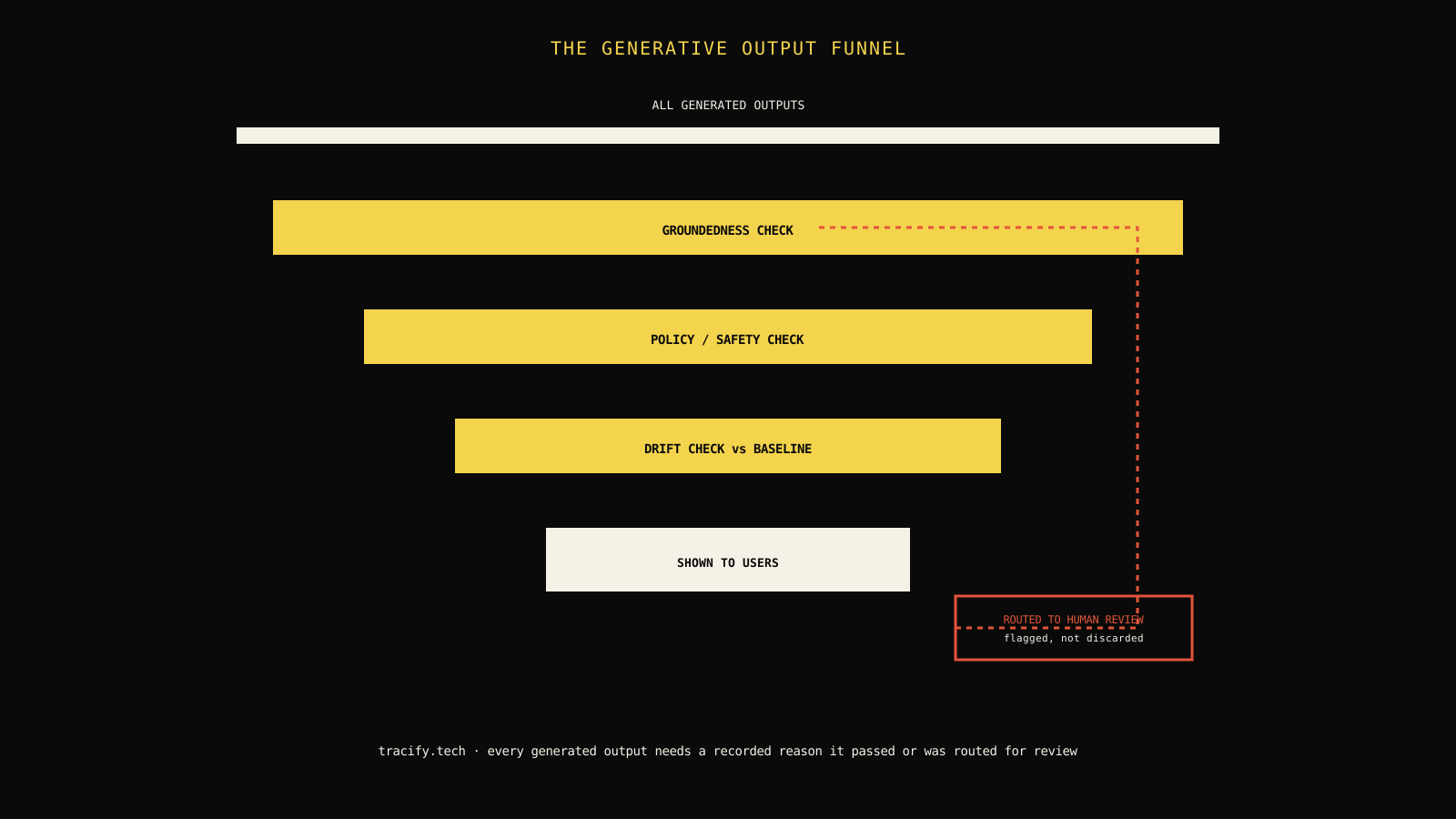
| Groundedness | Whether claims in the output are supported by retrieved or provided source material | Fabricated facts stated with full confidence |
| Policy and safety compliance | Whether the output avoids disallowed content, tone violations, or unsafe instructions | Brand-damaging or unsafe content reaching users at scale |
| Drift from baseline | Whether output quality or style is degrading over time relative to an established reference | Slow, cumulative quality decay that no single output flags as clearly wrong |
The defining challenge of generative AI observability is that any single output can look completely reasonable while a meaningful percentage of the full volume is quietly wrong. Spot-checking a handful of outputs by hand catches the ones a reviewer happens to look at; it does not tell you the actual rate across the full volume, which is the number that determines real-world impact.
Detect hallucinations by type, not as one bucket
"Hallucination rate" as a single number hides more than it reveals, because different hallucination types have different causes, different detection methods, and different appropriate responses.

The three categories worth tracking separately
- Factual fabrication — the model states a fact with no basis anywhere in its training or provided context. Best caught by checking claims against a trusted knowledge base or structured data source.
- Unsupported extrapolation — the model makes a plausible-sounding leap beyond what its source material actually supports. Best caught by groundedness scoring that measures how tightly the output's claims map to the retrieved or provided context.
- Source contradiction — the model's output directly conflicts with a document it was given. Best caught with a natural-language-inference style entailment check between the source and the output.
Treating all three as one "hallucination rate" number means you cannot tell whether a spike came from a retrieval problem, a prompting problem, or a model regression, and each of those has a different fix. A rising source-contradiction rate points at retrieval or context-window truncation; a rising unsupported-extrapolation rate points at prompting or temperature; a rising fabrication rate on topics with no source material at all points at a task the system should not be attempting ungrounded in the first place.
Field note: If your generation pipeline retrieves source documents before writing, log which specific document passages were provided for each output alongside the output itself. Without that pairing, you cannot distinguish "the model contradicted its source" from "the model was never given the right source to begin with" — two very different problems with the same symptom.
Build a groundedness pipeline, not a spot check
Manual review does not scale with generation volume, and it introduces reviewer bias toward whatever catches a human eye rather than what is statistically most common. A groundedness pipeline runs automatically on every output, or a representative sample, and produces a score alongside the content itself.
// Illustrative: a groundedness scoring pass run on every generated output.
type GenerationRecord = {
  outputId: string;
  content: string;
  sourceDocs: string[];
  claims: string[]; // extracted factual claims from the output
};

type GroundednessResult = {
  outputId: string;
  score: number; // 0-1, share of claims supported by sourceDocs
  unsupportedClaims: string[];
};

export function scoreGroundedness(record: GenerationRecord, entails: (claim: string, docs: string[]) => boolean): GroundednessResult {
  const unsupportedClaims = record.claims.filter((claim) => !entails(claim, record.sourceDocs));
  const score = record.claims.length === 0 ? 1 : 1 - unsupportedClaims.length / record.claims.length;
  return { outputId: record.outputId, score, unsupportedClaims };
}
Decision rule: Route any output scoring below your groundedness threshold to human review before it reaches a user, rather than blocking it outright or letting it through silently. Outright blocking loses legitimate edge cases where the claim is correct but phrased in a way the entailment check misses; silent pass-through is the failure this pipeline exists to prevent.
Sample deliberately as volume grows
Full human review of every output is realistic at low volume and impossible at scale. The mistake teams make is letting review coverage shrink as a percentage without deliberately deciding what percentage is still statistically meaningful.

Stratify the sample, don't take it randomly
A pure random sample under-represents rare but high-consequence content categories. Stratify the sample across content type, topic sensitivity, and any category where a past incident occurred, and weight the sample toward higher-risk categories rather than sampling every category at the same rate. A generation system producing both routine product descriptions and health-adjacent claims should review the health-adjacent category at a much higher rate even if it is a small share of total volume, because the cost of a wrong output there is disproportionately higher.
| Content category | Share of volume | Review rate | Why |
|---|---|---|---|
| Routine product descriptions | 85% | 2% sampled | Low individual consequence, high volume — statistical sampling is sufficient |
| Health or safety-adjacent claims | 3% | 25% sampled | High individual consequence justifies disproportionate review rate |
| Content flagged by automated groundedness check | 12% | 100% reviewed | Already identified as elevated risk; review every instance |
Work through a realistic example
Consider a marketing team using a generative system to draft weekly newsletter copy summarizing recent product updates from a changelog feed.
| Observation | Weak interpretation | Better next move |
|---|---|---|
| The newsletter reads smoothly and matches brand voice | "Content quality is fine" | Check groundedness score against the actual changelog entries; smooth prose says nothing about factual accuracy |
| Groundedness score has held steady at 0.96 for months | "No action needed" | Check whether the unsupported-claims category has shifted even while the aggregate score is stable — a stable average can hide a rising specific failure type |
| One customer complaint about a fabricated feature claim arrived this week | "Isolated incident" | Pull the sampled review data for the same content category over the past month; one reported complaint is a lower bound on the true rate, not the full picture |
Diagnose the first divergence
When a quality regression is reported, the diagnostic path should start from the same place agentic tracing does: find the earliest point where measured output quality departed from baseline, not just the point where a human happened to notice.
Compare the meaningful trade-offs
Automated groundedness and policy checks are not free: they add latency to the generation pipeline if run synchronously, and false positives route legitimate content to unnecessary human review, adding operational cost.
| Dimension | No automated checks | Automated groundedness + policy pipeline |
|---|---|---|
| Latency | Fastest, no added pipeline step | Adds latency unless run asynchronously post-generation |
| Coverage | Effectively zero beyond spot checks | Every output or a statistically meaningful sample, consistently |
| False positive cost | None, but no protection either | Real but manageable operational cost of unnecessary reviews |
| Ability to detect scale-level rate | None | Direct — this is the entire point of the pipeline |
Decision rule: Run groundedness and policy checks asynchronously after generation for low-stakes content where a brief review delay is acceptable, and synchronously before the output ever reaches a user for anything with real-world consequence — health, legal, financial, or safety-adjacent content chief among them.
Protect the security boundary
Generative systems that draw on retrieved documents or user-provided context can leak that source material into outputs shown to the wrong audience, and prompt injection embedded in a retrieved document can steer generation toward disallowed content. Log which source documents fed each output so a leak can be traced to its origin, apply the same access controls to generation logs that you apply to the underlying source data, and treat any output that closely reproduces verbatim text from a source document outside its intended context as a signal worth investigating, not just a style note. A generative system with access to internal or customer data is a data-handling system first and a content system second, and observability needs to reflect that ordering rather than treating data exposure as a secondary concern behind content quality.
Watch for template and format regressions, not just content regressions
Quality monitoring tends to focus entirely on factual and policy correctness and overlook a quieter failure: the output's structure silently drifting from what downstream systems or readers expect. A newsletter generator that starts occasionally dropping its required disclaimer footer, or a code-generation system that starts omitting error handling in a way that still compiles, is a real regression that a purely content-focused groundedness check will not catch. Track structural conformance — required sections present, expected format followed, length within bounds — as its own monitored dimension, separate from factual groundedness, because the two fail independently and a fix for one says nothing about the other.
Read the lower half visually: drift is the quiet failure

A generative system's quality can decay gradually — a model update, a prompt template change, or a shift in the underlying data distribution — without any single output crossing an obvious quality threshold. Drift monitoring compares current output quality against a fixed historical baseline, not against last week, because comparing only to the recent past lets a slow decline hide inside a series of small, individually unremarkable week-over-week changes.
| Drift signal | What it catches | What a week-over-week-only comparison misses |
|---|---|---|
| Groundedness score vs. fixed baseline | Cumulative decline invisible in short comparisons | The gradual slope that never triggers a single alert |
| Output length or structure distribution shift | Unintended template or prompt changes | Sudden but small shifts that look like normal variance |
| Category-specific error rate vs. baseline | A single content category degrading while the aggregate looks stable | Aggregate metrics that average away a localized regression |
A generative system that never gets re-evaluated against its original baseline will eventually drift somewhere nobody chose deliberately, one small unnoticed change at a time, and the only way to catch that pattern is a fixed reference point that does not move with each incremental update.
What changes the recommendation
For a low-volume, low-consequence generation task — internal draft summaries reviewed by their author before use, for example — full automated groundedness scoring is more infrastructure than the risk justifies. The moment output reaches an external audience unreviewed, or volume exceeds what any team could plausibly spot-check by hand, automated monitoring stops being optional.
Make the operating decision
Start with groundedness scoring on your highest-volume or highest-consequence generation task, stratify review sampling by content risk rather than by convenience, and establish a fixed quality baseline before your next model or prompt change so drift has something real to be measured against. LLM hallucination detection goes deeper on the detection techniques referenced above, and AI evaluation metrics covers how to define the quality thresholds this pipeline routes against.
Leave the reader with the next move
- [ ] Hallucinations are tracked by type — fabrication, extrapolation, contradiction — not as one aggregate rate.
- [ ] Review sampling is stratified by content risk, not taken as a flat random percentage.
- [ ] A fixed quality baseline exists to measure drift against, separate from week-over-week comparisons.
- [ ] Source documents provided to the generation pipeline are logged alongside each output.
- [ ] The target error rate the sampling strategy is designed to detect has been stated explicitly, not left implicit.
Pick your highest-volume generation task this week and check whether you can currently answer "what percentage of last month's outputs were ungrounded" with a real number instead of an impression from spot checks. If you cannot, that gap — not a new dashboard — is the next thing worth building.
A note on tooling maturity
Generative AI observability tooling is younger than traditional application monitoring, and teams sometimes assume a mature off-the-shelf solution exists for every piece described above. In practice, groundedness scoring, hallucination-type classification, and stratified sampling infrastructure are frequently assembled from a mix of vendor tooling and custom evaluation logic specific to the content domain. Budget engineering time for that assembly work rather than assuming a single dashboard purchase closes the gap, and revisit the buy-versus-build question periodically as the tooling landscape matures — what required custom work this year may be a standard feature next year. Treat the pipeline described in this article as a starting architecture to adapt to your own content domain, evaluation resources, and risk tolerance, not a fixed specification to implement exactly as written.
Frequently asked questions
Is generative AI observability the same as agent observability?
They overlap but are not the same. Generative AI observability covers any system producing novel content — text, code, images — and focuses on output quality, hallucination detection, and drift. Agent observability additionally covers multi-step reasoning, tool calls, and autonomous decision-making. A generation system embedded inside an agent needs both.
How do I measure hallucination rate without a large team of human reviewers?
Use automated groundedness scoring — comparing extracted claims in the output against retrieved or provided source material — as the primary signal at scale, and route only the lowest-scoring outputs or a statistically stratified sample to human review. This keeps human effort focused where it is most likely to catch a real problem.
What is the difference between a policy check and a groundedness check?
A groundedness check verifies factual claims are supported by source material. A policy check verifies the output avoids disallowed content, tone violations, or unsafe instructions regardless of whether the content is factually accurate. Both are needed; a policy-compliant output can still be ungrounded, and a well-grounded output can still violate policy.
How often should the quality baseline used for drift detection be updated?
Update it deliberately after an intentional model, prompt, or pipeline change that you have separately validated as an improvement — not automatically on a rolling schedule. A rolling baseline that always compares to 'recent normal' will absorb gradual drift instead of catching it.
What is the biggest mistake teams make when scaling generative AI observability?
Letting review coverage shrink as a percentage of volume without deciding what absolute review count is still statistically meaningful for the error rate they actually care about catching. A fixed percentage that looked reasonable at low volume often becomes far too little review at production scale.
Practical field notes from the team building Tracify and operating AI agents in production.
Related posts


Next in the loop
Agentic AI Observability: Tracing Reasoning, Tools, and Autonomy Failures
Keep reading →