Agentic AI Observability: Tracing Reasoning, Tools, and Autonomy Failures
Agentic AI observability means tracing the reasoning chain and tool-call graph a multi-step agent produces, not just its final answer. Here is what to capture, the autonomy failure modes generic monitoring misses, and how to build the operating model that catches them.
In this guide13 sections
At a glance
Agentic AI observability is the practice of capturing and reconstructing the full reasoning-and-action trace a multi-step, tool-calling, autonomous agent produces — its plan, its intermediate reasoning, every tool call and its result, every delegation to a sub-agent, and every point where the agent revised its own plan — not just the prompt it received and the answer it returned. This article focuses specifically on the "agentic" framing: what changes once a system can choose its own next action, call tools, and operate across multiple steps without a human in the loop at each one.
| Reader | Job | Boundary |
|---|---|---|
| Engineer or team lead operating a multi-step, tool-calling, or autonomous agent in production | Instrument, trace, and diagnose agent behavior that a single-call LLM monitoring setup cannot see | Assumes basic AI observability concepts; see the complete agent observability guide for the broader operational playbook this article's tracing model plugs into |
If you have not yet set up any tracing for an agent, start with AI agent observability: the complete guide for the operational fundamentals — alerting, on-call, incident response. This article goes deeper on one specific piece: what "agentic" changes about what you need to capture and why single-call monitoring silently misses the failures that matter most.
Why "agentic" changes the observability problem
A single-call LLM system has one meaningful trace: prompt in, completion out. You can monitor it with the same instincts you'd apply to any API — latency, error rate, output quality on that one call. An agentic system breaks that model in three specific ways.
The operating model: three properties that break single-call monitoring
| Property | What it means for observability | Why single-call monitoring misses it |
|---|---|---|
| Multi-step reasoning | The agent's output at step N depends on decisions made at steps 1 through N-1 | A final-answer log shows the output, not the reasoning chain that produced it |
| Tool calling | The agent invokes external functions, APIs, or sub-agents and acts on their results | A tool call can fail, return an unexpected shape, or succeed with a result the agent misinterprets — none of which shows up in a completion-only log |
| Autonomy | The agent chooses its own next action rather than following a fixed pipeline | The failure is often in the choice, not in any single step's execution — you need the decision trace, not just the outcome |
The core shift is that an agentic system's failure surface is the path it took, not just the destination it reached. Two runs can produce the identical final answer while one of them silently retried a failing tool four times, burned ten times the cost, and got lucky on attempt five. Observability that only checks the final answer against a quality bar will call both runs identical successes.
Trace the reasoning chain, not just the endpoints
The first requirement of agentic observability is capturing each reasoning step as a discrete, inspectable unit — not compressing the agent's internal deliberation into a single opaque completion.
What a reasoning-step trace actually needs
A useful reasoning trace records, for every step: the input state the agent had at that point, the plan or intention it formed, the action it chose (respond, call a tool, delegate, ask for clarification), and a timestamp. This is different from logging the raw chain-of-thought text, which is verbose, sometimes unreliable as a description of the model's actual process, and not the same thing as a structured decision record.
{
  "run_id": "run_7c2f1",
  "step": 3,
  "step_type": "reasoning",
  "input_state": { "user_goal": "refund order #4471", "policy_checked": false },
  "decision": "call_tool",
  "chosen_action": "search_orders",
  "rationale_summary": "need order status before evaluating refund eligibility",
  "latency_ms": 180
}
Field note: Do not try to capture every token of internal reasoning verbatim. Capture the structured decision — what state the agent had, what it chose to do next, and why in one sentence. That is enough to reconstruct the path during an incident without drowning the trace in unstructured text nobody reads under time pressure.
Separate the plan from the execution
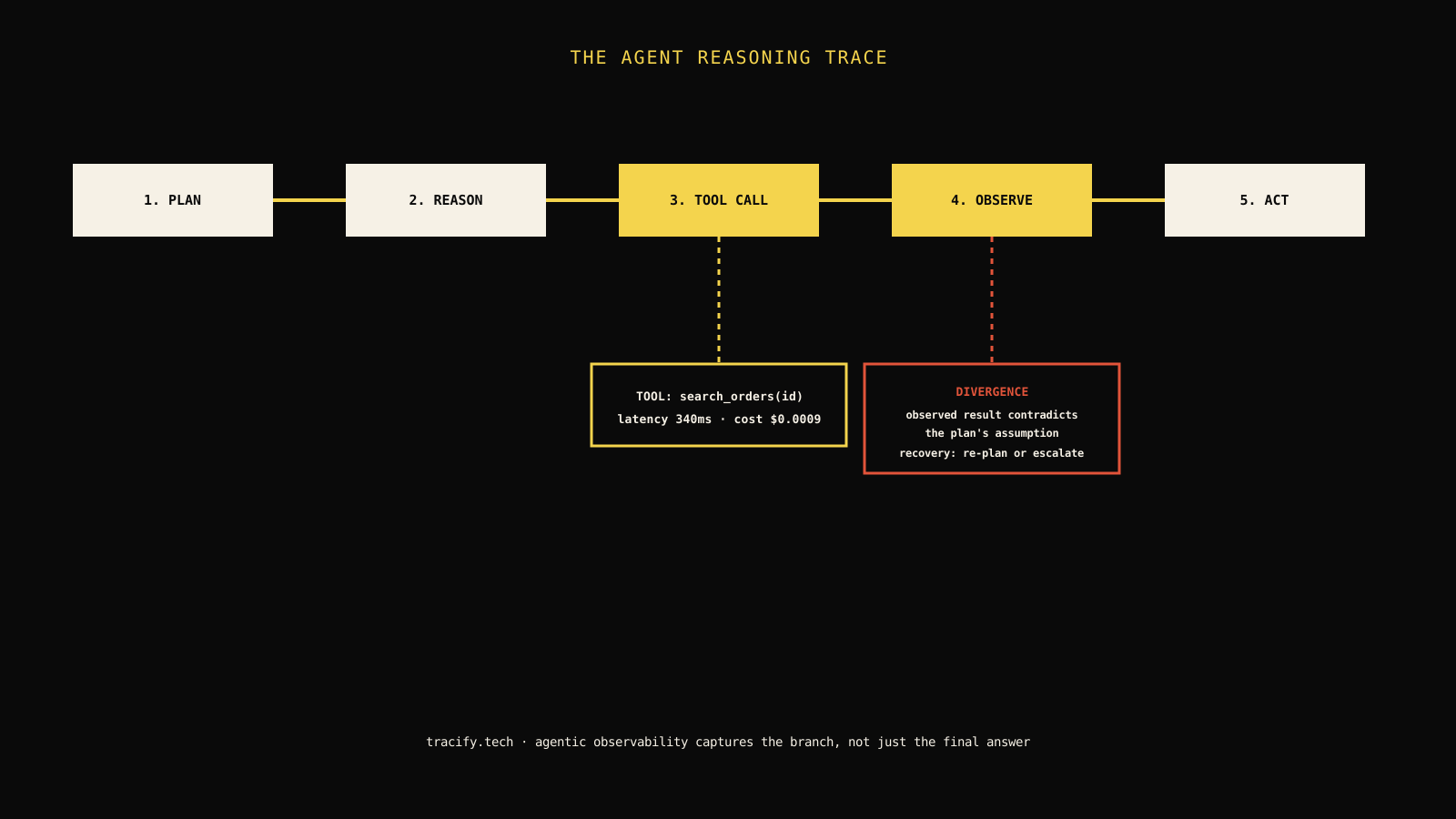
An agent typically forms an initial plan and then executes it, sometimes revising the plan mid-run when a tool result contradicts an assumption. The single most useful signal in agentic observability is the moment a run's execution diverges from its original plan — that divergence point is where autonomy either recovers gracefully or compounds into a bigger failure.
| Stage | What to record | Reader decision |
|---|---|---|
| Initial plan | The sequence of steps the agent intends to take | Baseline to compare execution against |
| Each executed step | Actual action taken, tool called, result received | Detect drift from the plan |
| Re-planning events | When and why the agent revised its plan | Distinguish healthy adaptation from thrashing |
Build the tool-call chain
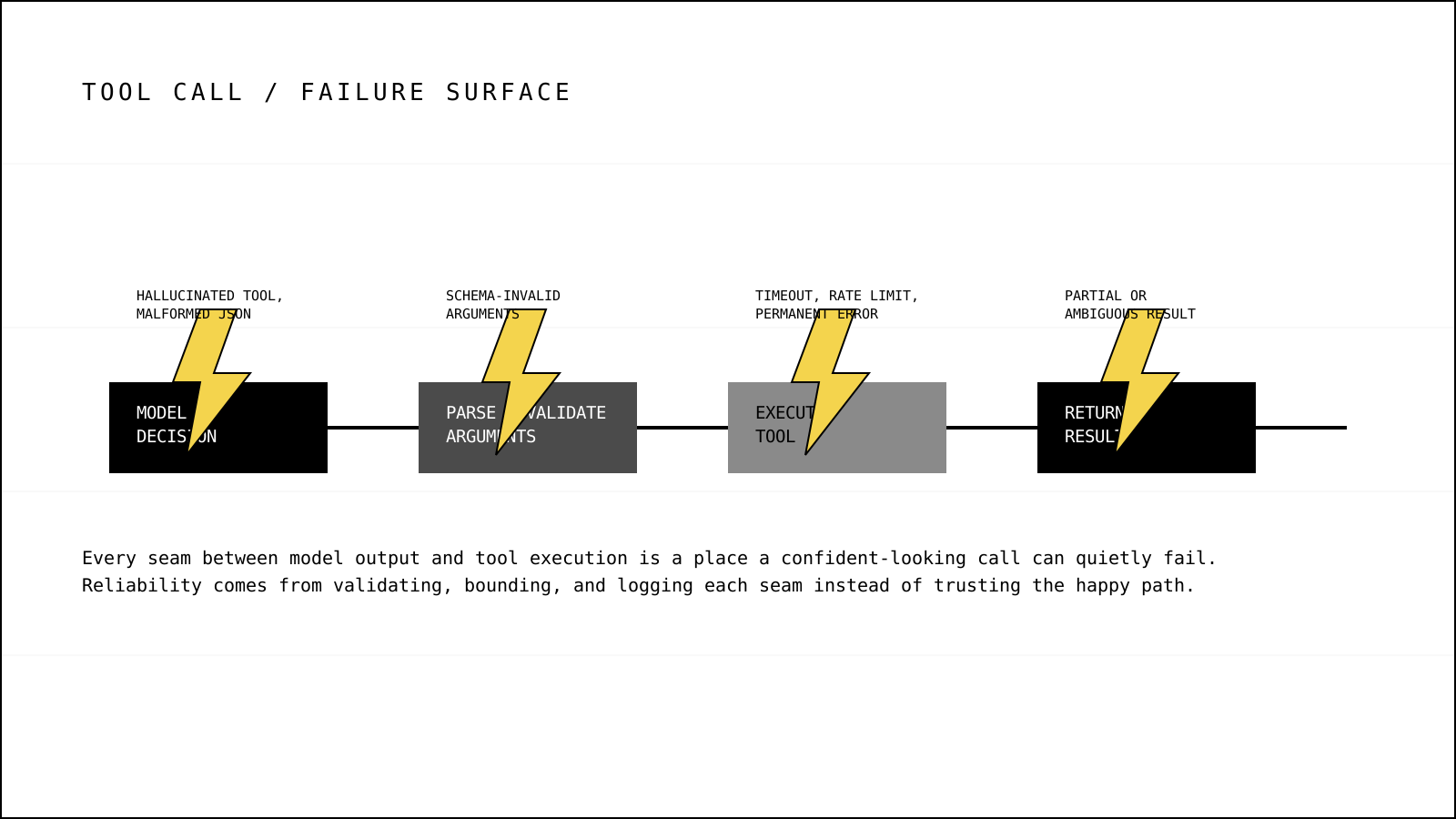
Tool calling is where agentic systems do real work and where most production incidents originate — a malformed argument, an unexpected response shape, a timeout, or a tool that succeeds but returns a result the agent misreads.

What a tool-call span must capture
Each tool call deserves the same rigor as an API call in traditional distributed tracing: the exact arguments sent, the raw result received, latency, retry count, and — critically — how the agent interpreted the result in its next reasoning step. That last piece is what distinguishes agentic tracing from generic API monitoring: you need the link between "the tool returned X" and "the agent concluded Y," because the failure is frequently in that interpretation step, not in the tool call itself.
// Illustrative: a tool-call span shape for agentic tracing.
type ToolCallSpan = {
  runId: string;
  stepIndex: number;
  toolName: string;
  arguments: Record<string, unknown>;
  result: { ok: boolean; payload?: unknown; error?: string };
  latencyMs: number;
  retryCount: number;
  agentInterpretation: string; // one-line summary of what the agent concluded from the result
};

export function flagMisinterpretation(span: ToolCallSpan): boolean {
  if (!span.result.ok) return false; // failure is already visible; not a misinterpretation case
  const emptyResult = span.result.payload == null;
  const proceededAsIfSuccessful = /proceed|confirmed|approved/i.test(span.agentInterpretation);
  return emptyResult && proceededAsIfSuccessful;
}
Decision rule: If a tool call returns successfully but with an empty or ambiguous payload, and the agent's next reasoning step proceeds as though it received a confirmed positive result, treat that as a defect regardless of what the final output looked like. This pattern — technically successful call, incorrectly optimistic interpretation — is one of the most common agentic failure modes and is invisible in a status-code-only view.
The delegation problem: sub-agents and nested chains
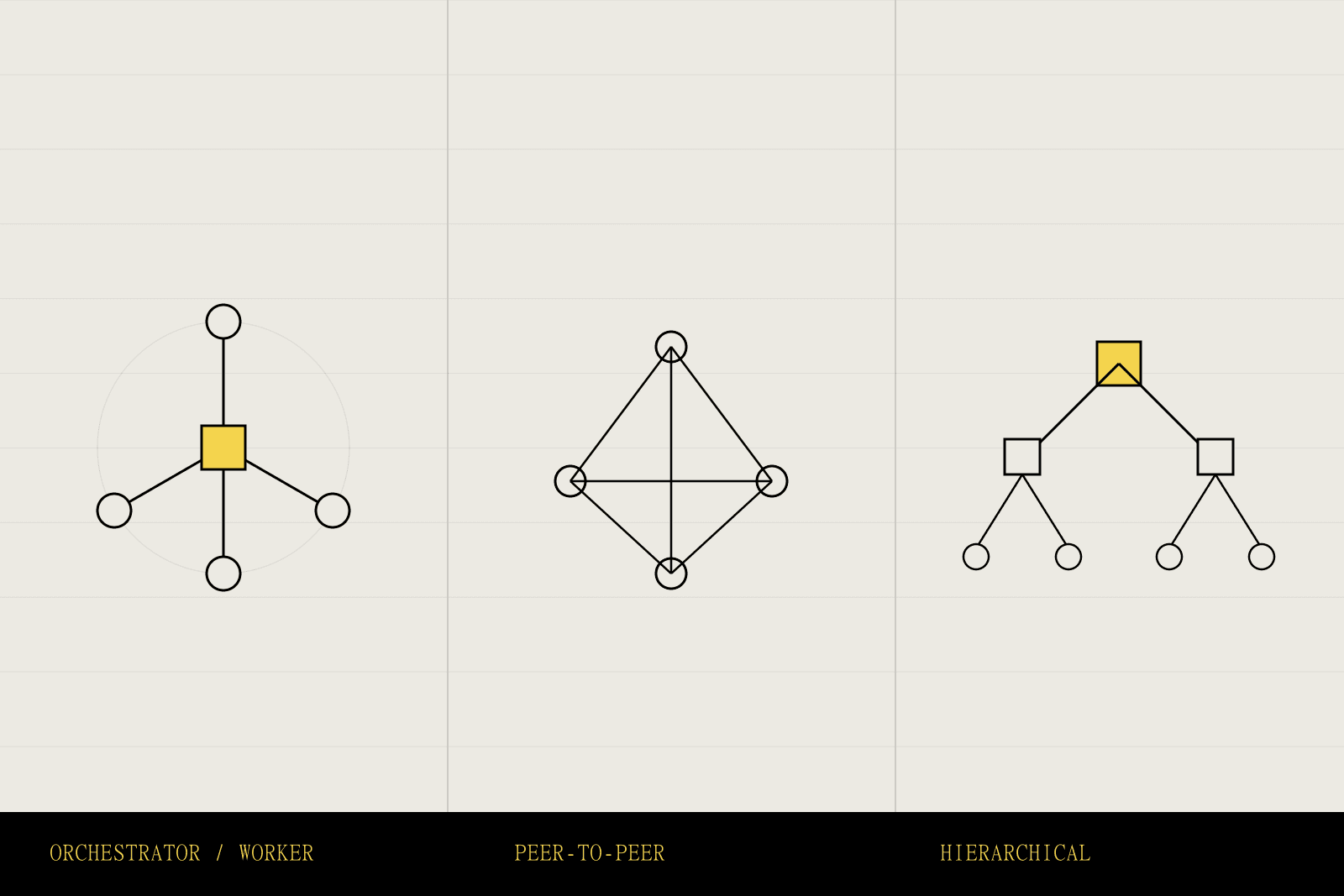
Many production agentic systems delegate: a root agent calls a specialized sub-agent, which may itself call tools or further sub-agents. Observability has to preserve one root identifier across the entire delegation tree and sum cost and latency correctly, or a single expensive nested failure gets invisibly absorbed into "the root agent's tool call took 640ms" with no visibility into what happened inside. A delegation tree without a preserved root identifier is functionally untraceable the moment something goes wrong two or more hops deep.
The autonomy failure modes generic monitoring misses
Four failure modes are specific to agentic systems and rarely show up in dashboards built for single-call LLM monitoring.

| Failure mode | What it looks like | Why it is hard to catch |
|---|---|---|
| Tool misuse | Agent calls the right tool with malformed or wrong arguments | Often produces a plausible-looking downstream answer anyway |
| Planning drift | Agent's executed path diverges from its stated plan without acknowledging it | Requires comparing plan to execution, which most logs don't preserve |
| Silent looping | Agent retries a failing action repeatedly without escalating or stopping | Final answer may still succeed on a late attempt, hiding the waste and risk |
| Cascading delegation failure | A failure deep in a sub-agent chain gets absorbed and reinterpreted incorrectly by a parent agent | Root-level trace shows a slow but "successful" call; the actual defect is several hops down |
Silent looping deserves special attention
A looping agent that eventually succeeds is easy to miss because the final output looks fine and the only visible symptom is elevated cost and latency — exactly the kind of anomaly that gets dismissed as "a slow day" rather than investigated. Track retry count and time-to-first-successful-action as first-class metrics per run, not just success/failure, because a run that succeeds on attempt six is a different reliability story than a run that succeeds on attempt one, even though both show up as "success" in an outcome-only dashboard. Teams that skip this instrumentation typically discover looping only after a cost spike forces a manual investigation, weeks after the pattern started.
Field note: A useful heuristic threshold: if more than 15% of successful runs for a given agent required three or more retries of the same action, treat that as a reliability regression worth investigating even though your success-rate metric looks unchanged. The success rate is hiding a cost and stability problem.
Work through a realistic example
Consider a research agent tasked with compiling a competitive analysis. It plans to search four sources, synthesize findings, and produce a report.
| Observation | Weak interpretation | Better next move |
|---|---|---|
| Final report reads well and cites four sources | "The agent executed its plan correctly" | Check the trace: did it actually call all four search tools, or did it fabricate a citation after one search tool timed out? |
| Total run latency is within the normal range | "Nothing unusual happened" | Check step-level timestamps for a long gap that indicates silent retries compressed into an average that looks normal |
| Cost for this run is slightly above median | "Acceptable variance" | Check tool-call count per run; a jump from 4 to 11 tool calls for the same task type is a planning-drift signal even if cost alone looks tolerable |
Diagnose the first divergence
When a reasoning trace exists, diagnosis becomes a search for the first point where executed reality departs from the stated plan — everything downstream of that point is a consequence, not a separate root cause.
Compare the meaningful trade-offs
Full reasoning-step tracing has real costs: storage volume grows with the number of steps rather than one record per call, and capturing rationale summaries adds a small amount of latency if done synchronously. Weigh these against the alternative, which is debugging a multi-step failure with only a final answer and a guess.
| Dimension | Final-answer-only monitoring | Full reasoning-and-tool trace |
|---|---|---|
| Storage cost | Low — one record per run | Higher — proportional to step count, manage with sampling for high-volume, low-risk agents |
| Debuggability | Poor for multi-step failures | High — the divergence point is directly visible |
| Latency overhead | None | Small if rationale capture is async; avoid blocking the agent's next action on trace writes |
| Coverage of autonomy failures | Misses looping, drift, misinterpretation | Directly designed to catch them |
Decision rule: Full reasoning tracing is worth the storage cost for any agent that can take an action with real-world consequence — a refund, a message sent, a database write, an escalation. For a purely internal, low-stakes summarization agent, sampled tracing (record full detail for a percentage of runs, plus every run that errors) is a reasonable middle ground.
Protect the security boundary
Agentic systems that call tools are executing actions, not just generating text, which raises the stakes on what observability needs to expose and to whom. A tool-call trace often contains API keys used for internal calls, customer data returned by a lookup tool, and the exact arguments an agent chose to send to a write-capable tool. Redact credentials before they are stored in trace payloads, restrict who can view raw tool arguments and results versus aggregate step counts, and make sure the trace itself never becomes an unauthenticated audit log of exactly how to replicate a sensitive action. An agent that can approve refunds or send messages needs its trace access controlled with the same rigor as the action itself — someone who can read the full trace of a refund-approval agent can often reconstruct enough to understand how to manipulate future runs.
Read the lower half visually
The recovery path matters as much as the failure itself. An agent that hits a divergence and recovers cleanly — re-planning, retrying with corrected arguments, or escalating to a human — is a different reliability story than one that proceeds on a false assumption, even when both runs eventually return an answer that looks acceptable to a downstream quality check.

The presence of a divergence is not itself a defect — the absence of a visible recovery decision is. An agent that hit an unexpected tool result and explicitly chose to re-plan, with that choice recorded in the trace, is behaving exactly as an autonomous system should. An agent that hit the same unexpected result and silently proceeded as though nothing changed is the pattern worth alerting on above almost any other signal in an agentic trace, because it is the one most likely to produce a confidently wrong action downstream.
What changes the recommendation
For a low-autonomy agent that only executes a fixed, short pipeline with no branching tool choice, full reasoning-step tracing is overkill — standard request/response tracing covers it, and the extra instrumentation is not worth the engineering time. The moment an agent gains the ability to choose between multiple tools, revise its own plan, or delegate to another agent, reasoning-step tracing stops being optional, because that is exactly the point where failures move from "the call failed" to "the agent made a bad choice that technically succeeded."
Make the operating decision
Start by instrumenting one production agent's tool-call chain end to end, including delegation hops if it has any, before expanding to full reasoning-step capture across every agent in your system. Multi-agent orchestration patterns covers the delegation architectures this tracing model needs to support, and tool-calling reliability goes deeper on the tool-call failure taxonomy referenced above.
Leave the reader with the next move
- [ ] Every tool call records arguments, result, retry count, and the agent's interpretation of the result.
- [ ] A single run identifier survives every hop of delegation to a sub-agent.
- [ ] Retry count and time-to-first-successful-action are tracked as first-class metrics, not just success rate.
- [ ] The trace can show, for any run, the first point where execution diverged from the initial plan.
- [ ] Trace access to sensitive tool arguments and results is restricted separately from aggregate step-count dashboards.
Pick your highest-stakes agent — the one that can take an action with real consequence — and confirm today whether its trace can answer "where did execution first diverge from the plan." If it cannot, that is the next instrumentation task, ahead of any dashboard work. A single well-instrumented agent that surfaces its divergence points clearly is worth more during an incident than a fleet of agents monitored only at the outcome level, and it gives your team a template to extend to the rest of the fleet once it proves useful.
Frequently asked questions
How is agentic AI observability different from regular LLM observability?
Regular LLM observability typically monitors a single prompt-completion call: latency, cost, and output quality for one request. Agentic AI observability additionally captures the multi-step reasoning chain, every tool call and its result, delegation to sub-agents, and the points where an agent's executed path diverges from its plan — because a multi-step autonomous system's failures often live in that path, not in any single call.
Do I need to log the full chain-of-thought text for every reasoning step?
No. Capturing the raw internal reasoning text verbatim is expensive, sometimes unreliable as a description of the model's actual process, and hard to use under incident pressure. A structured decision record — input state, chosen action, and a one-line rationale summary — is usually more useful than the full text.
What is the single highest-value thing to instrument first in an agentic system?
The tool-call chain: arguments sent, raw results received, and how the agent interpreted each result in its next step. Most production agentic incidents originate at a tool call or in how its result was interpreted, making this the highest-leverage starting point before full reasoning-step tracing.
How do I keep tracing overhead manageable for high-volume agents?
Use sampling: capture full reasoning-and-tool detail for a percentage of routine runs, plus every run that errors, retries more than a defined threshold, or takes an action with real-world consequence. Reserve full-detail tracing for every run only on agents where the action itself carries meaningful risk.
What is the clearest sign that an agent is silently looping instead of working correctly?
A rising retry count or time-to-first-successful-action per run while the overall success rate stays flat. Success rate alone hides looping because a run that eventually succeeds on a late attempt still counts as a success — track retries and time-to-success as separate metrics to catch it.
Practical field notes from the team building Tracify and operating AI agents in production.
Related posts
Next in the loop
AI Observability Platform: What to Require Before You Buy
Keep reading →