AI Agent Release Checklist: What to Verify Before Changing a Prompt, Model, or Tool
A change-type-specific checklist for releasing prompt, model, tool, retrieval, and orchestration changes to a live AI agent, with a rollback-trigger table and a worked model-upgrade scenario.
In this guide16 sections
A team upgrades its support agent to a newer model version, expecting the usual bump in answer quality. Two days later, finance asks why cost per run has tripled. Nothing crashed. No alert fired. The new model is simply calling the search tool on almost every turn instead of only when it needs to, and no one had a check in place that would have caught that before it reached every customer.
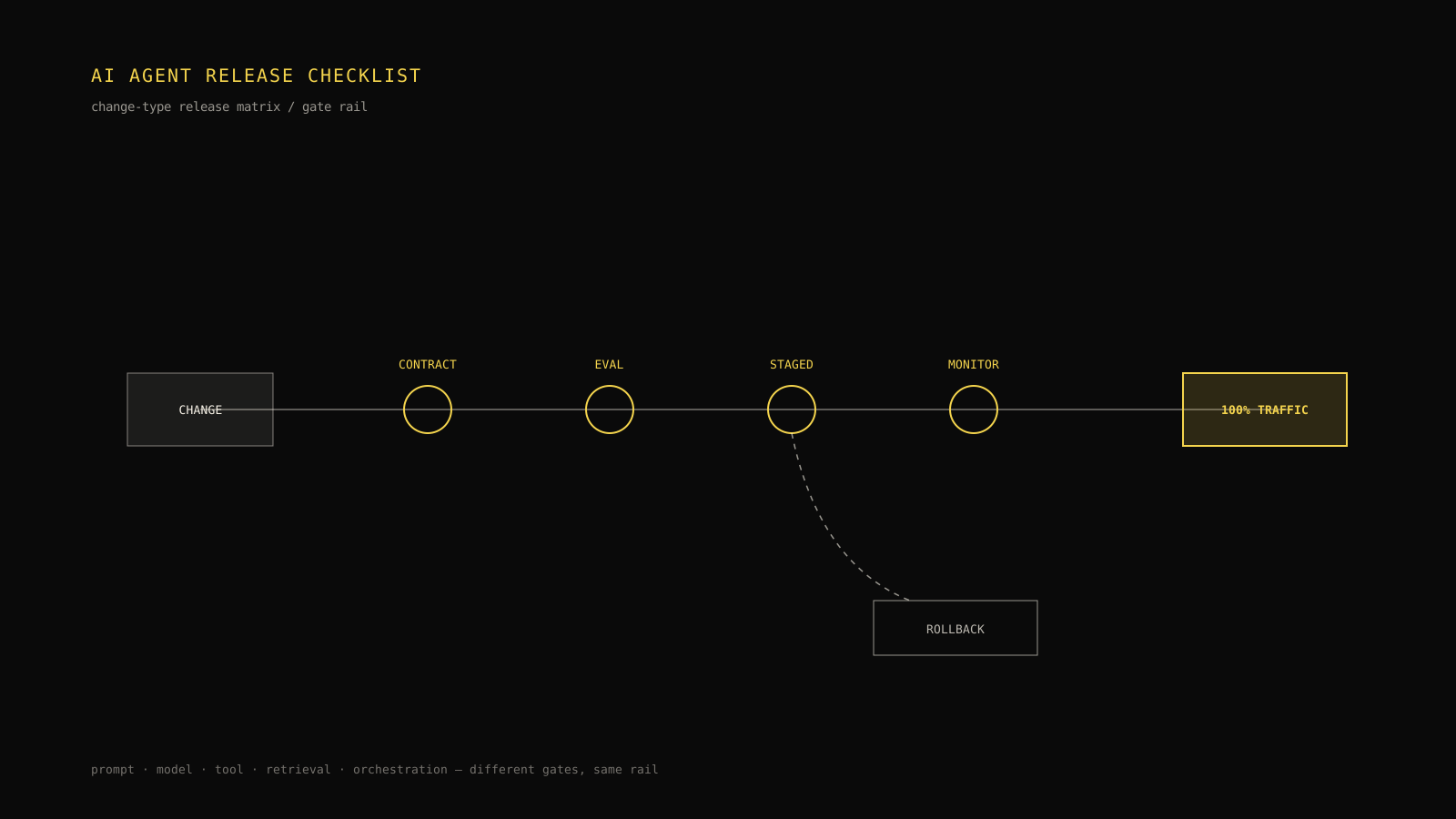
That is not a bug in the traditional sense — the model did what models do, just differently than the last version did. It is a release-process gap: the team had a deploy pipeline, but not a checklist that asked "what does this specific kind of change require before it ships?" Before releasing a prompt, model, or tool change to an AI agent, verify that the change passes a representative evaluation dataset, that output-format and contract checks still hold, that the change is exposed to a small slice of traffic first, that monitoring and a rollback trigger are active during that window, and that someone is named as the owner of the release. Which of those matter most, and how much, depends entirely on what kind of change is shipping — and that dependency is the part most deploy checklists skip.
What "release" means for an AI agent
For a typical web service, a release is a code deploy: a new binary, a new container image, a rollout across replicas. An AI agent has that kind of release too, but it also has a second, less visible category — changes that never touch a code repository at all. Editing a system prompt in a config file, swapping a model version string, adding a new tool the agent can call, updating a retrieval index, or reordering the steps in an orchestration graph are all releases in the sense that matters here: each one can change what the agent does on the next real request, for every user, immediately.
Treating only the code-deploy category as "a release" is the root cause of the opening scenario. A model-version string is often a one-line config change, reviewed as casually as a typo fix, but it can shift behavior more broadly than a large code change would. The first job of a release process for an agent is naming every category of change that deserves a checklist, not just the ones that trigger a CI pipeline.
This is deliberately scoped to iterative releases on an agent that is already live. If you are standing up a new agent for the first time, the AI agent production checklist covers first-launch readiness — boundaries, observability, and ownership before anything is turned on. This article assumes that groundwork exists and asks a narrower question: given a live agent, what does the next change need before it ships?
The five change types and why each needs different checks
Not every change carries the same risk, and not every change needs the same gate. A one-word prompt tweak and a full model-version upgrade are both "just a config change" in the sense that neither touches application code, but they are not remotely the same size of risk. Treating them identically means either over-gating trivial changes until nobody wants to ship anything, or under-gating large changes until a model swap reaches every user with no eval coverage at all.
Prompt changes
A prompt change edits wording, instructions, few-shot examples, or formatting guidance without touching the underlying model or tools. The risk is usually narrow and local: a rephrased instruction can change tone, structure, or edge-case handling, but it rarely changes what tools the agent reaches for or how it handles inputs the prompt never mentions. Targeted regression cases — the specific scenarios the prompt change was meant to affect — plus a small general sample are usually enough. Full re-evaluation on every prompt edit is expensive and, for most small wording changes, disproportionate to the risk.
Model changes
A model change swaps the provider, model family, or model version an agent calls. This is the highest-blast-radius, least-local change type in the list, because a different model can shift reasoning style, tool-selection tendencies, output formatting, refusal behavior, and cost profile all at once, in ways a prompt author never touched and did not anticipate. A model change deserves a full representative evaluation run, not a targeted subset — the whole point is that you don't know in advance which part of the behavior distribution moved.
Tool changes
A tool change adds a new tool, removes one, or changes a tool's argument schema, permissions, or error behavior. The risk here concentrates at the boundary between the model and the outside world: a schema mismatch can cause malformed calls, a permission change can cause unauthorized or blocked actions, and a new tool can get selected inappropriately if its description overlaps with an existing one. Contract checks on the tool's schema and error shape are non-negotiable; the eval suite matters most for cases where the model has to choose between the new tool and something similar.
A model change and a tool change fail in different places — a model change fails inside the reasoning, a tool change fails at the boundary — so they need different evidence.
Retrieval changes
A retrieval change updates the index, the embedding model, the chunking strategy, or the retrieval logic itself. This is often the quietest of the five change types, because it can degrade groundedness and citation accuracy without producing any errors, timeouts, or malformed output — the agent still runs cleanly, it just answers from worse context. Retrieval changes need groundedness-specific eval cases, not just task-success cases, because task success can look unaffected while the evidence behind each answer quietly gets weaker.
Orchestration changes
An orchestration change touches control flow: step order, routing logic between sub-agents, retry policy, or how one step's output becomes the next step's input. This is usually the widest blast radius of the five, because a change to one step can affect outcomes several steps downstream in ways that are hard to predict from reading the diff. Orchestration changes need scenario-level eval coverage — multi-step cases, not single-turn cases — and staged exposure that watches every affected step individually, not just the final outcome.
The Change-Type Release Matrix
Putting those five change types next to the checks they need produces a single reference table: the Change-Type Release Matrix. Read it as a floor, not a ceiling — a genuinely high-risk prompt change (one that touches a safety instruction, for instance) can reasonably borrow the "required" row from model changes, and a trivial, easily-reverted tool tweak can sometimes relax a "required" cell to "recommended." The matrix is a starting default, not a rule that overrides judgment about a specific change.
| Change type | Contract check | Eval suite | Staged exposure | Rollback trigger | Owner |
|---|---|---|---|---|---|
| Prompt | Recommended | Required (targeted) | Recommended | Required | Required |
| Model | Required | Required (full) | Required | Required | Required |
| Tool | Required | Recommended | Required | Required | Required |
| Retrieval | Recommended | Required (groundedness) | Recommended | Required | Required |
| Orchestration | Required | Required (scenario-level) | Required | Required | Required |

Two columns are required for every change type without exception: a rollback trigger and a named owner. That is deliberate. Even the smallest, most reversible change should have a defined condition that reverts it and a person watching for that condition — the cost of writing those two things down is small, and the cost of skipping them is exactly the opening scenario: a change reaches full traffic with no one specifically watching and no line that says when to pull it back.
Pre-release: contract and format checks
A contract check verifies that the agent's output still conforms to whatever downstream systems expect: required fields present, tool-call syntax valid, terminal states recognized, no unexpected free text where a structured field was expected. This check exists separately from the eval suite because it answers a narrower, more mechanical question — not "is this a good answer," but "is this a parseable one." A change can produce excellent answers that a downstream parser cannot read, and a contract check is the fastest, cheapest way to catch that before it becomes a production incident that looks like an unrelated system failure.
Run the contract check first, before the eval suite, because a change that fails it invalidates most of what the eval suite would otherwise measure — an eval score computed on malformed output is not meaningful. For tool changes specifically, extend the contract check to the tool's argument schema and error response shape, not just the agent's final output; a tool that starts returning errors in a new shape can silently break every workflow that consumes it.
Pre-release: representative evaluation
An eval suite is representative when it reflects what the change can plausibly affect, at a sample size large enough to distinguish a real shift from noise. For a prompt change, that means the specific scenarios the wording was meant to improve, plus enough of a general sample to catch an unintended regression elsewhere. For a model change, it means the full dataset, because a model swap is the one change type where you genuinely do not know which slice of behavior moved.
This checklist assumes the dataset already exists and is versioned; building one from real production signal is a separate discipline, covered in depth in AI agent regression testing, which walks through turning a specific production failure into a repeatable test case. The release checklist's job is narrower: deciding how much of that dataset a given change type needs to clear before shipping, not how the dataset gets built in the first place.
Decision rule: If a change could plausibly affect tool selection, output format, or cost per run — and you cannot rule that out by reading the diff alone — run the full eval suite rather than a targeted subset. The cost of an unnecessary full run is minutes; the cost of a missed regression is the opening scenario.
Staged exposure: how much traffic, for how long
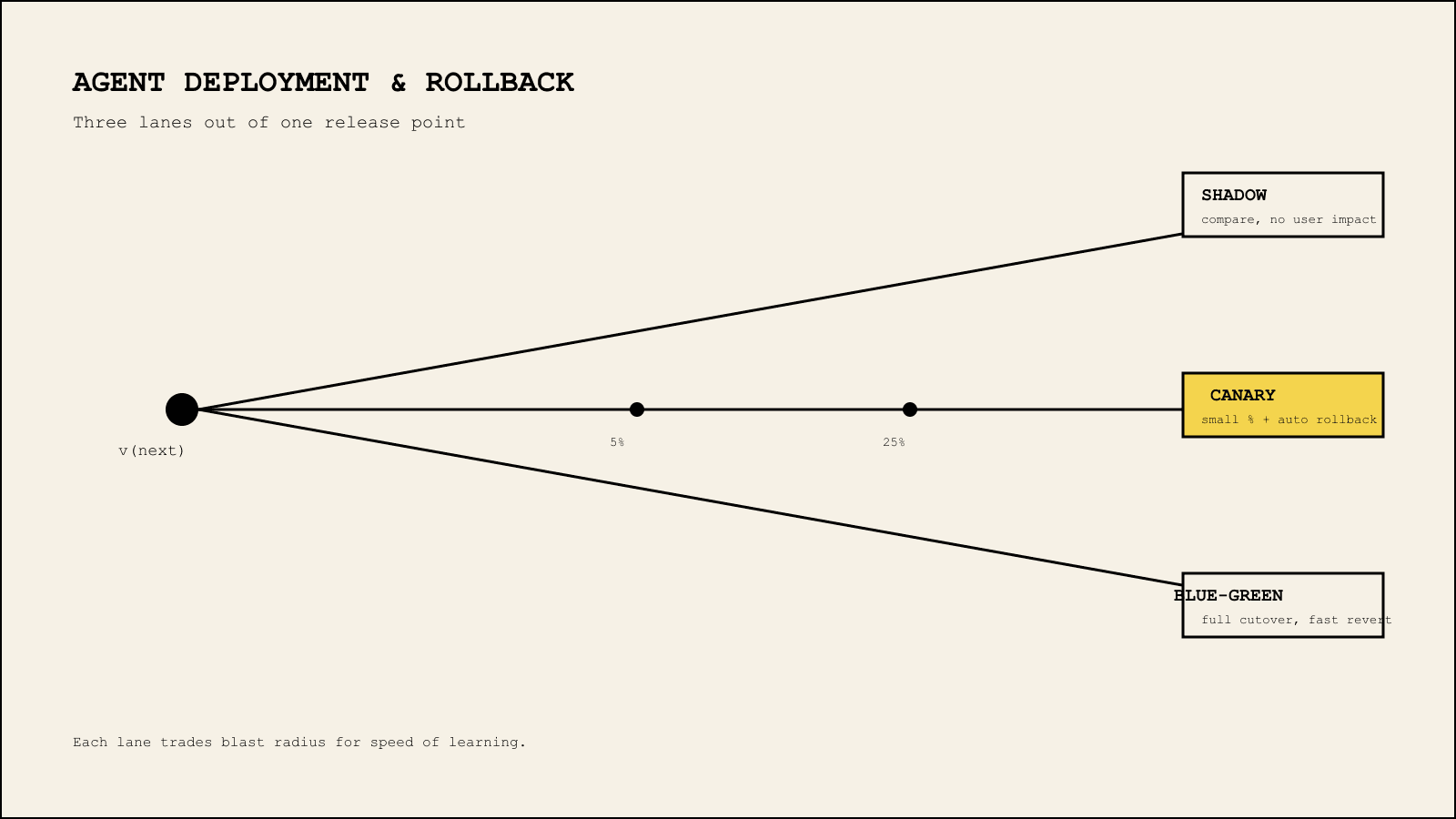
Staged exposure means routing a limited share of real traffic to the new version before committing all of it, so a regression is caught on a small blast radius instead of every user at once. How much traffic and for how long depends on two things: how quickly the release can accumulate a statistically meaningful sample, and how expensive a missed regression would be if it reached full traffic before anyone noticed.
A hypothetical illustrates the trade-off without pretending to a universal number: a workflow handling on the order of ten thousand runs a day can accumulate a meaningful sample from a small percentage of traffic within an hour or two, while a workflow handling a few hundred runs a day might need a full day at the same percentage just to see enough examples to trust the comparison. There is no single correct percentage or duration that applies to every agent — the right answer follows from traffic volume and blast-radius tolerance, decided explicitly for that release rather than inherited by habit from the last one.
# Illustrative staged-exposure config — vendor-neutral, not tied to a specific
# deployment tool. Adapt the field names to your own release system.
release:
  change_type: model
  target_version: "model-v2"
  staged_exposure:
    initial_percent: 5
    ramp_steps: [5, 25, 100]
    min_sample_per_step: 500
  rollback_trigger:
    error_rate_delta_max: 0.02
    eval_score_delta_max: -0.05
    cost_per_run_delta_max: 0.50   # ratio: 1.5 = 50% cost increase
  owner: "release-window-owner@team"
Not every change needs a staged rollout. A low-risk change with strong eval coverage — a prompt tweak that only affects a rarely-hit edge case, verified against a passing targeted eval — can sometimes go straight to full traffic. The decision to skip staging should be explicit and recorded, though, not a default born from not having thought about it. "We chose to skip staged exposure because X" is a defensible release note; a release with no mention of the decision either way is not.
Monitoring during the release window
Staged exposure only works if something is actually watching the exposed traffic while it runs. The metrics worth watching during a release window are narrower than the full observability surface a dashboard might show day to day: error rate, eval score on sampled live traffic if that's feasible, cost per run, and latency, compared against the pre-release baseline for the same traffic segment — not against yesterday's average, which can hide a regression inside normal day-to-day variance.
For a tool change specifically, watch the tool's own error rate and any permission-denial rate separately from the agent's overall error rate; a tool that fails quietly can leave the agent's top-line success rate looking normal while every call to that specific tool is broken. For a retrieval change, watch groundedness or citation-accuracy signal, if one exists, since retrieval degradation frequently does not show up as an error at all.
Rollback triggers and who pulls them
A rollback trigger is a threshold, agreed before the release starts, that automatically or immediately manually reverts the change when crossed. The critical property of a good rollback trigger is that it is decided in advance — "we'll roll back if it looks bad" is not a trigger, it is a hope, and it tends to produce exactly the kind of slow, argued-about response that lets a regression sit in production for days while people debate whether it's real.
| Metric | Example threshold | Action |
|---|---|---|
| Error rate | More than 2 percentage points above the pre-release baseline, sustained for the sample window | Automatic rollback to the previous version |
| Eval score (sampled live traffic) | Drops more than 5% below the baseline eval score for the same case set | Pause the ramp; do not increase exposure percentage until investigated |
| Cost per run | Exceeds 1.5x the pre-release baseline for the exposed segment | Pause the ramp and page the release owner; do not silently continue |
| Tool error or permission-denial rate | Any sustained rate above the tool's historical baseline for more than a few minutes | Automatic rollback of the tool change specifically |
| Latency (p95) | Exceeds a fixed ceiling agreed for that workflow, not a relative delta | Pause the ramp; investigate before continuing exposure |
These numbers are illustrative starting points for a hypothetical workflow, not universal defaults — a workflow with tight margins might set a tighter cost threshold, and a workflow already running near a latency ceiling might need to define that ceiling well below what "feels" acceptable. What should not vary is the discipline of writing the threshold down before the release starts and having a defined action attached to it, rather than leaving the response to be improvised in the moment.
Who pulls the trigger matters as much as what the trigger is. The rollback strategies guide goes deeper into the mechanics of reverting a live agent safely — versioned rollback targets, in-flight work handling, and how to avoid a rollback that itself causes inconsistent behavior mid-run. For the release checklist's purposes, the short version is: name the person or on-call role responsible for watching the exposure window before the release starts, not after something looks wrong.
Ownership: who is on point during a release
An owner for a release window is whoever is actively watching monitoring and empowered to pull the rollback trigger during the exposure period — not necessarily whoever wrote the change. For a small team this might be the same person by default; for a larger team it is worth naming explicitly, because "someone will probably notice" is not an ownership assignment, and a regression that surfaces at 2am with no one watching costs a lot more than one caught within the exposure window by a person who was told they were on point for it.
Post-release review
A release is not finished when exposure reaches 100% of traffic. A short post-release review — comparing the full-traffic metrics against the staged-exposure sample, checking whether the rollback trigger thresholds held up as useful signal or turned out too tight or too loose, and recording what the change type actually needed versus what the matrix predicted — closes the loop and improves the next release. If a model change's eval suite caught nothing but staged exposure caught a real cost regression, that is useful information for calibrating how much weight to put on each check next time.
Keep post-release notes attached to the release record itself, not scattered across chat history. A future release of the same change type benefits from knowing what actually mattered last time, and a checklist that never gets revised based on what it caught or missed will eventually stop matching how the agent actually fails.
The release-readiness checklist
Pick the change type below to see the matching subset of the Change-Type Release Matrix as a checkable list. The purpose is not to produce a perfect audit trail — it is to make the point concrete that release gates are not one-size-fits-all, and that a model change genuinely needs more evidence than a prompt tweak before it should reach every user.
Release Readiness Checklist
This is a static decision aid: selecting a change type reveals a fixed subset of the Change-Type Release Matrix on this page. It does not call a model, read live telemetry, or store your selections beyond this browser tab.
Worked example: swapping a model version on a support agent
Return to the opening scenario with the matrix applied instead of skipped. A team plans to upgrade a support agent from one model version to a newer one, expecting better handling of multi-part questions.
Contract check. The team confirms the new model's tool-call syntax and structured-output format match what the agent's downstream code expects — required for a model change, and cheap to verify before anything else.
Eval suite. Rather than running only the handful of multi-part-question cases the upgrade was meant to help, the team runs the full representative dataset, because a model change is the one type where an unrelated part of the behavior distribution can move without warning. The full run surfaces something the targeted subset would have missed: on cases involving ambiguous questions, the new model calls the search tool roughly three times as often as the previous version, even though answer quality on those same cases looks slightly improved.
Staged exposure. Instead of shipping to all traffic, the team routes a small percentage first, with cost per run and tool-call frequency tracked specifically, not just error rate and eval score.
Rollback trigger. The team had already set a cost-per-run threshold before starting — in this hypothetical, 1.5x the baseline — sustained past a defined sample size. The staged sample crosses that threshold within the first exposure window.
Outcome. Because the rollback trigger was defined before the release started, the team pauses the ramp immediately rather than debating whether the cost increase is "real" while it burns through a growing share of traffic. They tune the prompt's tool-use instructions to reduce unnecessary search calls, re-run the eval suite, and re-stage. The second attempt clears the cost threshold with the quality improvement intact. The difference between this version of the story and the opening one is not a smarter model or a better prompt — it is a checklist that named a model-version bump as a change requiring full evaluation, staged exposure, and a cost-specific rollback trigger, rather than treating it as a one-line config edit.
Where this fits with prompt versioning and regression testing
A release checklist is only as useful as the infrastructure underneath it. Staged exposure and rollback both assume the previous version is still addressable and comparable — which is a versioning problem, covered in prompt versioning and prompt management, including how to keep a prompt's version identifier attached to every run so a regression can be traced back to the exact change that caused it. And the eval suite each change type depends on is only as good as the test cases in it, which is why building that dataset from real production signal — not from imagination — is worth treating as its own discipline rather than an afterthought bolted onto the release process.
Limitations and what this checklist does not cover
This is a release-time checklist, not a substitute for the production-readiness groundwork a first-time launch needs — permission boundaries, redaction, and incident response are covered in the production checklist, and this article assumes that groundwork is already in place. It also does not replace judgment: a genuinely trivial change within a category the matrix marks "required" can sometimes be shipped with a lighter check if the team explicitly records why, and a change that looks small but touches a safety-relevant instruction should be treated more like a model change than a prompt change regardless of what the diff line count suggests. The matrix is a default that reduces the chance of forgetting something, not a formula that removes the need to think about the specific change in front of you.
The rollback-trigger thresholds in this article are illustrative examples for a hypothetical workflow, not industry-standard numbers — set your own based on the actual cost, error, and quality baselines your agent has established, and revise them as you learn what a real regression looks like against your own traffic.
Put this into practice
- Name the change type before writing the change — prompt, model, tool, retrieval, or orchestration — and pull up its row in the matrix, not the previous release's checklist by habit.
- Run the contract check first; an eval score on malformed output is not a meaningful signal.
- Size the eval suite to the change's plausible blast radius, not to how many lines changed.
- Write the rollback trigger and name the owner before exposure starts, not after something looks wrong.
- Close the loop with a short post-release note on what the checks actually caught, so the next release of the same change type benefits from what this one learned.
Frequently asked questions
Do you need a different checklist for a prompt change vs. a model change?
Yes. A model change needs a full re-evaluation since the underlying behavior can shift broadly and unpredictably, while a small, targeted prompt tweak may only need regression cases for the specific scenario it was meant to affect.
What is staged exposure?
Releasing a change to a small percentage of traffic before full rollout, so a regression is caught on a small blast radius instead of reaching every user at once.
What should trigger an automatic rollback?
A defined threshold breach in error rate, cost per run, or evaluation score, agreed before the release starts — not decided in the moment while a regression is already spreading.
Who owns an AI agent release?
Whoever is actively watching monitoring during the exposure window and is empowered to pull the rollback trigger, named before the release starts rather than assumed after something goes wrong.
Does every AI agent change need a staged rollout?
No. Low-risk changes with strong eval coverage can sometimes go straight to full traffic, but that decision should be explicit and recorded, not a default from never having thought about it.
Practical field notes from the team building Tracify and operating AI agents in production.
Related posts


Next in the loop
AI Agent Cost Per Task: How to Measure Unit Economics Beyond Token Usage
Keep reading →