Agent Deployment and Rollback Strategies
A decision framework for shipping a new agent prompt, model, tool set, or orchestration change safely, from shadow deployment through canary release to automatic rollback.
In this guide18 sections
At a glance
This guide is for the engineer who owns a production agent and is about to ship a new prompt, model, tool set, or orchestration change. It helps you choose a rollout strategy that matches your traffic, blast radius, and detection speed so you can leave with a specific deployment pattern, a versioning approach, and a rollback trigger you can implement this week.
| Before you start | What to inspect | What good looks like |
|---|---|---|
| A pending agent change: prompt, model, tools, or orchestration | Traffic volume, blast-radius tolerance, and eval maturity | A rollout strategy chosen from evidence, not habit |
The boundary is worth stating up front. This is not a guide to writing evaluations from scratch, designing a retry policy, or running an incident once things have already gone wrong — the evaluation guide and the incident response guide cover those. This article assumes you have a working agent, a proposed change, and a decision to make about how that change reaches users.
The operating model
Every safe agent rollout answers four questions in order: what changed, how is it detected, how far can it spread before detection, and how does it come back. Call this Change → Detect → Bound → Revert.

| Stage | Question | What it produces |
|---|---|---|
| Change | What exactly is different, and what version does that make? | A version bundle you can point to and revert to |
| Detect | What signal proves the new version is worse? | A quality, error, or cost threshold tied to an evaluator |
| Bound | How much traffic sees the change before detection fires? | A percentage, a cohort, or a fully separate environment |
| Revert | What happens automatically when detection fires? | A router flip, a flag toggle, or a traffic cutover |
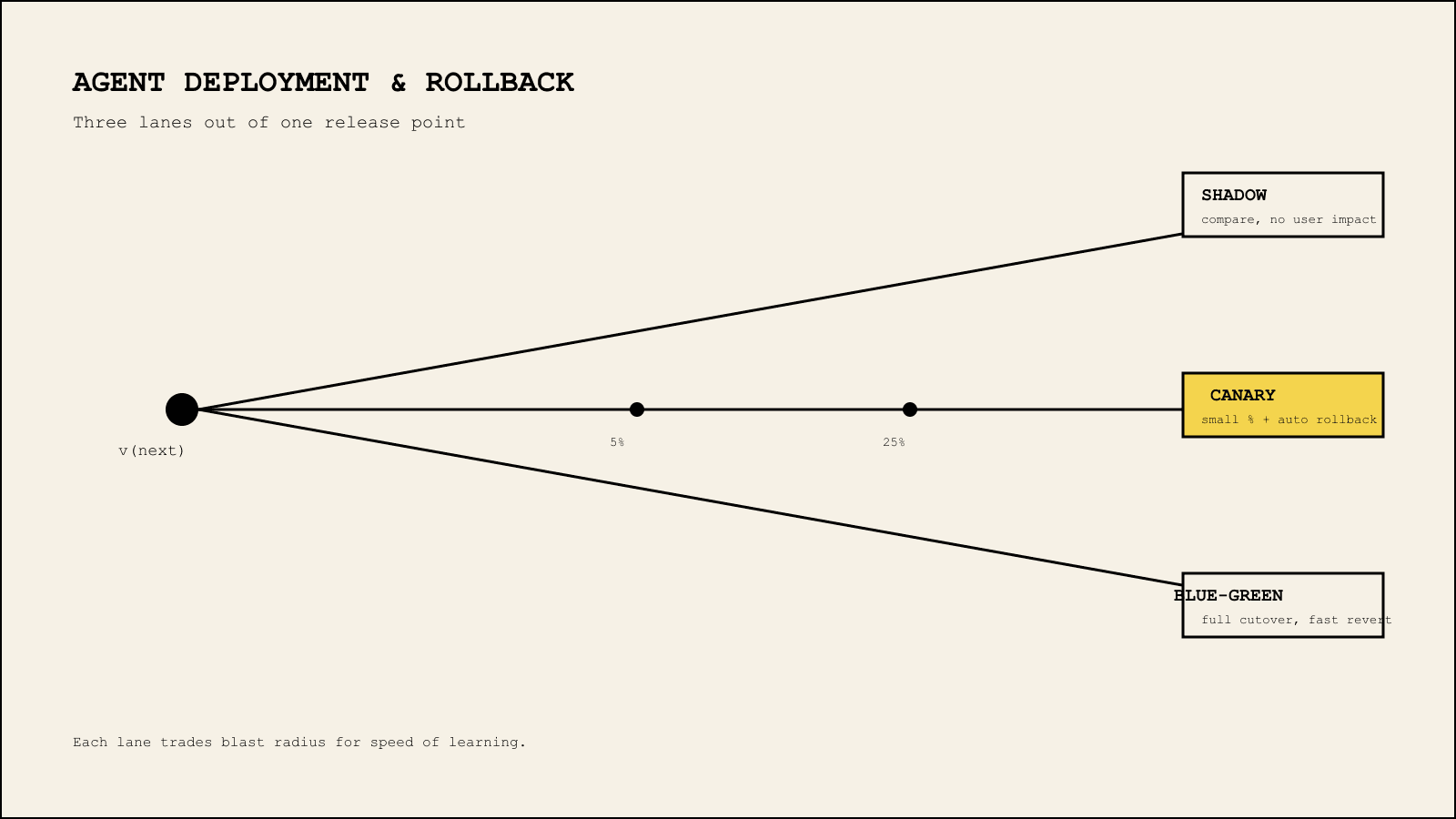
Shadow deployment, canary release, and blue-green deployment are three different answers to the Bound question. They assume different amounts of Detect maturity, and they fail differently if you get the assumption wrong. The rest of this article works through each one, then gives you a way to choose between them for a specific change.
Why agent rollouts are not like service rollouts
A conventional service rollout asks whether the new binary crashes, times out, or returns the wrong HTTP status. Those failures are loud and mechanical. An agent rollout has to catch a fourth failure mode that has no equivalent in a typical deploy: the new version can run perfectly — no errors, no timeouts, normal latency — and still be wrong. It calls a different tool than it should. It gives a fluent, confident answer that is subtly worse than before. It solves 80% of tasks it used to solve at 95%.
That failure mode does not show up in infrastructure metrics. It shows up in task outcomes, and task outcomes require an evaluator — automated, human, or both — to observe. This is the single fact that should shape every deployment decision in this article: your rollout strategy can only be as fast as your slowest reliable detector. A team with a mature evaluation pipeline can run an aggressive canary with automatic rollback. A team with no evaluator beyond "did anyone complain" has no business routing live traffic to an unproven version at all, regardless of how confident the change looks in a demo.
There is a second difference. A web service usually has one deployable artifact. An agent has several independently mutable surfaces that can each change the outcome: the system prompt, the model or model version, the tool definitions and their implementations, and the orchestration logic that decides what to call when. A rollback that only reverts the prompt while leaving a new model pinned underneath it is not a rollback — it is a half-measure that leaves you debugging a system in a state nobody intentionally created. Versioning strategy, covered later in this article, exists to prevent exactly that.
Field note: If your only rollback plan is "redeploy the previous commit," check whether the previous commit also pins the previous model version and previous tool schemas. A commit revert that leaves the model floating on a provider alias is not a real rollback.
Shadow deployment: learn without exposure
Shadow deployment runs the new version of the agent on real production inputs, in parallel with the current version, without ever showing its output to a user. The old version's response is what users see; the new version's response is captured and compared afterward.
This is the correct starting point for almost every agent change, for one reason: it is the only rollout mode with zero blast radius. If the new version loops forever, calls the wrong tool, or produces an unsafe response, no user experiences it. The cost is that you only get comparison data, not live outcome data — you cannot observe how the new version affects downstream metrics like task completion or user correction, because it never actually completes a task for a real user.
What to compare in shadow mode
Run both versions on the same input and record, at minimum: whether the final answer or action differs, whether the tool-call sequence differs, latency and token cost for each version, and the evaluator score for each version's output against the same rubric. A structural diff — the same technique used to triage incidents in debugging AI agents in production — is often more informative than a raw score difference, because it tells you where behavior diverged, not just that it did.
// Illustrative: shadow comparison for one production input.
// The shadow result is never returned to the user.

type AgentResult = {
  finalAnswer: string;
  toolCalls: string[];
  tokensUsed: number;
  latencyMs: number;
};

async function runShadowComparison(input: AgentInput): Promise<ShadowRecord> {
  const primary = await runAgent(input, { version: "v(prev)" });
  // Fire-and-forget: never blocks or affects the user-facing response.
  const shadow = await runAgent(input, { version: "v(next)" }).catch((error) => ({ error }));

  return {
    inputId: input.id,
    primary,
    shadow,
    diverged: hasStructuralDivergence(primary, shadow),
    scoreDelta: await scoreDelta(primary, shadow, input),
  };
}
The limits of shadow mode
Shadow deployment cannot tell you everything. It cannot measure how users react to a genuinely different answer, because users never see the shadow output. It is expensive to run indefinitely, since every shadow run doubles inference cost for that input. And it does not exercise timing-sensitive behavior well — a shadow run started slightly after the real one may see stale state that the live run already mutated.
Canary release: a small, measured exposure
A canary release routes a small, fixed percentage of live traffic to the new version while the rest continues on the current one. Unlike shadow mode, canary traffic produces real outcomes: real task completions, real user corrections, real cost. That is both the value and the risk — a canary is the first point where a bad version can actually hurt a real user, which is why it needs the strongest automatic guardrails of any strategy in this article.
What must be true before you canary
A canary release is not a substitute for evaluation maturity; it depends on it. Before routing any live traffic to an unproven agent version, you need:
- A scoring signal that runs on live traffic, not just offline test cases. This can be an automatic evaluator, a lightweight heuristic (tool-call success, schema validity, refusal rate), or sampled human review with a fast enough turnaround to matter.
- A baseline from the current version, measured the same way, so a canary score is a comparison rather than an isolated number.
- A rollback mechanism that does not require a human to be awake. If firing the rollback needs someone to notice a dashboard, read a Slack alert, and manually flip a flag, your effective blast radius is however much traffic flows during that response time — often much larger than the canary percentage implies.
- Fast enough feedback relative to traffic volume. A canary on 500 requests a day needs hours to reach a meaningful sample. A canary on 500,000 requests a day can reach the same sample in minutes, which changes how aggressively you can ramp.
A canary router with automatic rollback
The core mechanism is a router that checks a live health signal before every routing decision, not just at deploy time. This example is illustrative — replace the scoring and threshold logic with your actual evaluator, but keep the shape: score continuously, compare to a fixed threshold, and flip the routing weight to zero the moment the threshold is crossed, without waiting for a human.
# Illustrative: a canary router that scores a rolling window of live
# outcomes and disables the canary automatically on regression.

from dataclasses import dataclass, field
from collections import deque
import random
import time

@dataclass
class CanaryState:
    weight: float = 0.05          # fraction of traffic routed to v(next)
    window: deque = field(default_factory=lambda: deque(maxlen=200))
    baseline_score: float = 0.91  # from v(prev), measured the same way
    min_samples: int = 30
    score_floor: float = 0.85     # absolute floor regardless of baseline
    error_rate_ceiling: float = 0.02
    cost_ceiling_multiplier: float = 1.5
    disabled: bool = False
    disabled_reason: str | None = None

def route(state: CanaryState, request_id: str) -> str:
    if state.disabled:
        return "v(prev)"
    return "v(next)" if random.random() < state.weight else "v(prev)"

def record_outcome(state: CanaryState, version: str, score: float, errored: bool, cost: float, baseline_cost: float):
    if version != "v(next)" or state.disabled:
        return
    state.window.append({"score": score, "errored": errored, "cost": cost})
    if len(state.window) < state.min_samples:
        return

    scores = [r["score"] for r in state.window]
    mean_score = sum(scores) / len(scores)
    error_rate = sum(1 for r in state.window if r["errored"]) / len(state.window)
    mean_cost = sum(r["cost"] for r in state.window) / len(state.window)

    if mean_score < min(state.baseline_score - 0.03, state.score_floor):
        return disable(state, f"quality regression: {mean_score:.3f} vs baseline {state.baseline_score:.3f}")
    if error_rate > state.error_rate_ceiling:
        return disable(state, f"error rate {error_rate:.3f} exceeds ceiling {state.error_rate_ceiling}")
    if mean_cost > baseline_cost * state.cost_ceiling_multiplier:
        return disable(state, f"cost {mean_cost:.4f} exceeds {state.cost_ceiling_multiplier}x baseline {baseline_cost:.4f}")

def disable(state: CanaryState, reason: str):
    state.disabled = True
    state.disabled_reason = reason
    state.weight = 0.0
    # In production: page the owner, freeze the version bundle, log the trigger.
    print(f"[{time.time():.0f}] canary disabled: {reason}")
The three thresholds — quality floor, error ceiling, cost ceiling — are deliberately separate checks. A composite score that blends quality, cost, and errors into one number can mask a serious regression in one dimension behind acceptable numbers in the other two. A version that got 6% cheaper by skipping half its retrieval calls should not survive a canary just because its blended score looks fine.
Ramping a canary
Do not jump from 5% to 100%. Ramp in fixed steps — 5%, 25%, 50%, 100% is a reasonable default — and hold each step long enough to gather the minimum sample your evaluator needs to be statistically meaningful. Reset the rolling window at each step; a regression that only appears at higher traffic (a rate limit, a cache contention issue, a cost ceiling on a shared resource) will not show up at 5% and needs its own observation window at 25% and 50%.
| Step | Typical hold time | What you're checking |
|---|---|---|
| 5% | Until minimum sample reached | Obvious regressions: schema errors, safety violations |
| 25% | A few hours to a day | Cost and latency under real concurrency |
| 50% | A day | Segment-level regressions hidden by a healthy global average |
| 100% | N/A — full rollout | Nothing left to compare against; monitor as the new baseline |
Blue-green deployment for agents
Blue-green deployment runs the new version as a complete, independent environment — its own prompt, model pin, tool configuration, and infrastructure — verified manually or against a synthetic suite, then cut over in one step by redirecting all traffic. The previous environment stays running, untouched, as an instant rollback target.
This pattern fits agents less naturally than it fits stateless web services, for one structural reason: an agent's "environment" includes conversational state, in-flight multi-step tasks, and sometimes long-running workflows. A web service can usually cut over between requests with no visible seam. An agent mid-task when you flip the switch may need to either finish on the old version or restart cleanly on the new one — silently switching versions inside a single multi-step run produces exactly the kind of incoherent behavior a version bundle (below) is supposed to prevent.
Blue-green is the right choice when canary's core assumption — enough traffic to reach a meaningful sample quickly — does not hold, and when the workflow's blast-radius tolerance is high enough that a full cutover is acceptable if verification was thorough. An internal, low-volume, easily-monitored agent is a better blue-green candidate than a high-volume, customer-facing one.
Decision rule: Use blue-green when traffic is too low for a canary to reach significance quickly and the action is either reversible or closely supervised. Use canary when traffic is high enough to make a small percentage statistically useful within a workable time window.
Feature-flagged prompt and model versions
Underneath all three rollout patterns sits the same mechanism: a way to route a specific request to a specific version without redeploying code. Feature flags — or a dedicated prompt/model registry keyed by flag — are how shadow, canary, and blue-green all get implemented in practice, rather than three unrelated pieces of infrastructure.
The flag should resolve a version bundle, not a single field. Flip one flag and you should get a prompt, a model pin, a tool set, and any orchestration parameters that were tested together — never a partial combination nobody actually evaluated.
// Illustrative: a version bundle resolved by one flag, not four independent settings.

type AgentVersionBundle = {
  versionId: string;              // e.g. "2026-08-20-refund-tool-fix"
  promptTemplateId: string;
  modelId: string;                // pinned, never a floating "latest" alias
  toolSetId: string;
  orchestrationConfigId: string;
  evaluatedAt: string;
  evaluatorScore: number;
};

function resolveVersion(flag: FeatureFlag, request: AgentRequest): AgentVersionBundle {
  const bundleId = flag.evaluate(request.userId, request.cohort);
  return VERSION_BUNDLES[bundleId]; // never assemble a bundle from mixed sources at request time
}
Treating prompt, model, tools, and orchestration as one versioned unit is what makes rollback coherent. Roll back the bundle ID and every component reverts together. Roll back one field at a time and you risk running a prompt that was never tested against the model, tool set, or orchestration logic it now finds itself paired with — a state that is often worse than either version alone, and one that is much harder to explain in a postmortem.
Metrics that must exist before you canary
A canary release is only as trustworthy as the signal that gates it. At minimum, have these four in place before routing any live traffic to an unproven version:
Task-level quality score. Not "did the model respond," but "did the response satisfy the actual user intent." This can come from an automated judge model, deterministic checks (schema validity, required fields present, forbidden actions absent), or sampled human review, but it must run on live outputs at a cadence fast enough to gate a canary before it does damage.
Error and exception rate. Provider errors, tool failures, timeouts, and malformed outputs — segmented by version so a canary's error rate is directly comparable to the baseline's.
Cost per successful task, not raw spend. A version that is 20% more expensive per request but resolves tasks in fewer turns can be a net win; raw spend alone will flag it as a regression it is not. The same distinction matters when reducing LLM costs without hurting quality — cost and value have to be read together.
A rolling baseline, not a fixed historical number. Normal shifts with model updates, seasonal traffic, and prompt tuning elsewhere in the system; compare the canary against the last several days of the current version, not against a number from a quarter ago.
Choosing a rollout strategy: the decision framework
Three inputs decide which of the three patterns fits a given change: traffic volume (how fast you reach a meaningful sample), blast-radius tolerance (how bad the worst plausible mistake is), and evaluation maturity (how reliably you can detect a regression before a human does). Use the tool below to work through a specific change, or read the reasoning in the table underneath it.
Pick a rollout strategy for your next agent change
Recommended strategy
Canary release with staged ramp-up
This combination does not force the extremes: blast radius is manageable and there is at least a basic quality signal. Start with a small canary slice, verify it against your evals, and increase the percentage in stages rather than committing all traffic at once.
Before you start: Write down the exact percentage steps and the metric thresholds that gate each step before starting the rollout.
This is a static decision aid: it maps three inputs to a recommendation using fixed rules on this page. It does not call a model, read live telemetry, or store your selections beyond this browser tab.
| Traffic | Blast-radius tolerance | Eval maturity | Recommended strategy |
|---|---|---|---|
| Any | Any | None | Shadow only, until an evaluator exists |
| Low | Low | Basic or mature | Shadow, then a small flag-gated canary with human review per run |
| Any | Low | Mature | Canary with automatic rollback, ramped in fixed steps |
| High | Medium or high | Mature | Canary, ramped by cohort, segmented metrics |
| Low | High | Basic or mature | Blue-green with a fast manual cutover |
| Medium | Medium | Basic | Canary with a conservative ramp and a human-reviewed gate at each step |
Two of these rows deserve emphasis. First, eval maturity is a hard gate, not a factor to weigh against the others — a workflow with unlimited blast-radius tolerance and enormous traffic still should not canary without a way to detect a regression, because "nobody will notice" is not the same as "nothing went wrong." Second, low traffic with high blast-radius tolerance favors blue-green over canary, because a canary's main advantage — a fast statistical read — evaporates when traffic is thin, while blue-green's main cost — a full cutover — is acceptable exactly when mistakes are cheap to absorb or quick to notice.
Work through a realistic example
A team ships a new tool-selection prompt for a support agent that currently resolves about 4,000 conversations a day. The change fixes a bug where the agent sometimes calls the refund tool instead of the order-lookup tool. Refund actions are irreversible for amounts under $50 (auto-approved) and require human sign-off above that.
Traffic: medium — 4,000 runs a day is enough to reach a usable canary sample within a few hours, not minutes. Blast radius: low for the sub-$50 auto-approved path, because a wrong refund call there is an irreversible, real-money mistake with no human in the loop. Eval maturity: the team has a dataset of 200 labeled conversations and an automated check for tool-selection correctness, but no live quality scoring yet.
Applying the framework: low blast radius with basic-to-mature evals — not yet fully mature, since the eval only checks tool selection and not overall task quality — points to shadow deployment first, then a small flag-gated canary with a human reviewing every routed refund call before removing the human check. The team should not canary directly into the auto-approve path until the live quality signal covers more than tool selection alone.
| Observation | Weak interpretation | Better next move |
|---|---|---|
| The fix passes all 200 labeled cases | "It's ready to ship everywhere" | Run it in shadow against live traffic first; labeled cases are not the full input distribution |
| Refund tool calls are rare in the test set | "Low risk, ship the canary at 25%" | Start at a low percentage specifically because irreversible actions are underrepresented in testing |
| The team has no live scoring yet | "The offline eval is close enough" | Add a live check — even a simple one — before trusting a canary's rollback trigger |
Automatic rollback triggers, beyond the canary router
The canary router shown earlier reacts to score, error rate, and cost. Two other trigger types matter enough to call out separately, because they catch failures the router's rolling window can miss.

Latency-tail triggers. A rolling mean can stay flat while the 95th or 99th percentile climbs, because a small share of requests entering a retry loop does not move an average much. Trigger on a percentile, not a mean, and set the threshold relative to the current version's own tail — an agent with a naturally long tail (deep research tasks) needs a different absolute number than one with short, bounded interactions.
Irreversible-action triggers. For any workflow with a real irreversible action — a refund, an email, a write to a system of record — add a trigger that is independent of the quality score: a hard cap on the number of irreversible actions the canary version can take per unit time, enforced even if every individual action scored well. This catches the case where the new version is technically correct more often but takes the irreversible action more frequently, which a per-action quality score will not flag on its own.
score check:       per-batch quality, error rate, cost   -> catches "getting worse"
tail-latency check: p95/p99 relative to this version's own baseline -> catches "getting stuck"
action-rate check:  count of irreversible actions per minute, hard cap -> catches "doing more, not better"
Each trigger should be independently testable against a replayed failing run, the same discipline used when regression-testing agents — a rollback trigger that has never fired against a known-bad batch is a trigger you are trusting on faith.
Decide who owns the rollback decision
Automatic rollback triggers handle the cases you anticipated. They do not handle the case where a canary is technically within every threshold and still feels wrong to the person watching it — a tool being called in a way that is valid but strange, a tone shift that no rubric captures, a pattern that looks like the early stage of a problem the metrics have not caught up to yet. That gap is why a rollout needs a named human owner in addition to automatic triggers, not instead of them.
Write the owner down before the rollout starts, not after something goes wrong. The owner needs three things to act quickly: visibility into the canary's live metrics without needing to build a dashboard from scratch, the actual permission to pause or disable the canary without a second approval, and a standing understanding of what "pause" costs — whether it drops users back to a known-good path cleanly or leaves in-flight multi-step tasks in an ambiguous state. An owner who has to ask someone else for the ability to stop a rollout is not really the owner; they are a reporter.
The owner's authority should be narrower than it sounds. They can pause or roll back the canary they are watching. They should not be expected to make a judgment call about whether an irreversible action the canary already took needs remediation — that decision belongs with the same incident-response process used for any other production harm, following the containment-before-diagnosis discipline in incident response for AI agents. Keep the rollout owner's job scoped to "stop this from getting worse" and let the incident process handle "here is what we do about what already happened."
Decision rule: A canary needs exactly one person who can say "pause it" without asking permission, for the duration of the rollout. If two people could plausibly make that call and neither is designated as primary, the actual response time during a real regression will be however long it takes them to notice they are both waiting on each other.
Rehearse the rollback before you need it
A rollback trigger that has only ever run against synthetic unit tests is a hypothesis, not a control. The gap between "the code looks correct" and "the code fires correctly under a real regression, at 2am, while someone else is asleep" is exactly where agent rollouts tend to fail, because the failure mode being guarded against is rare by construction — if it happened often, you would have caught it before the canary started.
Treat rollback rehearsal the same way infrastructure teams treat game days: schedule it, replay a known-bad batch of production-shaped traffic through the canary path, and confirm three things independently. First, that the detector actually fires — feed it the replayed failing batch and watch the score, error rate, or action-rate cross the threshold. Second, that the router actually responds — confirm traffic weight drops to zero within the expected window, not just that a log line was written saying it should have. Third, that the fallback path is itself healthy — a rollback that routes traffic back to v(prev) is only a fix if v(prev) is still deployed, still has warm capacity, and has not silently drifted out of sync with the infrastructure the canary was using.
That third check catches a failure mode specific to longer-running rollouts. Teams sometimes decommission the previous version's supporting infrastructure — a cache, a smaller model deployment, a scaled-down worker pool — once the canary has been healthy for a few days, on the assumption that the canary is basically the new baseline now. If the canary regresses after that infrastructure is gone, the "rollback" reverts to a version pointer that no longer has anywhere to run. Keep the previous version's full stack live until the new version has been at 100% for long enough that reverting is genuinely unlikely, not merely until the canary looked good for an afternoon.
| Rehearsal check | What it proves | Common way it silently fails |
|---|---|---|
| Detector fires on a replayed bad batch | The threshold and scoring logic actually catch the regression class you're worried about | Threshold tuned against synthetic data that doesn't match real failure shape |
| Router responds within the expected window | Traffic weight drops fast enough to bound blast radius | Router polls state on an interval longer than the intended detection window |
| Fallback path is healthy | Reverting actually restores working behavior | Previous version's infrastructure was scaled down or decommissioned early |
Schedule this rehearsal on a cadence tied to how often the underlying agent changes, not to a fixed calendar interval. A workflow that ships a new prompt weekly needs its rollback path re-verified roughly that often, because a router or evaluator change can quietly break the trigger between rollouts without anyone noticing until the day it matters.
Coordinate rollout across a multi-agent system
Everything so far assumes one agent with one rollout decision. Many production systems are not that simple — a request may pass through a router agent, a retrieval step, one or more tool-calling sub-agents, and a final synthesis step, each independently versioned. Rolling out a change to one component in isolation, without accounting for the others, produces a specific and hard-to-diagnose class of failure: the new sub-agent version was evaluated against the old version of an upstream component, and the combination that actually ships together was never tested as a pair.
The version bundle concept from earlier extends naturally here, but the bundle now needs to cover the full pipeline, not just one agent's prompt-model-tools triplet. When component A and component B are both mid-rollout at the same time, define which combinations are valid — old-A with old-B, new-A with new-B — and make the router refuse combinations that were never evaluated together, such as new-A paired with old-B. This is more restrictive than rolling out each component independently, and that restriction is the point: an untested pairing is not safer just because each half was tested alone.
The most common multi-agent rollout mistake is treating each component's canary as statistically independent when their outputs are not. If a router agent's canary and a tool-selection agent's canary both happen to be active on the same request, a regression could originate in either one, and a scoring pipeline that only labels outcomes by the final agent's version will misattribute the cause. Tag every recorded outcome with the full version bundle across every component involved, not only the component nearest the user, so a regression can be traced to the pairing that actually produced it.
Sequencing also matters more than it first appears to. When two components are both changing, roll them out one at a time rather than concurrently whenever the coupling between them is tight — finish canarying the upstream component to 100%, establish it as the new baseline, and only then start a canary for the downstream component against that new, stable upstream. Concurrent rollouts of tightly coupled components are occasionally unavoidable under time pressure, but they should be the exception that gets extra scrutiny, not the default operating mode.
Field note: If your system has more than two independently versioned components in a single request path, the version-bundle table itself becomes worth automating. A spreadsheet of "which combinations have been evaluated together" that a human updates by hand will fall behind the actual rollout state within a few releases.
What changes the recommendation
The framework above assumes a few things that are worth checking before you apply it mechanically.
It assumes the agent's actions are attributable to a version — that you can tell, after the fact, which prompt, model, and tool set produced a given output. Without that, a canary's comparison is meaningless, because you cannot cleanly separate "this batch of traffic used v(next)" from "this batch happened to arrive during a provider incident."
It assumes a canary's traffic split is truly random with respect to task difficulty. If your router disproportionately sends easy or hard cases to the canary — a common bug when routing is based on something correlated with task type, like account age or region — the comparison is biased and the rollback trigger will fire on the wrong signal, or fail to fire on a real one.
It also assumes irreversible actions can be identified in advance. Some agents surprise their own designers here: a tool that looked read-only turns out to write an audit log a downstream system treats as authoritative, making the "read-only" action harder to undo than expected. Re-examine the blast-radius classification whenever a new tool is added, not only when the prompt changes.
Protect the security boundary during a rollout
A rollout is a period of deliberately running two versions with different capabilities, which raises specific security considerations. The canary version should never receive broader tool permissions or higher-trust cohort routing than the baseline "just for testing" — if it needs elevated access to be evaluated fairly, that access should be justified independently of the rollout, not granted as a rollout convenience. Version bundles should be signed or otherwise verifiable, so a rollback restores a known-good configuration rather than whatever the registry happened to contain at revert time. And canary traffic selection should never be based on a signal a user or an upstream system can manipulate — if attackers can predict or influence which cohort routes to the canary, they can probe an unreleased version's behavior or selectively avoid detection.
Do not promise a rollback speed or blast-radius bound that the current implementation cannot prove. A canary router with no tested rollback path is not a safety mechanism; it is a variable nobody has measured yet.
Make the operating decision
Carry the refund-agent example to a close: the team ships shadow deployment this week, builds a live quality check that covers more than tool selection over the next sprint, then opens a 5% flag-gated canary with a human reviewing every auto-approved refund call. The human check comes out only once thirty days of canary data show no divergence from the shadow-mode findings. That sequence — shadow, narrow human-reviewed canary, then automation — is slower than shipping straight to 100%, and it is also the version of this rollout that a postmortem never has to be written about.
Leave the reader with the next move
- [ ] The change is bundled into one version ID covering prompt, model, tools, and orchestration together.
- [ ] A live quality signal exists and has a measured baseline from the current version.
- [ ] The blast radius of the specific change has been classified, including any irreversible actions.
- [ ] A rollback trigger is implemented and has been tested against at least one replayed failing batch.
- [ ] The rollout strategy (shadow, canary, or blue-green) matches the traffic, blast-radius, and eval-maturity inputs — not habit or convenience.
- [ ] The rendered article, including the strategy picker and both diagrams, has been checked on desktop and mobile.
Decision rule: If you cannot answer what the rollback trigger is and how it was tested, you do not have a rollout strategy yet — you have a deploy button and a hope.
Start with the smallest version of this that is honest: instrument the current, already-shipped version with the four metrics above, establish its baseline, and only then plan the next change's rollout. A canary compared against nothing is not a canary.
Frequently asked questions
What is the difference between shadow deployment and a canary release?
Shadow deployment runs the new version on real inputs without ever showing its output to a user, so it carries zero blast radius but produces comparison data only. A canary release routes a small percentage of live traffic to the new version and lets it actually complete tasks for real users, which produces real outcome data but means a bad version can affect a real, if small, number of people.
How small should a canary's initial traffic percentage be?
Small enough that a worst-case regression affects an acceptable number of users, and large enough to reach a statistically useful sample within a workable time window. High-traffic agents can often start at 1-5%; low-traffic agents may need a higher percentage or a longer hold time to reach the same sample, which is often a sign that blue-green deployment fits better than a canary.
Why version prompt, model, and tools together instead of separately?
Because only the combination was ever evaluated. Rolling back one component while leaving another pinned to whatever it happened to be at the time creates a configuration nobody tested, which can behave worse than either the old or new version alone. A single version bundle ID makes rollback restore a known-good combination instead of a partial, untested mix.
What metrics need to exist before it is safe to canary an agent change?
A task-level quality score that runs on live outputs, an error and exception rate segmented by version, cost per successful task rather than raw spend, and a rolling baseline from the current version measured the same way. Without a live quality signal specifically, a canary has no reliable way to detect a behavioral regression before users do.
When should blue-green deployment be preferred over a canary release?
When traffic is too low for a small canary percentage to reach a meaningful sample quickly, and when the workflow's blast-radius tolerance is high enough that a full cutover after manual verification is an acceptable risk. Blue-green trades a canary's gradual, statistically-driven exposure for a single verified cutover with an instant rollback target.
Practical field notes from the team building Tracify and operating AI agents in production.
Related posts


Next in the loop
Multi-Agent Orchestration Patterns: A Practical Guide
Keep reading →