AgentOps vs Tracify: Auto-Instrumentation vs Integrated Evaluation
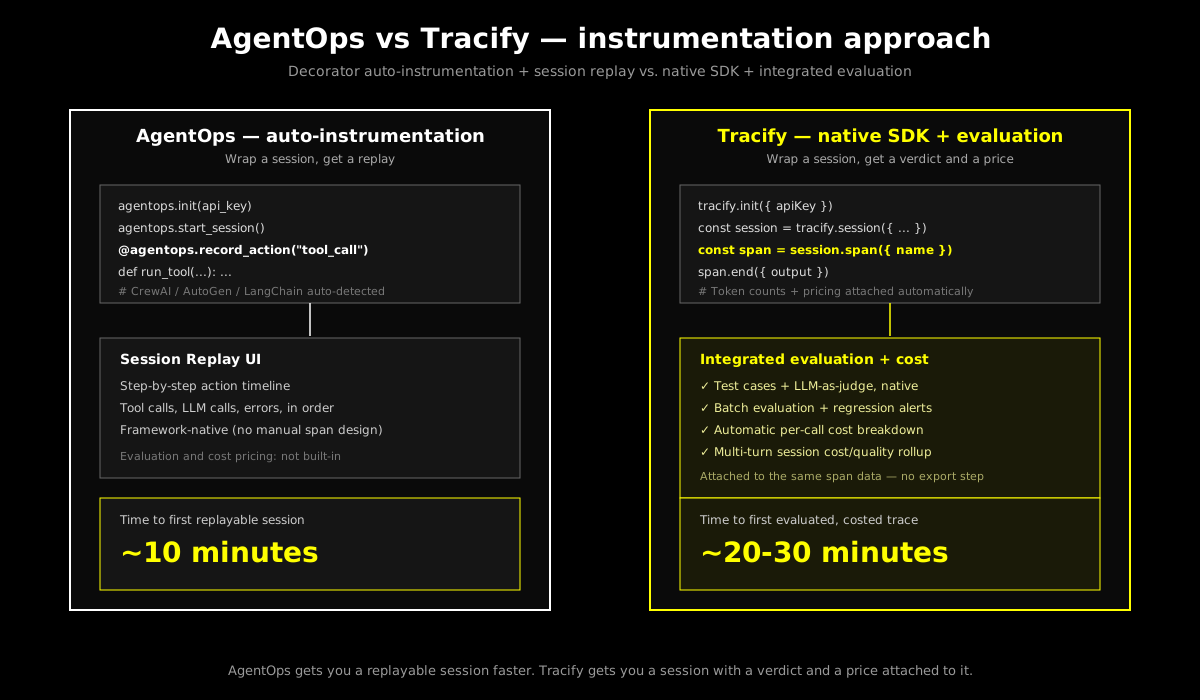
AgentOps gets you a replayable agent session in minutes with decorator-based auto-instrumentation. Tracify adds integrated evaluation, automatic cost tracking, and experimentation on top of tracing. Here's when each is the right call.
In this guide14 sections
At a glance
| Dimension | AgentOps | Tracify |
|---|---|---|
| Primary focus | Auto-instrumented session recording and replay | Integrated tracing + evaluation + cost tracking |
| Instrumentation model | Decorator/wrapper auto-instrumentation, framework-aware | Native SDK, explicit spans, framework-aware |
| Session replay | Native, high-fidelity, action-by-action | Trace timeline view; replay is secondary to evaluation |
| Evaluation framework | Limited; mostly manual review plus newer add-on tooling | Integrated: test case library, LLM-as-judge, batch runner, regression alerts |
| Cost tracking | Basic token/spend visibility per session | Automatic per-call cost breakdown by model/provider, with rollups |
| Framework integrations | Deep, opinionated: CrewAI, AutoGen, LangChain, Python-first | Broad: LangChain, LlamaIndex, native OpenAI/Anthropic/Mistral, TS-first |
| Setup time | ~10 minutes to first recorded session | ~20-30 minutes to first evaluated, costed trace |
| Deployment model | SaaS (hosted dashboard) | SaaS (hosted dashboard) |
| Best for | Fast debugging of agent behavior during build-out | Production quality gates, cost accountability, experimentation |
AgentOps tells you exactly what your agent did. Tracify tells you whether what it did was good, and what it cost you to find out.
The operating model
AgentOps is built around frictionless observation: drop in a decorator or a couple of init calls, and every action, tool call, and LLM call inside an agent session gets recorded automatically, with framework-level awareness of CrewAI, AutoGen, and LangChain agent patterns. The dashboard's centerpiece is session replay — a step-by-step reconstruction of what the agent actually did, in order, with minimal instrumentation effort from you. Tracify is built around integrated production confidence: the same category of tracing, plus a native evaluation framework, automatic cost calculation, and multi-turn session rollups, all attached to the same span data with no export-and-rebuild step. Choose AgentOps when your immediate bottleneck is understanding agent behavior with the least possible setup friction. Choose Tracify when your bottleneck is proving the agent's outputs are good and knowing what they cost, on an ongoing basis.
The real question behind the comparison
Teams rarely compare AgentOps and Tracify in the abstract. They compare them at a specific moment: right after the first multi-agent workflow starts producing outputs that a human has to eyeball, and right before someone asks "what's this costing us" in a planning meeting. Four groups tend to be in that room, and they're asking different questions:
Engineers building the agent want to know: what did the agent actually do on this run? Which tool call failed, and why? Did the LLM hallucinate a function argument, or did the tool itself return garbage? This is a debugging question, and it's the one AgentOps was built to answer with the least setup.
Engineers responsible for keeping it working want to know: how do we stop a bad prompt change or a bad model swap from silently degrading quality in production? Can we catch a regression before a customer does? This is an evaluation question, and it's the one that separates the two platforms most sharply.
Whoever owns the budget wants to know: what does this agent cost per request, per session, per customer? Which model or routing decision is driving spend? This is a cost-accounting question, and it's the one where "basic" and "automatic" stop meaning the same thing.
Engineering leadership wants to know: how much of our team's time goes into operating the observability tooling itself, versus building the product? This is a total-cost-of-ownership question, and it only becomes visible a few months in.
This article works through all four, with worked scenarios, real numbers, and — because neither platform is the objectively correct answer — the situations where AgentOps' simplicity is genuinely the better call.
Core difference: recording fidelity vs. evaluation depth
The choice between AgentOps and Tracify is not about which one traces agents better. Both do. It's about whether your team's next bottleneck is understanding what an agent did, or proving what it did was good and knowing what it cost.
AgentOps is built for teams that need to see agent behavior with near-zero instrumentation overhead. You add a decorator or two, call start_session(), and the platform auto-detects agent framework patterns (CrewAI crews, AutoGen conversations, LangChain chains) and reconstructs a full session timeline without you designing a span hierarchy by hand. The upside: genuinely fast time-to-first-insight, and a replay experience purpose-built for multi-agent debugging. The downside: evaluation and cost analysis are thin. You get session data; you build (or bolt on) the judgment layer yourself.
Tracify is built for teams that need the judgment layer attached to the trace, not built separately. Tracing, evaluation, cost tracking, and experimentation live in one product, over the same span data. The upside: you go from "we have traces" to "we have a quality gate and a cost breakdown" without a second integration project. The downside: instrumentation is a native SDK with explicit spans rather than a wrap-and-forget decorator, so first setup takes a little longer than AgentOps' fastest path, and you're paying for evaluation infrastructure whether or not you're using it yet.
The architecture comparison
AgentOps: decorator auto-instrumentation, replay-first
AgentOps' instrumentation model is deliberately low-friction:
- Decorator and session wrapper based.
agentops.init(api_key)plusagentops.start_session()at the top of your run, and@agentops.record_action(...)around the functions you want tracked. No manual span tree to design. - Framework-aware auto-instrumentation. CrewAI, AutoGen, and LangChain agent patterns are recognized automatically — crew handoffs, tool selection, and conversation turns show up in the session without extra code.
- Session replay as the core product. The dashboard reconstructs the full sequence of actions: which tool was called, with what arguments, what it returned, which LLM call followed, and where an error broke the chain. This is built specifically for the "what did my agent actually do" question that generic APM tools answer badly.
- Python-first. The SDK and framework integrations are strongest in the Python agent ecosystem, which is where most multi-agent frameworks (CrewAI, AutoGen, LangGraph-adjacent stacks) live.
- Evaluation and cost are secondary surfaces. Cost visibility exists at the session level (token counts, rough spend), but there is no native test-case library, no LLM-as-judge evaluator, and no batch regression runner comparable to a dedicated evaluation platform. Teams that need that layer typically integrate an external tool or build one.
The trade-off: minimal setup friction and best-in-class replay, in exchange for building your evaluation and detailed cost-accounting layer separately.
Tracify: native SDK, evaluation and cost attached natively
Tracify's architecture keeps tracing, evaluation, and cost in one data model:
- Explicit span-based SDK.
tracify.init({ apiKey }), thensession.span({ name })/span.end({ output })around the units of work you want visible. Slightly more code than a pure decorator, but you control exactly what's captured and how it's named. - Automatic cost calculation. Every span with a model call is priced automatically using live provider pricing (OpenAI, Anthropic, Mistral, and others) — no separate pricing table to maintain.
- Native evaluation framework. Test cases live in the dashboard: exact match, substring, semantic similarity, and LLM-as-judge evaluators, run individually or in batch against historical traces. Regression alerts fire when a metric crosses a threshold.
- Native multi-turn sessions. Conversations spanning multiple LLM calls roll up cost and quality at the session level, not just the individual span level.
- Experiment framework. Compare prompt versions, model choices, or routing logic with statistical comparison built in, rather than manual trace-by-trace review.
- TypeScript-first, broad integrations. LangChain, LlamaIndex, and native OpenAI/Anthropic/Mistral instrumentation, with framework support that spans both TS and Python agent stacks.
The trade-off: you're paying for and setting up an evaluation and cost layer even in the early weeks when you might not need it yet, and the "wrap and forget" simplicity of a pure decorator is traded for a few more lines of deliberate instrumentation.
Scenario 1: an agent system that needs cost optimization at scale
Your team runs a production agent that routes customer requests across Claude, GPT-4, and a smaller open model depending on complexity, then takes real actions (refunds, ticket updates, order lookups). You're eight weeks past initial launch. Three things are now true: quality regressions from prompt or model changes are hitting real customers before anyone notices; nobody can say with confidence what a single resolved ticket costs; and leadership wants a cost-per-resolution number for the next board update.
With AgentOps
Week 1: instrumentation. Decorators go in fast — a day, maybe less, since the routing logic is already a Python service and CrewAI-style orchestration is auto-detected.
# Illustrative: AgentOps decorator instrumentation
import agentops

agentops.init(api_key=os.environ["AGENTOPS_API_KEY"])

@agentops.record_action("route-and-execute")
def route_and_execute(user_message: str):
    session = agentops.start_session()
    complexity = analyze_complexity(user_message)
    selected_model = "gpt-4" if complexity > 0.7 else "claude-3"

    response = call_llm(selected_model, user_message)
    # Token counts are visible in the session; cost math is on you
    session.end_session(end_state="Success")
    return response
Week 1-2: you can see everything. Session replay shows exactly which requests routed where, and where a tool call returned something unexpected. This is genuinely valuable for the immediate incident review.
Week 2 onward: the gap opens. There is no native way to define "a refund response must not promise a dollar amount that doesn't match the order total" as a reusable, versioned test case and run it in batch against the last 5,000 sessions. That gets built by hand: pull sessions via the API, write your own scoring functions (likely another LLM call acting as judge), store results somewhere, and build a dashboard on top. Cost-per-resolution is a similar story — token counts exist, but turning them into "$0.34 per resolved ticket, broken out by model" means writing and maintaining your own pricing table against three providers' rate cards, which change.
Result by week 8: Excellent session replay and fast incident debugging from day one. Regression detection and true cost-per-resolution are still partially hand-built, and someone owns maintaining that glue code going forward.
With Tracify
Day 1: instrumentation and first evaluated trace.
// Illustrative: Tracify instrumentation
import { Tracify } from "@tracify/sdk";

const tracify = new Tracify({ apiKey: process.env.TRACIFY_API_KEY });

async function routeAndExecute(userMessage: string) {
  const session = tracify.session({ userId: user.id, sessionId });

  const routingSpan = session.span({ name: "routing-decision" });
  const complexity = await analyzeComplexity(userMessage);
  const selectedModel = complexity > 0.7 ? "gpt-4" : "claude-3";
  routingSpan.end({ output: selectedModel });

  const llmSpan = session.span({ name: "llm-call", input: { model: selectedModel } });
  const response = await callLLM(selectedModel, userMessage);
  llmSpan.end({ output: response }); // cost is calculated automatically
  return response;
}
Day 1-2: define the quality gate. In the dashboard: "a refund response must not state a dollar amount that differs from order.total," scored with a mix of exact-match on the order ID and LLM-as-judge on the phrasing. Batch-run it against the existing trace history immediately.
Day 2-3: cost is already broken out. Per-call cost by model and provider is automatic; the session rollup gives cost-per-resolution without a manual pricing table. Set a threshold alert: "flag any session over $0.60."
Result by day 3: Tracing, a running quality gate, and a real cost-per-resolution figure, all from the same instrumentation pass. The team spends the following weeks tuning routing rules against real metrics instead of building the metrics pipeline itself.
Scenario 2: a team that needs fast setup and time-to-first-insight above all else
You're three engineers, five weeks into building an agentic research assistant on CrewAI. You don't have production traffic yet, you don't have a customer-facing quality bar to defend, and your only goal this sprint is understanding why the agent sometimes loops on a tool call instead of finishing the task. You need answers today, not a quality framework for a product that doesn't exist yet.
With AgentOps
Minutes 0-10: pip install agentops, add agentops.init() and wrap the CrewAI kickoff. Because CrewAI is auto-instrumented, you don't touch the agent internals at all.
Minute 10: Run the agent. Open the dashboard. See the full session: which agent in the crew picked which tool, what arguments it passed, and — there it is — the search tool returning a malformed query on retry three, which is why the agent loops instead of completing. Fixed in the next fifteen minutes.
Result: From zero to root cause in under thirty minutes, with instrumentation you'll basically never think about again for pure debugging purposes.
With Tracify
Minutes 0-20: Instrumentation is a similar amount of code, but you're writing explicit spans around the CrewAI kickoff and tool calls rather than relying on framework auto-detection, since the emphasis is on span design that will still make sense once you add evaluation later.
Minute 20-30: You get the same visibility into the loop — the trace shows the same malformed retry — plus cost per run and the option to write a test case for "tool call must not repeat with an unchanged input," which you don't need yet but could use in week six.
Result: Same root cause found, roughly ten to twenty minutes slower to first insight, with evaluation and cost infrastructure sitting there unused until you need it.
This scenario is the honest case for AgentOps. When the job is purely "show me what the agent did, as fast as possible, with nothing else to configure," AgentOps' decorator model and CrewAI/AutoGen-native replay are a better fit than a platform that's optimized for the production-quality-gate problem you don't have yet.
Deep comparison: feature by feature

Instrumentation
AgentOps:
- Decorator/wrapper-based; minimal code to get full session capture.
- Deep, opinionated auto-instrumentation for CrewAI, AutoGen, and LangChain — agent handoffs and tool selection appear without manual span design.
- Python-first SDK; this is where the framework coverage is strongest.
- Little control over span naming/structure — you get what the auto-instrumentation decides to capture, which is usually right for debugging but less flexible for custom evaluation criteria later.
Tracify:
- Native SDK with explicit spans; a bit more code, full control over what's named and captured.
- Framework integrations for LangChain, LlamaIndex, and native OpenAI/Anthropic/Mistral instrumentation.
- TypeScript-first with solid Python support; broader language coverage for mixed-stack teams.
- Span structure is deliberately designed to also carry evaluation and cost metadata, which pays off once you need those layers.
Winner: AgentOps for raw setup speed and CrewAI/AutoGen-specific fidelity. Tracify for span design that scales into evaluation without rework. If your agent framework is CrewAI or AutoGen and your only need today is visibility, AgentOps' auto-instrumentation is hard to beat on friction alone.
Evaluation
AgentOps:
- No native test-case library comparable to a dedicated evaluation platform; quality review is largely manual, done by browsing session replays.
- Newer add-on evaluation surfaces exist but are not the product's center of gravity — the platform's identity is recording and replay, not judgment.
- No built-in regression detection or batch scoring against historical sessions; you build or bolt this on.
Tracify:
- Native test-case library: define expected behavior once, version it, reuse it across evaluation runs.
- Batch evaluation runner against historical traces, with exact-match, substring, semantic-similarity, and LLM-as-judge scorers built in.
- Regression alerts when a metric crosses a threshold — the thing that catches a bad prompt change before a human does.
- Experiment framework for comparing prompt/model/routing variants with statistical comparison, not manual eyeballing.
Winner: Tracify, decisively. This is the single largest capability gap between the two platforms. If evaluation is a near-term requirement — not a someday requirement — AgentOps' current surface area does not close that gap without meaningful engineering investment on your side.
Cost tracking
AgentOps:
- Session-level token counts and rough spend visibility.
- No automatic, always-current provider pricing engine comparable to Tracify's; turning tokens into an accurate, provider-current dollar figure is manual work you maintain.
- Good enough for "is this session obviously expensive," not precise enough for a board-ready cost-per-resolution number without extra work.
Tracify:
- Automatic per-call cost calculated from live provider pricing (OpenAI, Anthropic, Mistral, and others) — no pricing table to maintain yourself.
- Cost rolls up per session, per agent, and trends over time, out of the box.
- Threshold alerts ("flag sessions over $0.60") and optimization suggestions tied to routing/model choice.
Winner: Tracify. Cost accountability is a business requirement the moment finance or a founder asks for it, and AgentOps' basic visibility means you're building the pricing layer yourself right when you least want to.
Session management
AgentOps:
- This is the category AgentOps is strongest in. Sessions are the native unit of the product, replayed step-by-step with full framework context (which crew member did what, in what order).
- Best-in-class for the specific job of "reconstruct exactly what happened on this run."
Tracify:
- Native multi-turn sessions with cost and quality metrics rolled up at the session level, but the emphasis is on session-level metrics over session-level replay fidelity.
- Trace timeline views are solid for debugging but not purpose-built for the same step-by-step replay experience AgentOps offers.
Winner: AgentOps for pure replay fidelity. Tracify for session-level cost and quality metrics. If your team's primary use of "session" is watching it back to debug, AgentOps wins this category outright.
Deployment and operations
AgentOps:
- SaaS, hosted dashboard. No infrastructure to run.
- Setup is close to zero-ops: install, init, done.
Tracify:
- SaaS, hosted dashboard. No infrastructure to run.
- Slightly more setup investment upfront (explicit span design), but equally zero-ops after that — no infrastructure maintenance on either side.
Winner: Tie on operations. Both are managed SaaS with no self-hosting story; neither asks your team to run infrastructure. The difference is entirely in setup time and what's included once you're live, not in who operates what.
Operational and organizational trade-offs
Beyond the feature checklist, the two platforms create different organizational patterns over time.
With AgentOps, the team that owns instrumentation tends to stay small and stays close to the agent code — usually the same engineers who wrote the CrewAI crew are the ones reading the replays. That's efficient early on. But as soon as a second team (QA, a data/eval specialist, or a non-engineering stakeholder like a support lead) needs to define what "good" looks like, they hit a wall: there's no native place to encode "a good response looks like X" that isn't a person reading a replay and forming an opinion. That knowledge stays tribal, in engineers' heads, rather than becoming a reusable, versioned artifact.
With Tracify, the test-case library becomes a shared artifact almost immediately — a support lead or product manager can define "what good looks like" as a test case without touching the agent code, and engineers can see the same score history everyone else sees. This distributes the judgment work away from whoever happens to be reading replays that day, at the cost of someone needing to actually write and maintain those test cases, which is real work too.
Team size matters more than it first appears. A team of two or three, moving fast pre-launch, rarely benefits from a shared test-case library — there's no one else to share it with yet, and the overhead of writing test cases for a product that's still changing weekly is often wasted effort. A team of ten or more, with a support function and a product owner who both have opinions about output quality, benefits enormously from moving that judgment out of engineers' heads and into a shared, versioned system.
A practical signal: if you've caught yourself writing "can someone check if this response is actually good" in a Slack thread more than once this month, that's the moment a native evaluation framework starts paying for itself. Before that point, session replay alone is often enough.
Cost analysis: total cost of ownership

Early-stage startup scenario
Assumptions: 5 engineers, 15,000 LLM calls/month, pre-product-market-fit, no external quality bar to defend yet, primary need is debugging agent behavior during active development.
AgentOps
| Category | Item | Cost |
|---|---|---|
| Platform | Paid tier for session volume and retention | $100/month |
| Setup (one-time) | Install SDK, wrap kickoff, first session review (half a day) | $200 |
| Evaluation | Not built yet — not a near-term need at this stage | $0 |
| Cost tracking | Session token counts only; no dedicated build yet | $0 |
| Total monthly | ~$100 | |
| Total annual | ~$1,200 | |
| Time-to-first-insight | Debuggable session replay | ~10 minutes |
Tracify
| Category | Item | Cost |
|---|---|---|
| Platform | Startup-tier SaaS, tracing + evaluation + cost included | $300/month |
| Setup (one-time) | SDK integration, first evaluated trace (a day) | $400 |
| Evaluation | Included, largely unused at this stage | $0 extra |
| Cost tracking | Included, automatic | $0 extra |
| Total monthly | ~$350 (amortizing setup) | |
| Total annual | ~$4,200 | |
| Time-to-first-insight | Evaluated, costed trace | ~20-30 minutes |
At this stage, AgentOps is roughly 3.5x cheaper and marginally faster to first insight, and the evaluation/cost capability Tracify includes is mostly unused. This is the honest scenario where AgentOps' pricing and simplicity are the better call.
Production-scale scenario
Assumptions: 15 engineers, 100,000 LLM calls/month, post-product-market-fit, customer-facing quality bar to defend, cost-per-resolution reporting required for leadership.
AgentOps
| Category | Item | Cost |
|---|---|---|
| Platform | Scaled session-volume tier | $800/month |
| Evaluation infrastructure | Hand-built batch scorer, LLM-as-judge glue code, regression dashboard (0.4 FTE) | $4,800/month |
| Cost-tracking build | Maintaining a provider-pricing table across three providers, keeping it current (rolled into the same 0.4 FTE) | included above |
| Maintenance | Keeping the hand-built eval pipeline running as providers change pricing/APIs | $1,200/month |
| Total monthly | ~$6,800 | |
| Total annual | ~$81,600 | |
| Time-to-production quality gate | Weeks, dependent on internal build | 6-10 weeks |
Tracify
| Category | Item | Cost |
|---|---|---|
| Platform | Production-tier SaaS, tracing + evaluation + cost + experiments | $2,000/month |
| Operations | Minor SDK/version maintenance (~0.1 FTE) | $1,200/month |
| Evaluation infrastructure | Included natively | $0 extra |
| Cost tracking | Included, automatic, always current | $0 extra |
| Total monthly | ~$3,200 | |
| Total annual | ~$38,400 | |
| Time-to-production quality gate | Native, no build phase | 2-3 days |
At production scale, the numbers flip. Tracify is roughly 2.1x cheaper annually, and reaches a working quality gate in days rather than the 6-10 weeks it takes to hand-build equivalent evaluation and cost-tracking infrastructure on top of AgentOps. The crossover isn't about tracing cost — it's entirely about who builds and maintains the evaluation and pricing layer.
The crossover point isn't a fixed call volume. It's the moment your team needs a repeatable, automated answer to "did this get worse" or "what did this cost," instead of a person reading a replay and forming an opinion. For some teams that's month one; for others it's month eight. Track when that question starts coming up in planning meetings — that's your signal, not a specific traffic number.
Trade-offs and honest boundaries
Choose AgentOps when:
1. Your only near-term job is understanding agent behavior, fast.
- You're pre-launch, iterating on agent logic daily, and the main question is "why did it do that," not "is it getting worse."
- Mitigation if you outgrow this: the migration to a platform with native evaluation is straightforward once you actually need it — see below.
2. Your stack is CrewAI or AutoGen and framework-native replay matters.
- AgentOps' auto-instrumentation and replay UI are purpose-built for exactly these multi-agent frameworks, and the fidelity shows.
- Mitigation: if you later need evaluation, you can run both platforms in parallel rather than choosing one exclusively — more on this below.
3. You genuinely don't have engineering time to spend on a heavier SDK integration.
- A two-or-three-person team mid-sprint often can't justify twenty minutes of deliberate span design when ten minutes of decorator wrapping answers today's question.
- Mitigation: revisit this decision the moment a second person outside engineering needs to weigh in on output quality.
4. Budget is the binding constraint pre-revenue.
- At early-stage scale, AgentOps' pricing is meaningfully lower, and you're not paying for evaluation/cost infrastructure you can't use yet.
- Mitigation: budget for a platform switch (or an additional platform) once cost-per-resolution or quality regressions become a real conversation, not a hypothetical one.
Choose Tracify when:
1. Production quality gates are a near-term requirement, not a someday one.
- If you can already name the failure mode you're worried about ("the refund bot might misquote a dollar amount"), that's a test case waiting to be written, and only one of these platforms has a place to write it.
- Mitigation: none needed — this is squarely Tracify's use case.
2. Cost accountability is a business requirement, not a nice-to-have.
- Finance or leadership wants per-request or per-resolution cost, broken out by model, on an ongoing basis.
- Mitigation: Tracify's automatic pricing removes the maintenance burden of a hand-built pricing table; this is hard to replicate cheaply on AgentOps.
3. Your team spans multiple stakeholders who need to define "good."
- Support, product, and engineering all have opinions about output quality, and you need a shared, versioned place to encode that.
- Mitigation: the test-case library is exactly this shared artifact; invest the setup time once and stakeholders self-serve after.
4. You're running multiple models or providers and need to compare them.
- The experiment framework gives statistical comparison across prompt/model/routing variants instead of manual trace review.
- Mitigation: none needed — this is a native capability, not a workaround.
Hybrid approach: AgentOps for debugging, Tracify for production gates
Some teams genuinely run both, and it's a reasonable pattern rather than a compromise:
- Upside: AgentOps' replay stays in the loop for day-to-day debugging during active development, where its fidelity and near-zero setup shine. Tracify handles the production-facing quality gate and cost reporting, where its evaluation and pricing depth matter most.
- Downside: two integrations to maintain, and no single source of truth — a session that looks fine in AgentOps replay might still fail a Tracify test case, and someone has to know to check both.
- When to use it: teams actively building new agent capabilities (where AgentOps' debugging loop stays valuable) while simultaneously running a stable production surface that needs quality gates (where Tracify's evaluation is required). This is common in the months right around a launch, when both jobs are happening at once.
Don't run both indefinitely "just in case." Two platforms mean two bills, two integrations to keep current, and a real risk that "we have observability" quietly becomes "half our team checks AgentOps and half checks Tracify, and nobody checks both." Set a review date — 60-90 days after launch is reasonable — and consolidate onto whichever one is actually answering your team's current question.
Decision framework for practitioners and leaders
For technical practitioners
| Question | Score if yes | Suggests |
|---|---|---|
| Is your framework CrewAI or AutoGen, and is replay fidelity the priority? | +5 AgentOps | Native framework support is a real advantage |
| Do you need a batch-run, versioned test case today (not eventually)? | +5 Tracify | Evaluation is a near-term requirement |
| Is your team under 5 engineers, pre-revenue? | +3 AgentOps | Budget and setup speed matter more than depth |
| Does finance or leadership want per-request cost this quarter? | +4 Tracify | Automatic cost calculation removes a real build |
| Do multiple non-engineering stakeholders need to define "good"? | +4 Tracify | A shared test-case library is the right tool |
| Is your only current question "what did the agent just do"? | +4 AgentOps | Session replay alone answers this |
| Do you need statistical comparison across prompt/model variants? | +4 Tracify | Native experiment framework, not manual review |
Scoring: If AgentOps score > 10, prioritize fast setup and replay fidelity — start there. If Tracify score > 12, evaluation and cost tracking are your real constraint — the setup-time difference won't matter once you're past week two. If both are high, the hybrid approach above is a reasonable interim step.
For engineering and product leaders
Time-to-first-insight: Do you need an answer today or can you invest half a day?
- Today, no room for setup: AgentOps. The decorator model wins on raw speed.
- Half a day is fine, and you want the answer to also carry a cost and a pass/fail: Tracify.
Where is the team in its lifecycle?
- Pre-launch, iterating daily: AgentOps, unless a quality gate is already a known near-term requirement.
- Post-launch, defending a quality bar: Tracify. Hand-building evaluation after launch is a much worse position than having it from day one.
Who needs to weigh in on quality?
- Just engineers, for now: AgentOps' replay is enough.
- Support, product, or leadership too: Tracify's shared test-case library removes the bottleneck of "someone has to read the replay and decide."
What does the budget conversation look like?
- Every dollar matters pre-revenue: AgentOps is meaningfully cheaper at this stage — use the savings.
- Cost-per-resolution is already a board topic: Tracify's automatic pricing pays for itself against the FTE cost of building it yourself.
Migration paths and reversibility
From AgentOps to Tracify (low-risk, common)
This is the more common direction, since it typically happens as a natural response to hitting a real evaluation or cost-reporting need rather than dissatisfaction with AgentOps itself.
- Parallel instrumentation (weeks 1-2): Add the Tracify SDK alongside AgentOps rather than ripping AgentOps out. Both can observe the same agent runs simultaneously with minimal conflict, since they're independent instrumentation layers.
- Define your first test cases (week 1-2): Start with the failure modes you already know about from AgentOps replays — these translate directly into Tracify test cases, since you've already done the hard part of identifying what "bad" looks like.
- Validate cost figures (week 2): Cross-check Tracify's automatic cost calculation against your own AgentOps-based estimates to build confidence in the numbers before they go in front of finance.
- Decide, per use case (week 2-4): Many teams keep AgentOps in the loop for active development debugging and let Tracify own the production quality gate and cost reporting — this is the hybrid pattern above, and it's a perfectly reasonable landing point rather than a stepping stone.
Total migration risk: Low. AgentOps and Tracify don't compete for the same instrumentation hooks in most stacks, so this is closer to "add a capability" than "rip and replace."
From Tracify to AgentOps (rare, and worth questioning)
Teams occasionally move this direction when evaluation and cost tracking turn out to be less of a near-term need than expected, and setup simplicity becomes the priority again — for instance, after a pivot back to an early-stage exploration phase.
- Confirm the need is real, not just budget pressure (before starting): If the actual issue is cost, consider whether a lighter Tracify tier solves it before doing a full platform switch — evaluation you've already built out has real value that's expensive to rebuild later.
- Export what you can (week 1): Trace history and evaluation results specific to Tracify's data model don't map directly onto AgentOps' session-replay model; expect to lose the structured pass/fail history, not just reformat it.
- Re-instrument (weeks 1-2): Swap explicit spans for AgentOps decorators; this is usually less code, not more.
- Accept the evaluation gap consciously (ongoing): Whatever quality gates existed in Tracify don't have a direct equivalent on AgentOps; either rebuild them externally or accept a return to manual review.
Total migration risk: Moderate. The instrumentation swap itself is easy; the real cost is losing a working evaluation layer and needing to consciously decide what replaces it, if anything.
Decision rule: Choose the platform that matches the failure you need to prevent next: AgentOps for fast replay-led debugging, or Tracify when evaluation and cost accountability must operate across runs.
Action checklist for decision-makers
- [ ] Stage check: Are you pre-launch and iterating on agent behavior daily, or post-launch defending a quality bar? This alone answers most of the AgentOps-vs-Tracify question.
- [ ] Framework check: If you're on CrewAI or AutoGen and replay fidelity is your top need, weight AgentOps higher regardless of stage.
- [ ] Stakeholder check: List who needs to judge output quality. If it's more than "the engineers who wrote the agent," a shared test-case library (Tracify) is worth the setup time.
- [ ] Cost-reporting check: Has finance or leadership asked for per-request or per-resolution cost yet? If yes, that's a near-term Tracify requirement, not a someday one.
- [ ] Budget check: Run the TCO math for your actual scale using the worked scenarios above as a template, not as your answer — plug in your own call volume and team size.
- [ ] Prototype: If undecided, instrument a single agent flow with both SDKs in parallel for a week. They don't conflict, and a week is enough to feel the difference in setup time and daily usefulness.
- [ ] Reversibility: Note that AgentOps-to-Tracify is low-risk and common; Tracify-to-AgentOps means consciously giving up a working evaluation layer. Weight your initial choice accordingly if you're unsure.
- [ ] Review date: Set a 60-90 day checkpoint post-launch to confirm the platform still matches your current bottleneck, not the one you had when you chose it.
If your near-term bottleneck is production confidence and cost accountability, the complete guide to AI agent observability walks through how tracing, evaluation, and cost tracking fit together as one system. If evaluation itself is the open question — what to test, how to score it, when to gate a deploy on it — the practical guide to AI agent evaluation is the deeper resource on building that layer well, whichever platform you land on.
Frequently asked questions
Does AgentOps have any evaluation capabilities at all?
Some, but they are not the center of the product. AgentOps' core strength is auto-instrumented session recording and replay; evaluation exists mostly as manual review of that replay, plus newer add-on tooling that is not comparable in depth to a dedicated evaluation platform's native test-case library, batch runner, and regression detection. If your near-term need is a repeatable, automated answer to 'did this get worse,' plan to either build that layer yourself on top of AgentOps' session data or pair AgentOps with a platform like Tracify that has evaluation as a first-class feature.
Is AgentOps actually faster to set up than Tracify?
For the specific job of 'see what my agent did,' yes, usually — a decorator and a couple of init calls get you a replayable session in around ten minutes, especially on CrewAI or AutoGen where framework auto-detection does the span design for you. Tracify's native SDK takes a bit longer, typically twenty to thirty minutes, because you're writing explicit spans that are also structured to carry evaluation and cost metadata later. The gap is real but small in absolute terms — it matters most when you truly have nothing beyond the debugging question to answer today.
Can I use AgentOps and Tracify together?
Yes, and it's a reasonable pattern rather than a workaround. They instrument independently and don't conflict, so many teams keep AgentOps in the loop for day-to-day agent debugging during active development while using Tracify for the production-facing quality gate and cost reporting. The main cost is running two integrations and two bills, plus the discipline to avoid a split-brain situation where different people check different dashboards. Set a review date to consolidate once one job clearly dominates your team's actual day-to-day use.
How does cost tracking actually differ between the two platforms?
AgentOps surfaces token counts and rough spend at the session level, which is enough to notice an obviously expensive run but not precise enough for a board-ready cost-per-resolution figure without extra work — you'd maintain your own provider pricing table across OpenAI, Anthropic, and others, and keep it current as rates change. Tracify calculates cost automatically per call using live provider pricing, rolls it up per session and per agent, and supports threshold alerts out of the box. If cost accountability is a near-term requirement rather than a someday one, this gap is one of the more expensive things to build yourself.
When would I genuinely prefer AgentOps over Tracify?
Choose AgentOps when your near-term job is understanding agent behavior with the least possible setup friction — you're pre-launch, iterating on agent logic daily, running CrewAI or AutoGen where its auto-instrumentation and replay fidelity are strongest, and you don't yet have a customer-facing quality bar or a cost-per-resolution number to defend. At that stage, AgentOps is also meaningfully cheaper, since you're not paying for evaluation and cost infrastructure you can't use yet. The moment a second stakeholder outside engineering needs to define 'good,' or finance asks for real cost numbers, or a bad prompt change needs to be caught automatically rather than noticed by a human reading a replay, that calculus flips toward a platform with evaluation and cost tracking built in natively.
Practical field notes from the team building Tracify and operating AI agents in production.
Related posts



Next in the loop
Arize vs Tracify: LLM Monitoring vs Agentic Observability
Keep reading →